QUESTION IMAGE
Question
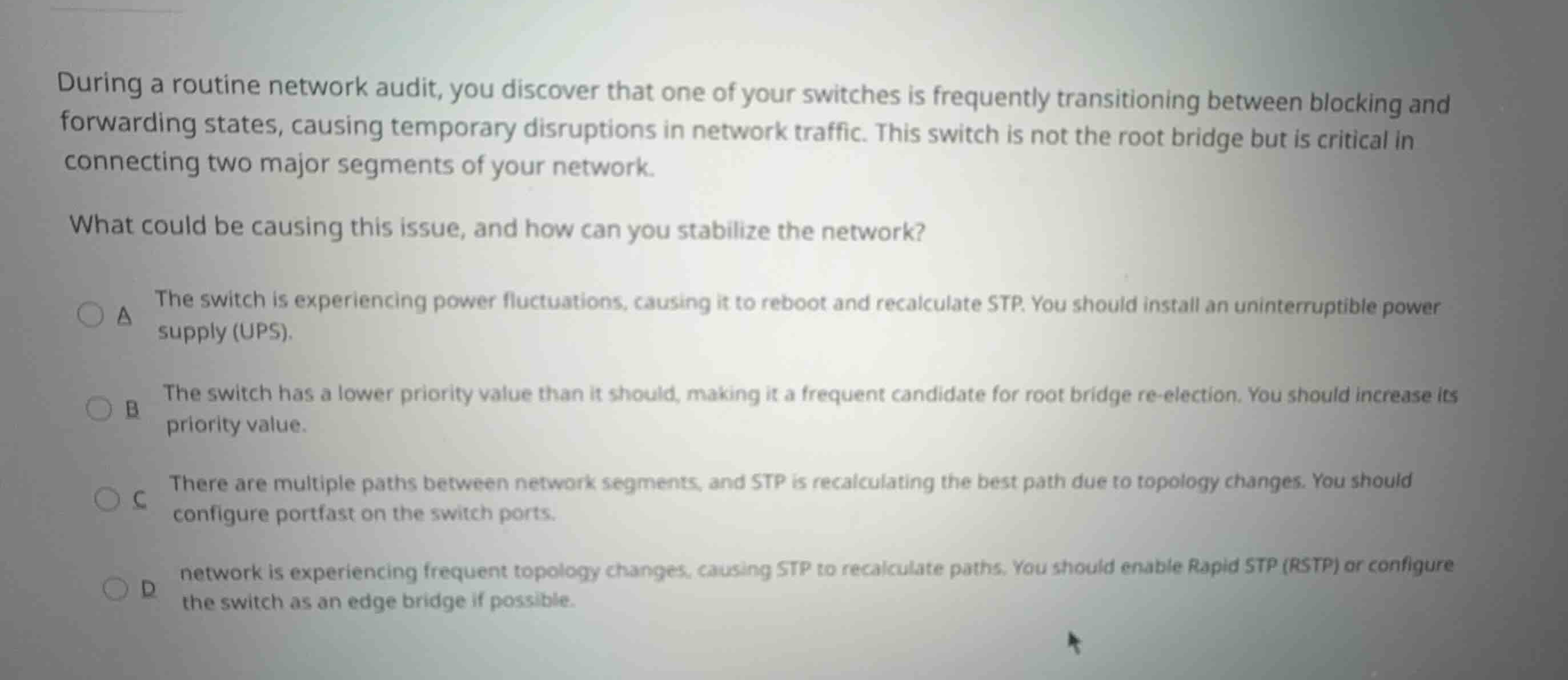
during a routine network audit, you discover that one of your switches is frequently transitioning between blocking and forwarding states, causing temporary disruptions in network traffic. this switch is not the root bridge but is critical in connecting two major segments of your network.
what could be causing this issue, and how can you stabilize the network?
a the switch is experiencing power fluctuations, causing it to reboot and recalculate stp. you should install an uninterruptible power supply (ups).
b the switch has a lower priority value than it should, making it a frequent candidate for root bridge re-election. you should increase its priority value.
c there are multiple paths between network segments, and stp is recalculating the best path due to topology changes. you should configure portfast on the switch ports.
d the network is experiencing frequent topology changes, causing stp to recalculate paths. you should enable rapid stp (rstp) or configure the switch as an edge bridge if possible.
Analyze the network scenario
The scenario describes a non-root switch frequently transitioning between blocking and forwarding states, causing temporary network disruptions. This behavior is characteristic of Spanning Tree Protocol (STP) recalculations triggered by frequent topology changes elsewhere in the network.
Evaluate Option A
Option A suggests power fluctuations are causing reboots. While a rebooting switch would recalculate STP, it would completely drop offline rather than just transitioning ports between blocking and forwarding states while remaining operational. A UPS is a power solution, not a direct STP stabilization mechanism for this specific symptom.
Evaluate Option B
Using the Root Bridge Election knowledge point
A lower priority value actually makes a switch more preferred to become the root bridge. If it had a lower priority value, it would likely remain the stable root bridge rather than frequently transitioning states as a non-root switch. Increasing the priority value makes it less likely to be root, which does not address frequent state transitions caused by external topology changes.
Evaluate Option C
Option C suggests configuring PortFast on the switch ports connecting the major segments. PortFast bypasses the listening and learning states for immediate transition to forwarding. However, PortFast must only be configured on edge ports connected to end stations (like PCs or printers). Configuring PortFast on trunk links connecting major network segments or other switches can easily cause catastrophic physical switching loops.
Evaluate Option D
Using the Spanning Tree Protocol knowledge point
Frequent topology changes in the network force standard STP to repeatedly transition ports through blocking, listening, learning, and forwarding states, causing temporary disruptions. Enabling Rapid STP (RSTP / 802.1w) significantly reduces convergence time (from 30-50 seconds to under 6 seconds) using a proposal-agreement handshake. Configuring edge ports (or edge bridge features) prevents end-user port transitions from triggering network-wide topology change notifications (TCNs), thereby stabilizing the core infrastructure.

Snap & solve any problem in the app
Get step-by-step solutions on Sovi AI
Photo-based solutions with guided steps
Explore more problems and detailed explanations
- (A) The switch is experiencing power fluctuations, causing it to reboot and recalculate STP. You should install an uninterruptible power supply (UPS).
- (B) The switch has a lower priority value than it should, making it a frequent candidate for root bridge re-election. You should increase its priority value.
- (C) There are multiple paths between network segments, and STP is recalculating the best path due to topology changes. You should configure portfast on the switch ports.
- (D) The network is experiencing frequent topology changes, causing STP to recalculate paths. You should enable Rapid STP (RSTP) or configure the switch as an edge bridge if possible. (Correct answer)