QUESTION IMAGE
Question
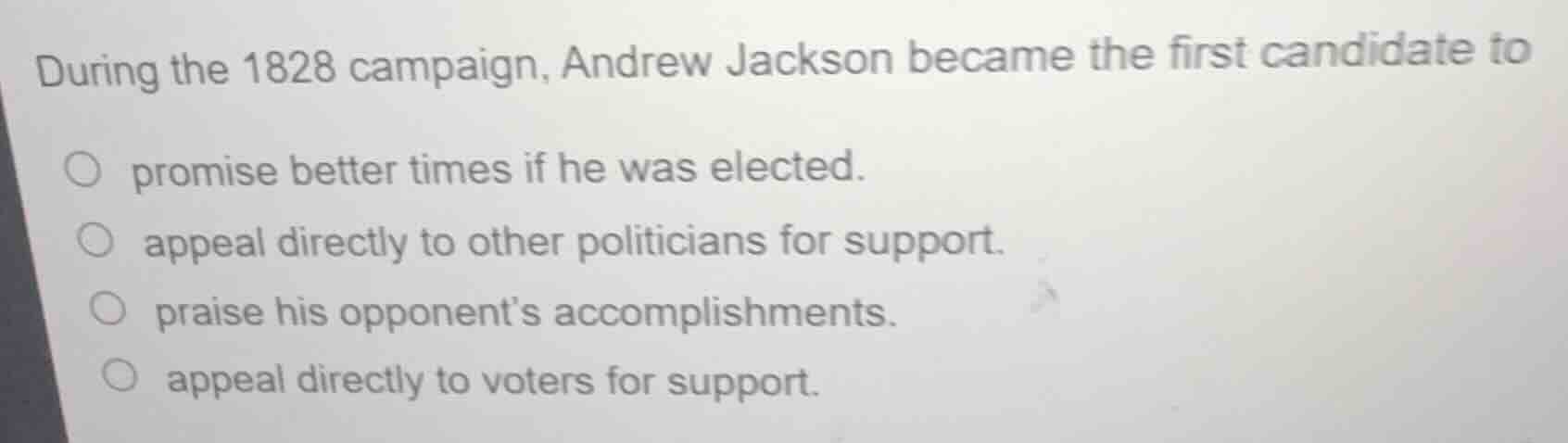
during the 1828 campaign, andrew jackson became the first candidate to
promise better times if he was elected.
appeal directly to other politicians for support.
praise his opponents accomplishments.
appeal directly to voters for support.
<pre_analysis>
{
"quality": "clear",
"question_count": 1,
"skills_matched": [
"direct_cot",
"multiple_choice_formatter",
"explain_then_answer",
"tutor"
],
"needs_drawing": false,
"concepts_used": [
"Andrew Jackson"
],
"new_concepts": [
"Election of 1828",
"Jacksonian Democracy"
],
"current_concepts": [
"Andrew Jackson",
"Election of 1828",
"Jacksonian Democracy"
]
}
</pre_analysis>
<reasoning>
Analyze the historical context of the 1828 election
The presidential election of 1828 between Andrew Jackson and John Quincy Adams marked a major turning point in American political history. Prior to this era, presidential campaigns were largely conducted by political elites, and candidates rarely campaigned directly to the public, as it was seen as unseemly.
Identify the shift in campaigning strategies
During the 1828 campaign, Andrew Jackson and his supporters revolutionized politics by building a massive grassroots organization. They utilized public rallies, parades, barbecues, and campaign songs to mobilize the newly enfranchised common man, bypassing traditional elite networks.
Evaluate the given options
- "promise better times if he was elected": Many previous candidates had made similar promises; this was not a novel feature of 1828.
- "appeal directly to other politicians for support": This was the traditional method of campaigning used by earlier candidates (such as through congressional caucuses).
- "praise his opponent's accomplishments": The 1828 campaign was notoriously personal and filled with mudslinging, not praise.
- "appeal directly to voters for support": This represents the fundamental shift of the 1828 campaign, where Jackson became the first candidate to actively and directly appeal to the mass electorate for their votes.
</reasoning>
<answer>
<mcq-option>promise better times if he was elected.</mcq-option>
<mcq-option>appeal directly to other politicians for support.</mcq-option>
<mcq-option>praise his opponent's accomplishments.</mcq-option>
<mcq-correct>appeal directly to voters for support.</mcq-correct>
</answer>
<post_analysis>
{
"subject": "Social Science",
"question_type": "Multiple Choice",
"knowledge_point": [
"Social Science",
"U.S. History",
"Jacksonian Democracy"
]
}
</post_analysis>
Snap & solve any problem in the app
Get step-by-step solutions on Sovi AI
Photo-based solutions with guided steps
Explore more problems and detailed explanations
<pre_analysis>
{
"quality": "clear",
"question_count": 1,
"skills_matched": [
"direct_cot",
"multiple_choice_formatter",
"explain_then_answer",
"tutor"
],
"needs_drawing": false,
"concepts_used": [
"Andrew Jackson"
],
"new_concepts": [
"Election of 1828",
"Jacksonian Democracy"
],
"current_concepts": [
"Andrew Jackson",
"Election of 1828",
"Jacksonian Democracy"
]
}
</pre_analysis>
<reasoning>
Analyze the historical context of the 1828 election
The presidential election of 1828 between Andrew Jackson and John Quincy Adams marked a major turning point in American political history. Prior to this era, presidential campaigns were largely conducted by political elites, and candidates rarely campaigned directly to the public, as it was seen as unseemly.
Identify the shift in campaigning strategies
During the 1828 campaign, Andrew Jackson and his supporters revolutionized politics by building a massive grassroots organization. They utilized public rallies, parades, barbecues, and campaign songs to mobilize the newly enfranchised common man, bypassing traditional elite networks.
Evaluate the given options
- "promise better times if he was elected": Many previous candidates had made similar promises; this was not a novel feature of 1828.
- "appeal directly to other politicians for support": This was the traditional method of campaigning used by earlier candidates (such as through congressional caucuses).
- "praise his opponent's accomplishments": The 1828 campaign was notoriously personal and filled with mudslinging, not praise.
- "appeal directly to voters for support": This represents the fundamental shift of the 1828 campaign, where Jackson became the first candidate to actively and directly appeal to the mass electorate for their votes.
</reasoning>
<answer>
<mcq-option>promise better times if he was elected.</mcq-option>
<mcq-option>appeal directly to other politicians for support.</mcq-option>
<mcq-option>praise his opponent's accomplishments.</mcq-option>
<mcq-correct>appeal directly to voters for support.</mcq-correct>
</answer>
<post_analysis>
{
"subject": "Social Science",
"question_type": "Multiple Choice",
"knowledge_point": [
"Social Science",
"U.S. History",
"Jacksonian Democracy"
]
}
</post_analysis>