QUESTION IMAGE
Question
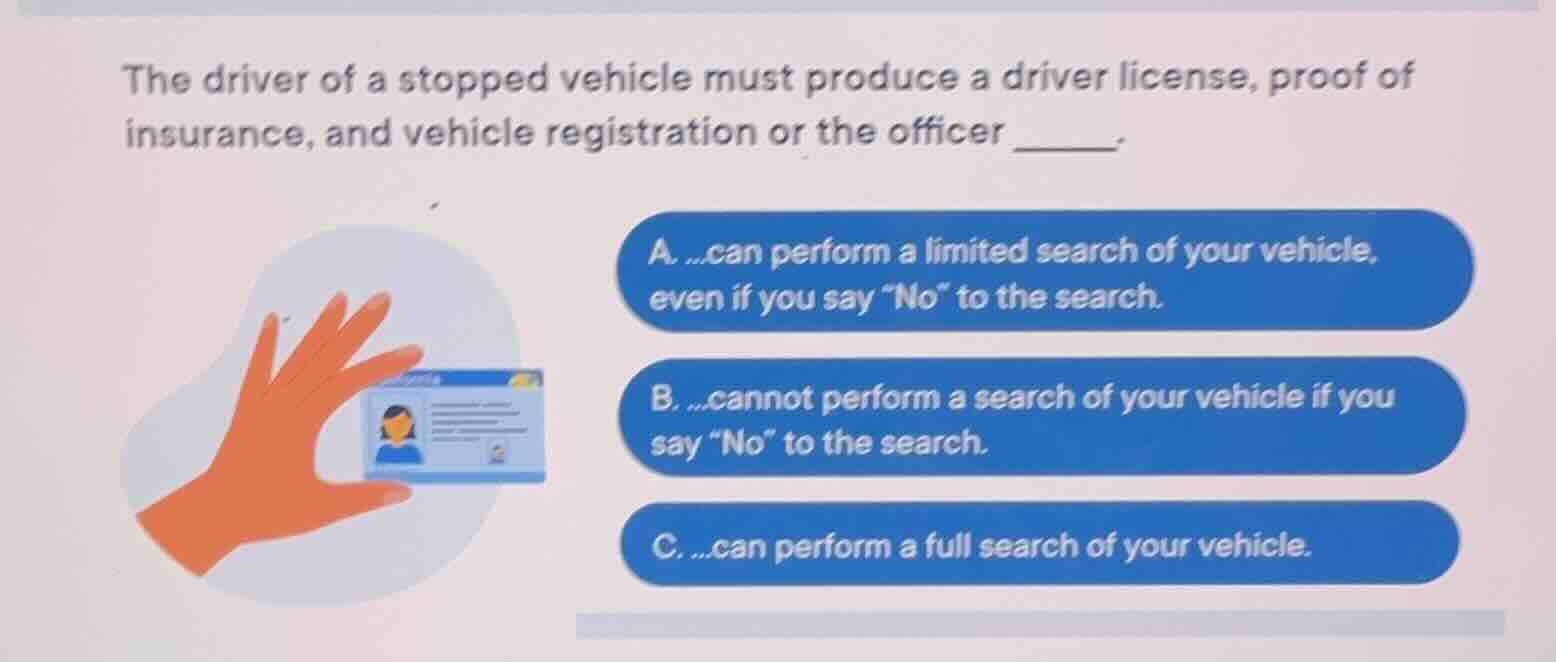
the driver of a stopped vehicle must produce a driver license, proof of insurance, and vehicle registration or the officer ______.
a. ...can perform a limited search of your vehicle, even if you say
o\ to the search.
b. ...cannot perform a search of your vehicle if you say
o\ to the search.
c. ...can perform a full search of your vehicle.
Analyze the legal requirements during a traffic stop
During a standard law enforcement stop, a driver is legally required to present their driver's license, proof of financial responsibility (insurance), and vehicle registration. This is a standard part of Enforcement Stop Procedures.
Evaluate the officer's authority regarding vehicle searches
Under standard constitutional law and Enforcement Stop Procedures, an officer cannot perform a search of your vehicle simply because you produced your documents, nor does your refusal ("No") automatically prevent a search if they have probable cause. However, if you do not consent, they generally cannot search unless specific legal exceptions apply.
Determine the correct option
Let's evaluate the choices:
- Option A suggests the officer can perform a limited search even if you say "No". This is incorrect under standard rules unless probable cause or another exception exists.
- Option B states the officer cannot perform a search of your vehicle if you say "No" to the search. This aligns with the protection of your rights against non-consensual searches without a warrant or probable cause.
- Option C suggests they can perform a full search, which is incorrect.
Thus, Option B is the correct choice.

Snap & solve any problem in the app
Get step-by-step solutions on Sovi AI
Photo-based solutions with guided steps
Explore more problems and detailed explanations
- (A) ...can perform a limited search of your vehicle, even if you say "No" to the search.
- (B) ...cannot perform a search of your vehicle if you say "No" to the search. (Correct answer)
- (C) ...can perform a full search of your vehicle.