QUESTION IMAGE
Question
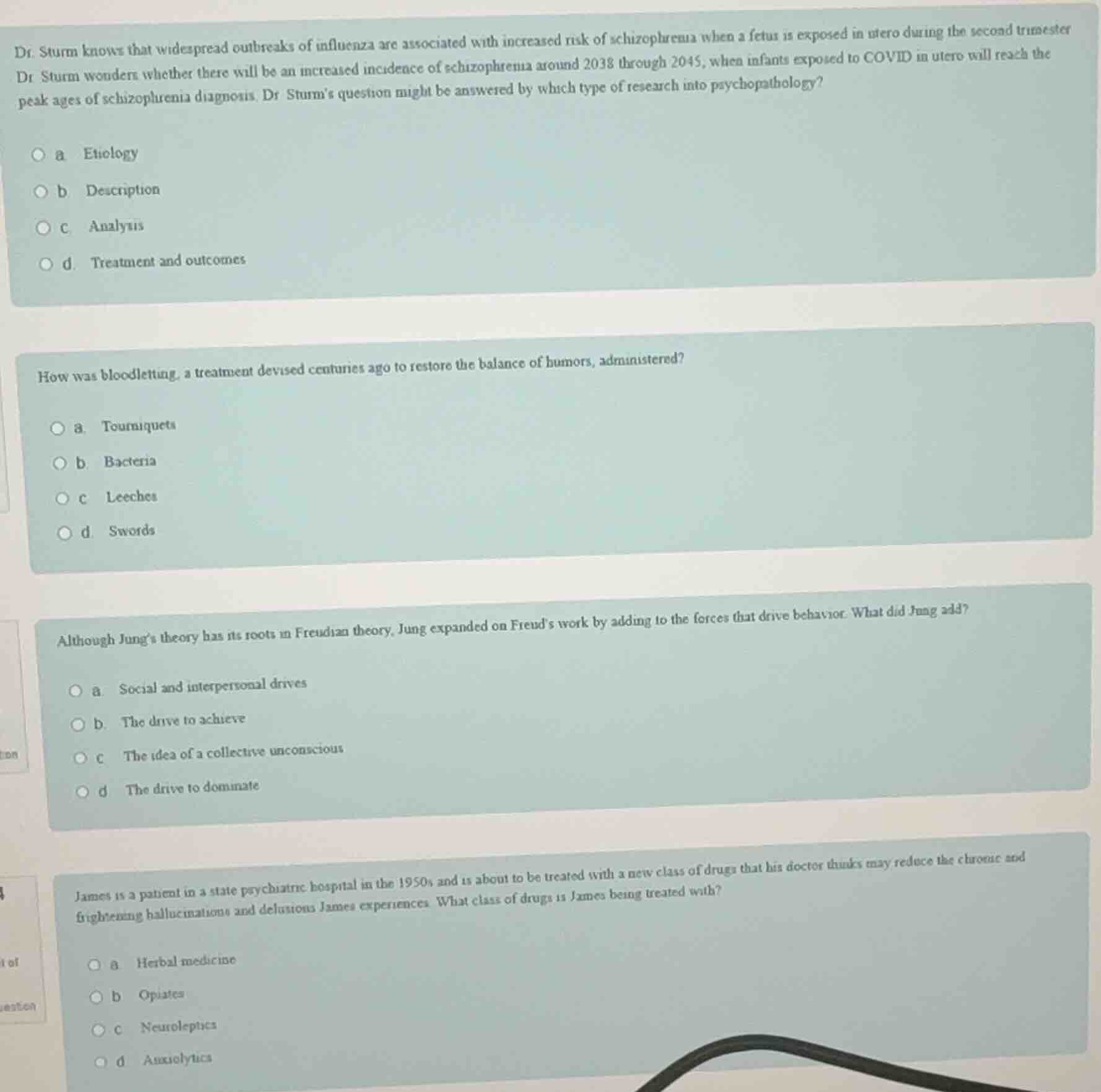
dr. sturm knows that widespread outbreaks of influenza are associated with increased risk of schizophrenia when a fetus is exposed in utero during the second trimester. dr. sturm wonders whether there will be an increased incidence of schizophrenia around 2038 through 2045, when infants exposed to covid in utero will reach the peak ages of schizophrenia diagnosis. dr. sturms question might be answered by which type of research into psychopathology?
a. etiology
b. description
c. analysis
d. treatment and outcomes
how was bloodletting, a treatment devised centuries ago to restore the balance of humors, administered?
a. tourniquets
b. bacteria
c. leeches
d. swords
although jungs theory has its roots in freudian theory, jung expanded on freuds work by adding to the forces that drive behavior. what did jung add?
a. social and interpersonal drives
b. the drive to achieve
c. the idea of a collective unconscious
d. the drive to dominate
james is a patient in a state psychiatric hospital in the 1950s and is about to be treated with a new class of drugs that his doctor thinks may reduce the chronic and frightening hallucinations and delusions james experiences. what class of drugs is james being treated with?
a. herbal medicine
b. opiates
c. neuroleptics
d. anxiolytics
<pre_analysis>
{
"quality": "clear",
"question_count": 4,
"skills_matched": [
"direct_cot",
"multiple_choice_formatter",
"explain_then_answer",
"tutor"
],
"needs_drawing": false,
"concepts_used": [],
"new_concepts": [
"Etiology in Psychopathology",
"Humoral Theory Treatments",
"Analytical Psychology Foundations"
],
"current_concepts": [
"Etiology in Psychopathology",
"Humoral Theory Treatments",
"Analytical Psychology Foundations",
"Early Psychopharmacology"
]
}
</pre_analysis>
<reasoning>
Analyze Question 1
The first question asks about Dr. Sturm's research into whether prenatal exposure to COVID-19 increases the risk of developing schizophrenia later in life. This type of research investigates the causes, origins, or developmental factors of a mental disorder. In psychopathology, the study of the causes or origins of diseases is defined as etiology. Therefore, the correct option is (a).
Analyze Question 2
The second question asks how bloodletting, a historical treatment based on balancing bodily humors, was administered. Among the choices provided, leeches were famously used in medicine for centuries to extract blood from patients to restore humoral balance. Therefore, the correct option is (c).
Analyze Question 3
The third question asks what Carl Jung added to Sigmund Freud's drive theories of behavior. Jung expanded on psychoanalytic theory by introducing the concept of a shared, inherited segment of the unconscious mind common to all humans, known as the collective unconscious. Therefore, the correct option is (c).
Analyze Question 4
The fourth question describes James, a psychiatric patient in the 1950s suffering from hallucinations and delusions, who is about to be treated with a new class of drugs. The first generation of antipsychotic medications introduced in the 1950s to treat schizophrenia and psychotic symptoms are known as neuroleptics (or antipsychotics). Therefore, the correct option is (c).
</reasoning>
<answer>
Question 1
<mcq-correct>(a) Etiology</mcq-correct>
<mcq-option>(b) Description</mcq-option>
<mcq-option>(c) Analysis</mcq-option>
<mcq-option>(d) Treatment and outcomes</mcq-option>
Question 2
<mcq-option>(a) Tourniquets</mcq-option>
<mcq-option>(b) Bacteria</mcq-option>
<mcq-correct>(c) Leeches</mcq-correct>
<mcq-option>(d) Swords</mcq-option>
Question 3
<mcq-option>(a) Social and interpersonal drives</mcq-option>
<mcq-option>(b) The drive to achieve</mcq-option>
<mcq-correct>(c) The idea of a collective unconscious</mcq-correct>
<mcq-option>(d) The drive to dominate</mcq-option>
Question 4
<mcq-option>(a) Herbal medicine</mcq-option>
<mcq-option>(b) Opiates</mcq-correct>
<mcq-correct>(c) Neuroleptics</mcq-correct>
<mcq-option>(d) Anxiolytics</mcq-option>
</answer>
<post_analysis>
{
"subject": "Social Science",
"question_type": "Multiple Choice",
"knowledge_point": [
"Social Science",
"Psychology",
"Abnormal Psychology"
]
}
</post_analysis>
Snap & solve any problem in the app
Get step-by-step solutions on Sovi AI
Photo-based solutions with guided steps
Explore more problems and detailed explanations
<pre_analysis>
{
"quality": "clear",
"question_count": 4,
"skills_matched": [
"direct_cot",
"multiple_choice_formatter",
"explain_then_answer",
"tutor"
],
"needs_drawing": false,
"concepts_used": [],
"new_concepts": [
"Etiology in Psychopathology",
"Humoral Theory Treatments",
"Analytical Psychology Foundations"
],
"current_concepts": [
"Etiology in Psychopathology",
"Humoral Theory Treatments",
"Analytical Psychology Foundations",
"Early Psychopharmacology"
]
}
</pre_analysis>
<reasoning>
Analyze Question 1
The first question asks about Dr. Sturm's research into whether prenatal exposure to COVID-19 increases the risk of developing schizophrenia later in life. This type of research investigates the causes, origins, or developmental factors of a mental disorder. In psychopathology, the study of the causes or origins of diseases is defined as etiology. Therefore, the correct option is (a).
Analyze Question 2
The second question asks how bloodletting, a historical treatment based on balancing bodily humors, was administered. Among the choices provided, leeches were famously used in medicine for centuries to extract blood from patients to restore humoral balance. Therefore, the correct option is (c).
Analyze Question 3
The third question asks what Carl Jung added to Sigmund Freud's drive theories of behavior. Jung expanded on psychoanalytic theory by introducing the concept of a shared, inherited segment of the unconscious mind common to all humans, known as the collective unconscious. Therefore, the correct option is (c).
Analyze Question 4
The fourth question describes James, a psychiatric patient in the 1950s suffering from hallucinations and delusions, who is about to be treated with a new class of drugs. The first generation of antipsychotic medications introduced in the 1950s to treat schizophrenia and psychotic symptoms are known as neuroleptics (or antipsychotics). Therefore, the correct option is (c).
</reasoning>
<answer>
Question 1
<mcq-correct>(a) Etiology</mcq-correct>
<mcq-option>(b) Description</mcq-option>
<mcq-option>(c) Analysis</mcq-option>
<mcq-option>(d) Treatment and outcomes</mcq-option>
Question 2
<mcq-option>(a) Tourniquets</mcq-option>
<mcq-option>(b) Bacteria</mcq-option>
<mcq-correct>(c) Leeches</mcq-correct>
<mcq-option>(d) Swords</mcq-option>
Question 3
<mcq-option>(a) Social and interpersonal drives</mcq-option>
<mcq-option>(b) The drive to achieve</mcq-option>
<mcq-correct>(c) The idea of a collective unconscious</mcq-correct>
<mcq-option>(d) The drive to dominate</mcq-option>
Question 4
<mcq-option>(a) Herbal medicine</mcq-option>
<mcq-option>(b) Opiates</mcq-correct>
<mcq-correct>(c) Neuroleptics</mcq-correct>
<mcq-option>(d) Anxiolytics</mcq-option>
</answer>
<post_analysis>
{
"subject": "Social Science",
"question_type": "Multiple Choice",
"knowledge_point": [
"Social Science",
"Psychology",
"Abnormal Psychology"
]
}
</post_analysis>