QUESTION IMAGE
Question
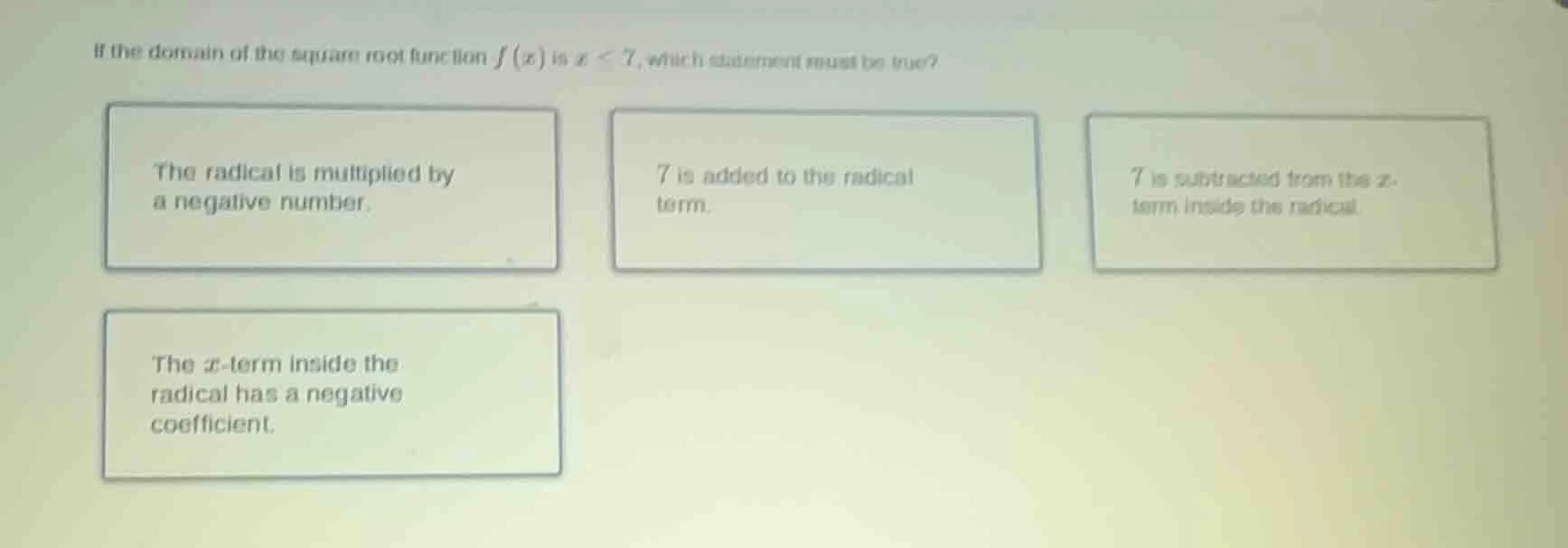
if the domain of the square root function $f(x)$ is $x \leq 7$, which statement must be true?
the radical is multiplied by
a negative number.
7 is added to the radical
term.
7 is subtracted from the $x$-term inside the radical
the $x$-term inside the
radical has a negative
coefficient.
Step1: Recall domain of square root function
The domain of a square root function \( f(x)=\sqrt{g(x)} \) is all real numbers \( x \) such that \( g(x)\geq0 \).
Step2: Analyze the given domain \( x \leq 7 \)
We need to find the form of \( g(x) \) such that \( g(x)\geq0 \) implies \( x \leq 7 \). Let's consider each option:
- Option 1: "The radical is multiplied by a negative number." Multiplying the radical (the square root part) by a negative number affects the range (the sign of the output), not the domain. So this does not affect the domain condition \( x \leq 7 \).
- Option 2: "7 is added to the radical term." Adding 7 to the radical (e.g., \( \sqrt{x}+7 \)) affects the range, not the domain. The domain of \( \sqrt{x}+7 \) is still \( x\geq0 \), not \( x \leq 7 \).
- Option 3: "7 is subtracted from the \( x \)-term inside the radical." If we have \( \sqrt{x - 7} \), the domain would be \( x-7\geq0\Rightarrow x\geq7 \), which is not our case.
- Option 4: "The \( x \)-term inside the radical has a negative coefficient." Let's assume the radicand is \( -x + 7 \) (or \( 7 - x \)). Then the domain is \( -x + 7\geq0 \). Solving for \( x \):
This matches the given domain. So when the \( x \)-term inside the radical has a negative coefficient (like \( -x \) in \( \sqrt{7 - x} \)), the domain becomes \( x \leq 7 \).

Snap & solve any problem in the app
Get step-by-step solutions on Sovi AI
Photo-based solutions with guided steps
Explore more problems and detailed explanations
The \( x \)-term inside the radical has a negative coefficient.