QUESTION IMAGE
Question
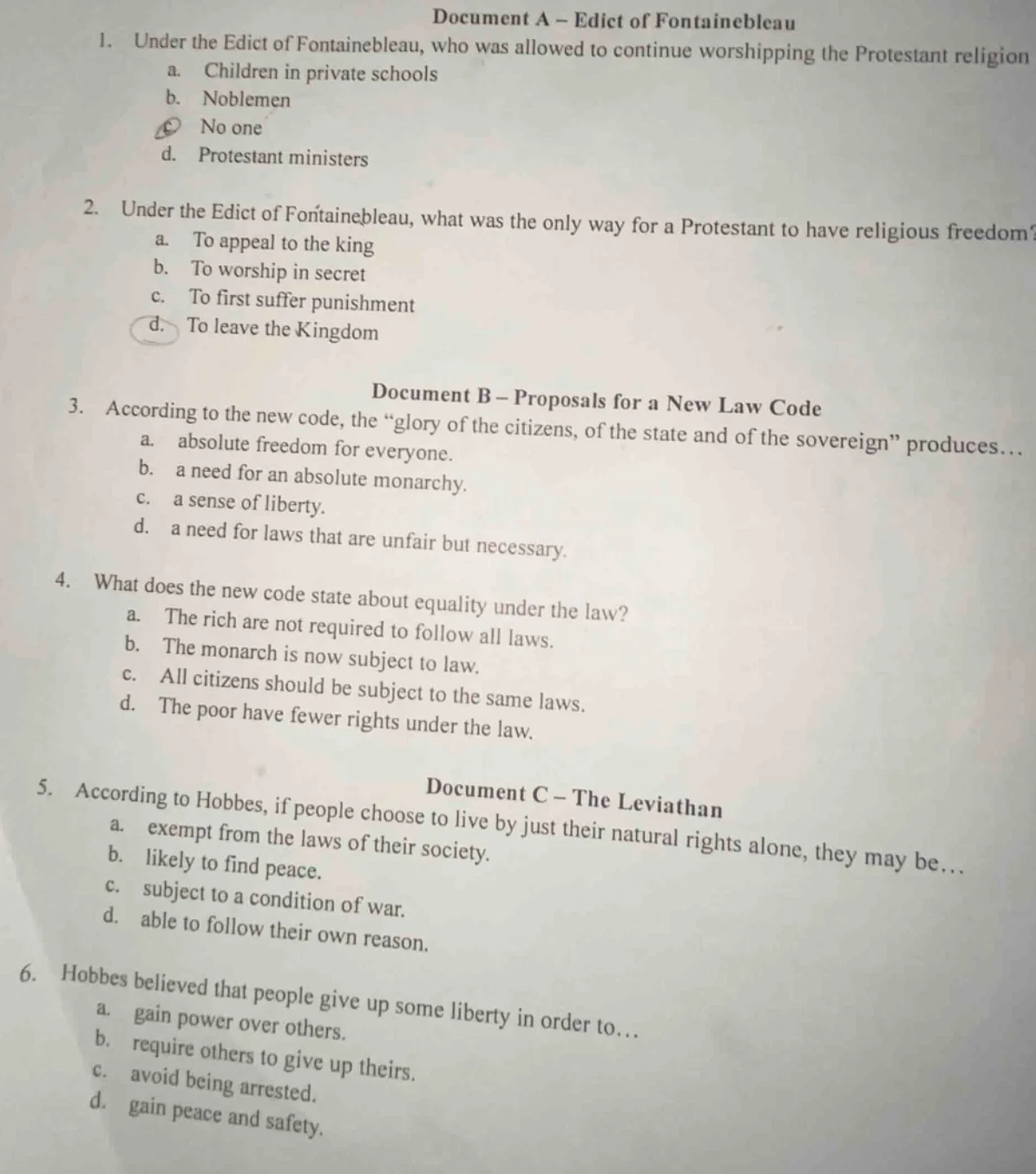
document a – edict of fontainebleau
- under the edict of fontainebleau, who was allowed to continue worshipping the protestant religion
a. children in private schools
b. noblemen
c. no one
d. protestant ministers
- under the edict of fontainebleau, what was the only way for a protestant to have religious freedom?
a. to appeal to the king
b. to worship in secret
c. to first suffer punishment
d. to leave the kingdom
document b – proposals for a new law code
- according to the new code, the “glory of the citizens, of the state and of the sovereign” produces…
a. absolute freedom for everyone.
b. a need for an absolute monarchy.
c. a sense of liberty.
d. a need for laws that are unfair but necessary.
- what does the new code state about equality under the law?
a. the rich are not required to follow all laws.
b. the monarch is now subject to law.
c. all citizens should be subject to the same laws.
d. the poor have fewer rights under the law.
document c – the leviathan
- according to hobbes, if people choose to live by just their natural rights alone, they may be…
a. exempt from the laws of their society.
b. likely to find peace.
c. subject to a condition of war.
d. able to follow their own reason.
- hobbes believed that people give up some liberty in order to…
a. gain power over others.
b. require others to give up theirs.
c. avoid being arrested.
d. gain peace and safety.
Question 1
The Edict of Fontainebleau (also known as the Revocation of the Edict of Nantes) revoked the rights of Protestants to practice their religion in France. So no one was allowed to continue worshipping Protestantism openly.
Under the Edict of Fontainebleau, Protestants were essentially forced to convert or leave the kingdom to have religious freedom (since practicing in secret was risky and not the "only" sanctioned way, appealing to the king wouldn't grant freedom, and suffering punishment was for non - compliance).
The context of "Proposals for a New Law Code" (likely related to absolutist or monarchical legal systems) - the "glory of citizens, state, and sovereign" would align with the need for an absolute monarchy, as absolute monarchies emphasized the glory of the sovereign and state, and didn't promote absolute freedom for all (a is wrong), a sense of liberty isn't the focus here (c is wrong), and laws being unfair but necessary isn't the implication of that phrase (d is wrong).

Snap & solve any problem in the app
Get step-by-step solutions on Sovi AI
Photo-based solutions with guided steps
Explore more problems and detailed explanations
c. No one