QUESTION IMAGE
Question
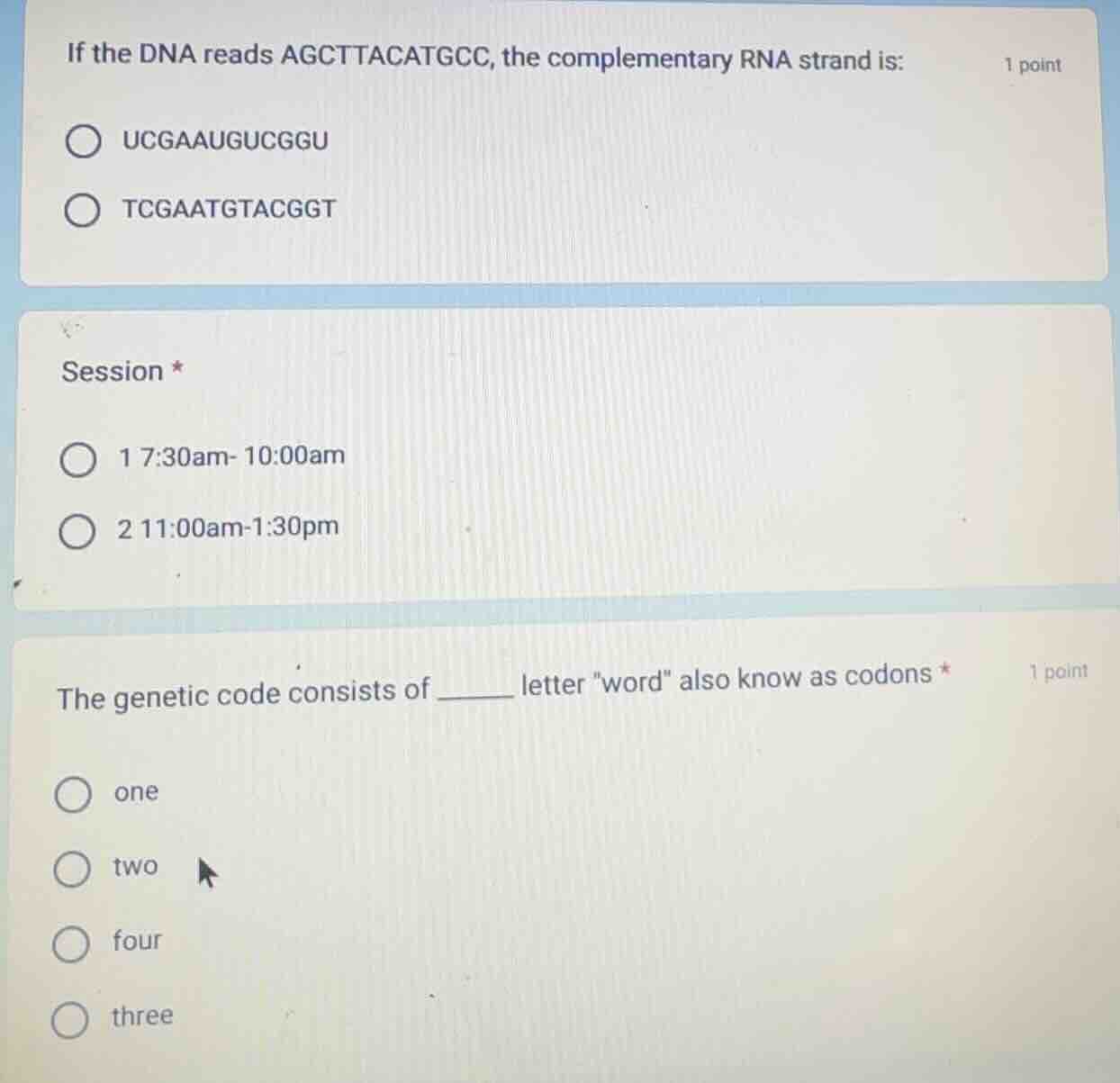
if the dna reads agcttacatgcc, the complementary rna strand is:
ucgaaugucggu
tcgaatgtacggt
session *
1 7:30am- 10:00am
2 11:00am-1:30pm
the genetic code consists of ______ letter \word\ also know as codons *
one
two
four
three
<pre_analysis>
{
"quality": "clear",
"question_count": 2,
"skills_matched": [
"direct_cot",
"multiple_choice_formatter",
"explain_then_answer",
"quick"
],
"needs_drawing": false,
"concepts_used": [
"DNA Base Pairing",
"Codon and Anticodon"
],
"new_concepts": [],
"current_concepts": [
"DNA Base Pairing",
"Codon and Anticodon",
"RNA Structure"
]
}
</pre_analysis>
<reasoning>
Determine the complementary RNA strand
The given DNA sequence is AGCTTACATGCC.
Using the base pairing rules for transcription:
- Adenine (A) pairs with Uracil (U) in RNA.
- Guanine (G) pairs with Cytosine (C).
- Cytosine (C) pairs with Guanine (G).
- Thymine (T) pairs with Adenine (A).
Applying these rules to each base:
- A -> U
- G -> C
- C -> G
- T -> A
- T -> A
- A -> U
- C -> G
- A -> U
- T -> A
- G -> C
- C -> G
- C -> G
The resulting complementary RNA sequence is UCGAAUGUCGGU.
Determine the length of a codon
A codon is a sequence of nucleotides on an mRNA molecule that codes for a specific amino acid. The genetic code is read in groups of three nucleotides, meaning each codon consists of three letters.
</reasoning>
<answer>
Question 1
<mcq-correct>(A) UCGAAUGUCGGU</mcq-correct>
<mcq-option>(B) TCGAATGTACGGT</mcq-option>
Question 2
<mcq-option>(A) one</mcq-option>
<mcq-option>(B) two</mcq-option>
<mcq-option>(C) four</mcq-option>
<mcq-correct>(D) three</mcq-correct>
</answer>
<post_analysis>
{
"subject": "Natural Science",
"question_type": "Multiple Choice",
"knowledge_point": [
"Natural Science",
"Biology",
"Molecular Genetics"
]
}
</post_analysis>
Snap & solve any problem in the app
Get step-by-step solutions on Sovi AI
Photo-based solutions with guided steps
Explore more problems and detailed explanations
<pre_analysis>
{
"quality": "clear",
"question_count": 2,
"skills_matched": [
"direct_cot",
"multiple_choice_formatter",
"explain_then_answer",
"quick"
],
"needs_drawing": false,
"concepts_used": [
"DNA Base Pairing",
"Codon and Anticodon"
],
"new_concepts": [],
"current_concepts": [
"DNA Base Pairing",
"Codon and Anticodon",
"RNA Structure"
]
}
</pre_analysis>
<reasoning>
Determine the complementary RNA strand
The given DNA sequence is AGCTTACATGCC.
Using the base pairing rules for transcription:
- Adenine (A) pairs with Uracil (U) in RNA.
- Guanine (G) pairs with Cytosine (C).
- Cytosine (C) pairs with Guanine (G).
- Thymine (T) pairs with Adenine (A).
Applying these rules to each base:
- A -> U
- G -> C
- C -> G
- T -> A
- T -> A
- A -> U
- C -> G
- A -> U
- T -> A
- G -> C
- C -> G
- C -> G
The resulting complementary RNA sequence is UCGAAUGUCGGU.
Determine the length of a codon
A codon is a sequence of nucleotides on an mRNA molecule that codes for a specific amino acid. The genetic code is read in groups of three nucleotides, meaning each codon consists of three letters.
</reasoning>
<answer>
Question 1
<mcq-correct>(A) UCGAAUGUCGGU</mcq-correct>
<mcq-option>(B) TCGAATGTACGGT</mcq-option>
Question 2
<mcq-option>(A) one</mcq-option>
<mcq-option>(B) two</mcq-option>
<mcq-option>(C) four</mcq-option>
<mcq-correct>(D) three</mcq-correct>
</answer>
<post_analysis>
{
"subject": "Natural Science",
"question_type": "Multiple Choice",
"knowledge_point": [
"Natural Science",
"Biology",
"Molecular Genetics"
]
}
</post_analysis>