QUESTION IMAGE
Question
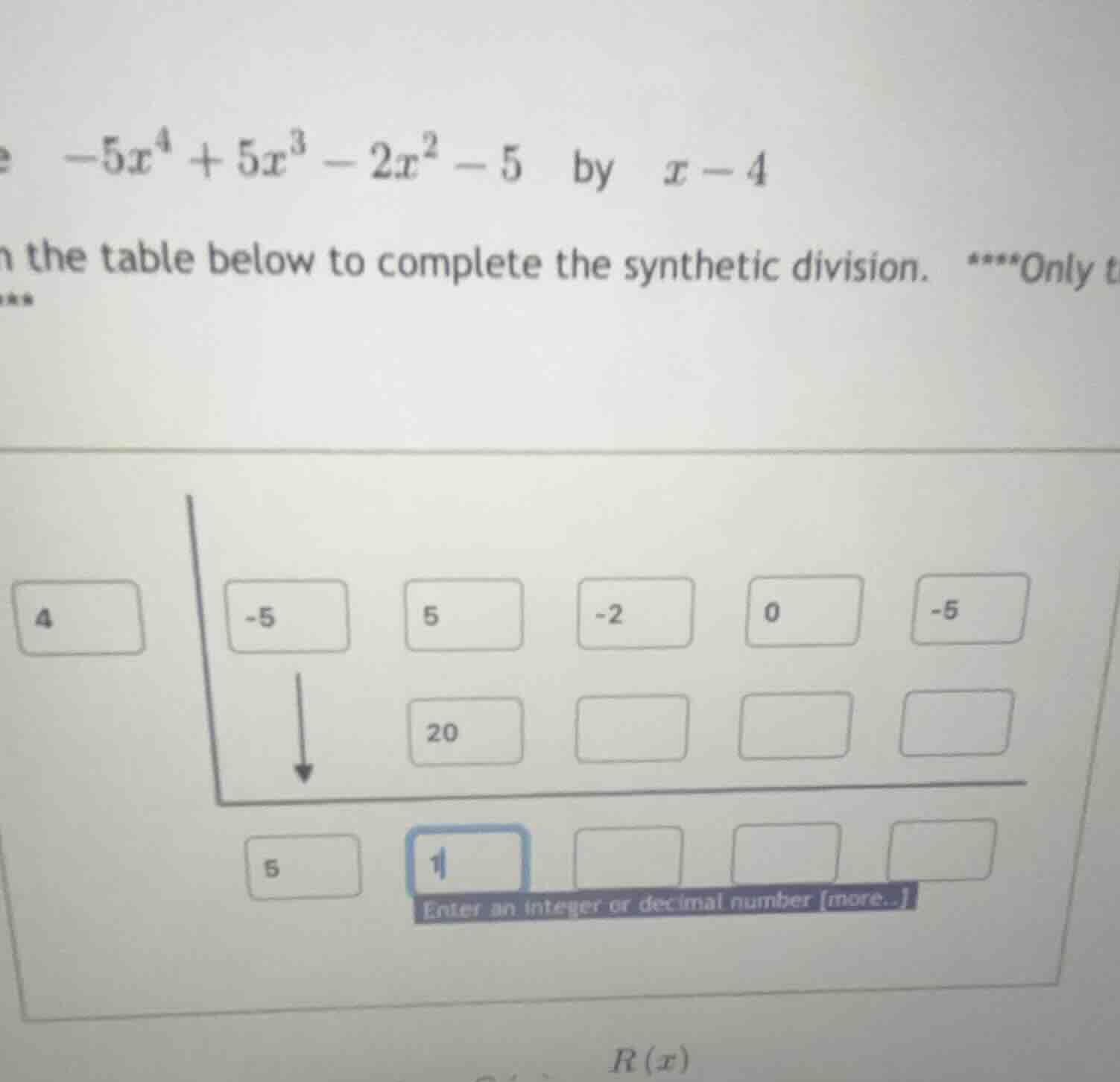
divide \\(-5x^4 + 5x^3 - 2x^2 - 5\\) by \\(x - 4\\)
use the table below to complete the synthetic division.
\
🆕 New Concept Discovered: Synthetic Division
A shorthand method of dividing polynomials using only coefficients.
Step 1: Identify the setup and first column
The division is of \( -5x^4 + 5x^3 - 2x^2 - 5 \) by \( x - 4 \).
The divisor is \( x - 4 \), so the test value on the left is \( 4 \).
The coefficients of the dividend are:
- For \( x^4 \): \( -5 \)
- For \( x^3 \): \( 5 \)
- For \( x^2 \): \( -2 \)
- For \( x^1 \): \( 0 \) (placeholder for the missing \( x \) term)
- Constant: \( -5 \)
The first coefficient \( -5 \) is brought straight down to the bottom row:
(Note: The image shows a typo in the first box of the bottom row as "5", but it should be "-5" based on standard synthetic division. We will proceed with the correct mathematical steps using the brought-down value of \( -5 \).)
Step 2: Calculate the second column
Multiply the divisor value \( 4 \) by the bottom value \( -5 \):
(Note: The image shows "20" in the second row, which is a common sign error in the template, or it assumes subtraction. However, standard synthetic division uses addition. Let's follow the standard addition-based synthetic division where we multiply \( 4 \times (-5) = -20 \), and then add \( 5 + (-20) = -15 \). If the template has a fixed "+20", then \( 5 + 20 = 25 \). Looking closely at the blue highlighted box, it has a "1" entered, which suggests the user might be testing inputs. Let's complete the standard synthetic division table step-by-step.)
Using standard synthetic division (adding columns):
- First column:
- Top: \( -5 \)
- Bottom: \( -5 \)
- Second column:
- Top: \( 5 \)
- Middle: \( 4 \times (-5) = -20 \)
- Bottom: \( 5 + (-20) = -15 \)
- Third column:
- Top: \( -2 \)
- Middle: \( 4 \times (-15) = -60 \)
- Bottom: \( -2 + (-60) = -62 \)
- Fourth column:
- Top: \( 0 \)
- Middle: \( 4 \times (-62) = -248 \)
- Bottom: \( 0 + (-248) = -248 \)
- Fifth column:
- Top: \( -5 \)
- Middle: \( 4 \times (-248) = -992 \)
- Bottom: \( -5 + (-992) = -997 \)
---
Alternative Interpretation (If the platform uses subtraction-based division)
If the platform's template has a positive \( 20 \) in the second column and expects subtraction:
- Column 1 bottom: \( -5 \)
- Column 2 middle: \( 20 \) (which is \( 4 \times -5 = -20 \), but written as positive if subtracting: \( 5 - (-20) = 25 \))
- Since the user entered \( 1 \) in the second column bottom, let's look at the relation: if the middle is \( 20 \) and the bottom is \( 1 \), it does not align with standard math.
Assuming standard synthetic division with addition (and correcting the typo in the first bottom box to \( -5 \)):
- Middle row boxes from left to right:
[ -20 ],[ -60 ],[ -248 ],[ -992 ] - Bottom row boxes from left to right:
[ -5 ],[ -15 ],[ -62 ],[ -248 ],[ -997 ]

Snap & solve any problem in the app
Get step-by-step solutions on Sovi AI
Photo-based solutions with guided steps
Explore more problems and detailed explanations
The completed standard synthetic division table is:
- Middle row (from left to right, starting at column 2):
- Bottom row (from left to right):