QUESTION IMAGE
Question
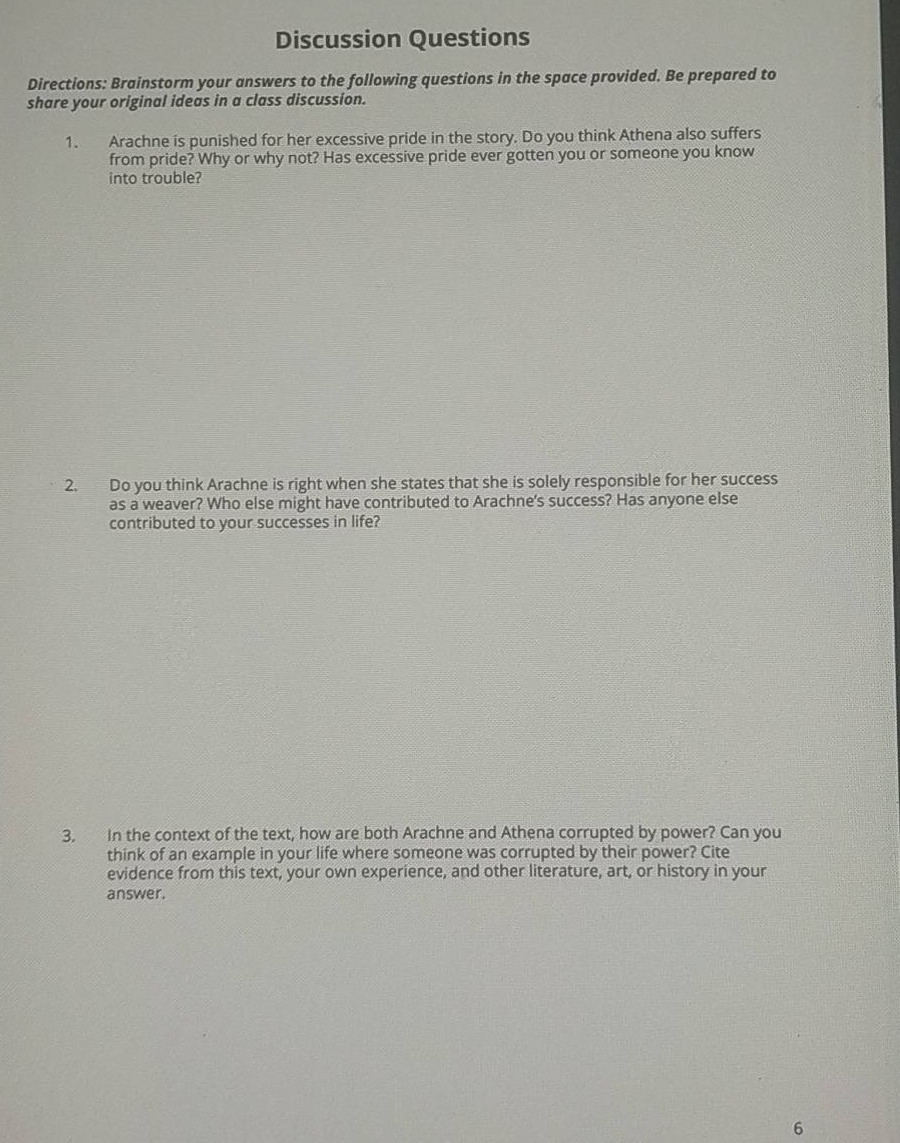
discussion questions
directions: brainstorm your answers to the following questions in the space provided. be prepared to share your original ideas in a class discussion.
- arachne is punished for her excessive pride in the story. do you think athena also suffers from pride? why or why not? has excessive pride ever gotten you or someone you know into trouble?
- do you think arachne is right when she states that she is solely responsible for her success as a weaver? who else might have contributed to arachnes success? has anyone else contributed to your successes in life?
- in the context of the text, how are both arachne and athena corrupted by power? can you think of an example in your life where someone was corrupted by their power? cite evidence from this text, your own experience, and other literature, art, or history in your answer.
🆕 New Concept Discovered: Character Analysis and Theme Exploration
Analyzing character motivations, flaws, and thematic connections to real life.
Step 1: Analyze Question 1 (Pride and Hubris)
To answer whether Athena also suffers from pride (hubris), we must look at her actions in the myth.
- Athena's Pride: Athena is the goddess of wisdom and crafts. When a mortal (Arachne) claims to be better than her, Athena's pride is deeply wounded. Instead of ignoring the mortal, she disguises herself to warn Arachne, and when that fails, she enters a competition to prove her superiority. Her reaction to Arachne's flawless tapestry—tearing it up in anger and turning her into a spider—shows that she cannot tolerate her divine authority and skill being challenged. This indicates she suffers from a divine form of pride that demands absolute submission from mortals.
- Personal Connection: To answer the personal part of the question, think of a time when overconfidence or refusing to back down led to a mistake, a broken friendship, or a failed project.
Step 2: Analyze Question 2 (Individual Success vs. External Influence)
This question explores the concept of self-made success versus community/divine support.
- Arachne's Claim: Arachne denies that Athena taught her or that anyone else helped her. She claims her skill is entirely her own.
- Alternative Perspectives: In the context of Greek mythology, all talents and raw materials ultimately come from the gods. Furthermore, Arachne's father was Idmon of Colophon, a famous dyer of wool. She grew up surrounded by the tools and materials of her craft, meaning her environment and family played a massive role in her development. Therefore, she is not solely responsible.
- Personal Connection: Reflect on your own achievements (academic, athletic, or artistic). Consider how teachers, parents, mentors, or friends provided the resources, encouragement, or guidance that made your success possible.
Step 3: Analyze Question 3 (Corruption by Power)
This question looks at how power influences both characters and how this theme manifests in the real world.
- Arachne's Corruption: Arachne's "power" is her unmatched talent. This talent corrupts her by making her feel superior to the gods, leading her to insult them openly in her tapestry (which depicted the gods' shameful love affairs). Her skill blinded her to her vulnerability as a mortal.
- Athena's Corruption: Athena's power is her divine authority. She uses her absolute power to punish a mortal who simply spoke the truth through her art. Instead of showing the mercy expected of a wise goddess, she uses physical transformation to silence and punish her rival forever.
- Real-World/Historical Connection: Think of historical figures, political leaders, or literary characters (like Macbeth or Creon) who became tyrannical or made poor decisions once they gained absolute authority.
---

Snap & solve any problem in the app
Get step-by-step solutions on Sovi AI
Photo-based solutions with guided steps
Explore more problems and detailed explanations
Here are structured brainstormed answers for your discussion sheet:
Question 1: Athena's Pride and Personal Connections
- Does Athena suffer from pride? Yes, Athena suffers from a divine form of pride (hubris). Although she is a goddess, she cannot tolerate a mortal claiming to be her equal or superior in weaving. Her anger at Arachne's perfect tapestry, her physical destruction of the artwork, and her transformation of Arachne into a spider demonstrate that her ego is fragile and she demands absolute submission.
- Personal Connection Example: “Excessive pride got me into trouble when I refused to ask for help on a difficult school project because I wanted to prove I could do it all myself. Because of my pride, I missed the deadline and ended up with a lower grade than if I had simply asked for assistance.”
Question 2: Responsibility for Success
- Is Arachne right? No, Arachne is not entirely right. While her dedication and practice were essential, she ignores the external factors that allowed her to succeed.
- Who else contributed? Her father, Idmon, was a famous wool dyer, meaning she grew up with access to high-quality materials and a creative environment. Culturally, the Greeks believed that natural talents were gifts from the gods (specifically Athena, the patron of crafts).
- Personal Connection Example: “While I study hard for my exams, my success is also due to my teachers who explain difficult concepts clearly, and my parents who provide a quiet place for me to study and support me when I am stressed.”
Question 3: Corruption by Power
- How are they corrupted?
- Arachne is corrupted by the power of her extraordinary talent. It makes her feel invincible, leading her to mock the gods through her tapestry and forget her place as a mortal.
- Athena is corrupted by her divine power. Instead of acting with the wisdom she is known for, she uses her supreme power to bully, punish, and permanently transform a mortal who challenged her authority.
- Real-World/Literature Connection: This dynamic is similar to historical figures or leaders who start out with great skills but become tyrannical when challenged. For example, in Shakespeare's Macbeth, Macbeth's rise to power corrupts his morals, leading him to eliminate anyone he perceives as a threat to his throne, much like Athena eliminating Arachne as a rival.