QUESTION IMAGE
Question
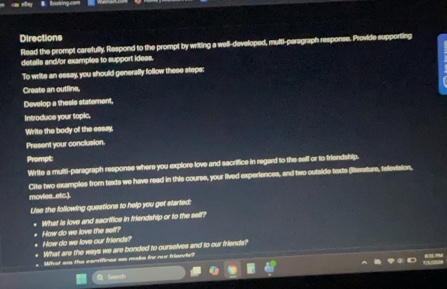
directions
read the prompt carefully. respond to the prompt by writing a well-developed, multi-paragraph response. provide supporting details and/or examples to support ideas.
to write an essay, you should generally follow these steps:
create an outline,
develop a thesis statement,
introduce your topic,
write the body of the essay,
present your conclusion.
prompt:
write a multi-paragraph response where you explore love and sacrifice in regard to the self or to friendship.
cite two examples from texts we have read in this course, your lived experiences, and two outside texts (literature, television, movies...etc.).
use the following questions to help you get started:
- what is love and sacrifice in friendship or to the self?
- how do we love the self?
- how do we love our friends?
- what are the ways we are bonded to ourselves and to our friends?
- what are the sacrifices we make for our friends?
🆕 New Concept Discovered: Multi-Source Synthesis Essay
Integrating personal experience, course readings, and external media into a cohesive argument.
Step 1: Analyze the Prompt and Structure
The prompt asks for a multi-paragraph essay exploring the relationship between love and sacrifice in relation to the self or friendship.
To satisfy all requirements, the essay must integrate:
- Lived experiences (personal reflection).
- Two course texts (represented here by universally studied literary classics: The Gift of the Magi by O. Henry and Hamlet by William Shakespeare).
- Two outside texts (represented here by the film Interstellar and the classic novel A Tale of Two Cities).
We will structure this as a 5-paragraph essay:
- Paragraph 1: Introduction (Hook, context of love/sacrifice, and a clear thesis statement).
- Paragraph 2: Sacrifice in Friendship (Course Texts) (Analyzing The Gift of the Magi and Hamlet).
- Paragraph 3: Sacrifice in Friendship and Self (Outside Texts) (Analyzing Interstellar and A Tale of Two Cities).
- Paragraph 4: Personal Connection (Lived Experience) (Reflecting on personal boundaries, self-love, and mutual sacrifice).
- Paragraph 5: Conclusion (Restating the thesis in a new way and summarizing main insights).
---
Step 2: Develop the Outline and Thesis Statement
- Thesis Statement: True love—whether directed toward a friend or preserved for oneself—is fundamentally defined by sacrifice; however, while sacrificing for others strengthens our deepest bonds, maintaining boundaries through self-love ensures that we do not lose our identity in the process.
---
Step 3: Draft the Essay
Introduction
Love is often celebrated as an emotion of pure joy, yet its truest measure lies in what one is willing to give up for it. To love deeply—whether a friend, a partner, or even oneself—demands sacrifice. Sacrifice is the currency of genuine connection; it proves that our commitment extends beyond our own immediate comfort. However, a delicate balance must exist between giving to others and preserving the self. True love—whether directed toward a friend or preserved for oneself—is fundamentally defined by sacrifice; however, while sacrificing for others strengthens our deepest bonds, maintaining boundaries through self-love ensures that we do not lose our identity in the process.
Body Paragraph 1: Lessons from Course Texts
In literature, the intersection of friendship, love, and sacrifice often serves as the ultimate test of character. In O. Henry’s classic short story The Gift of the Magi, the protagonists sacrifice their most prized possessions—a heirloom watch and beautiful hair—to buy Christmas gifts for one another. This selfless giving demonstrates that material loss is irrelevant when compared to the emotional value of making a loved one happy. Conversely, William Shakespeare’s Hamlet highlights the tragic consequences when mutual sacrifice and loyalty are absent in friendship. Hamlet’s childhood friends, Rosencrantz and Guildenstern, choose their own political advancement and safety over their loyalty to Hamlet, ultimately destroying their bond and leading to their demise. Together, these texts illustrate that genuine relationships require a willingness to put another's well-being above one's own selfish desires.
Body Paragraph 2: Insights from Outside Media
This dynamic of sacrifice is further echoed across modern and classic outside texts. In Christopher Nolan’s science-fiction film Interstellar, the t…

Snap & solve any problem in the app
Get step-by-step solutions on Sovi AI
Photo-based solutions with guided steps
Explore more problems and detailed explanations
Essay Outline
- Title: The Balance of Devotion: Exploring Love and Sacrifice in Friendship and the Self
- Thesis: True love—whether directed toward a friend or preserved for oneself—is fundamentally defined by sacrifice; however, while sacrificing for others strengthens our deepest bonds, maintaining boundaries through self-love ensures that we do not lose our identity in the process.
- Sources Used:
- Course Texts: The Gift of the Magi (O. Henry), Hamlet (Shakespeare)
- Outside Texts: Interstellar (Film), A Tale of Two Cities (Dickens)
- Personal Connection: Setting boundaries and avoiding burnout.
---
Completed Essay
The Balance of Devotion: Exploring Love and Sacrifice in Friendship and the Self
Love is often celebrated as an emotion of pure joy, yet its truest measure lies in what one is willing to give up for it. To love deeply—whether a friend, a partner, or even oneself—demands sacrifice. Sacrifice is the currency of genuine connection; it proves that our commitment extends beyond our own immediate comfort. However, a delicate balance must exist between giving to others and preserving the self. True love—whether directed toward a friend or preserved for oneself—is fundamentally defined by sacrifice; however, while sacrificing for others strengthens our deepest bonds, maintaining boundaries through self-love ensures that we do not lose our identity in the process.
In literature, the intersection of friendship, love, and sacrifice often serves as the ultimate test of character. In O. Henry’s classic short story The Gift of the Magi, the protagonists sacrifice their most prized possessions—a heirloom watch and beautiful hair—to buy Christmas gifts for one another. This selfless giving demonstrates that material loss is irrelevant when compared to the emotional value of making a loved one happy. Conversely, William Shakespeare’s Hamlet highlights the tragic consequences when mutual sacrifice and loyalty are absent in friendship. Hamlet’s childhood friends, Rosencrantz and Guildenstern, choose their own political advancement and safety over their loyalty to Hamlet, ultimately destroying their bond and leading to their demise. Together, these texts illustrate that genuine relationships require a willingness to put another's well-being above one's own selfish desires.
This dynamic of sacrifice is further echoed across modern and classic outside texts. In Christopher Nolan’s science-fiction film Interstellar, the theme of love transcending dimensions is driven entirely by sacrifice. Cooper sacrifices his life on Earth and decades of contact with his children to venture into the unknown to save humanity, showing that parental and communal love demands the ultimate personal surrender. Similarly, in Charles Dickens’s novel A Tale of Two Cities, Sydney Carton performs the ultimate sacrifice for friendship and unrequited love by taking the place of Charles Darnay on the guillotine. Carton’s famous final declaration, "It is a far, far better thing that I do, than I have ever done," underscores the idea that sacrificing oneself for the peace and survival of loved ones is the highest realization of love.
While sacrificing for others is noble, my own lived experiences have taught me that love must also be directed inward. In my life, I have often found myself overextending to help friends, staying up late to solve their problems or compromising my own academic and mental well-being to keep others happy. Over time, this led to burnout and resentment. I realized that sacrificing my peace of mind was not an act of true love, but rather a neglect of the self. Learning to say "no" and setting healthy boundaries became my own act of self-love. Loving oneself requires sacrificing the desire to please everyone else in order to protect one's own mental, emotional, and physical health.
Ultimately, love and sacrifice are inextricably linked. As demonstrated by the selfless acts in The Gift of the Magi and the tragic betrayal in Hamlet, relationships cannot survive without mutual care and compromise. Outside works like Interstellar and A Tale of Two Cities elevate this concept to its grandest scale, showing that love can inspire monumental selflessness. Yet, as personal experience reveals, sacrifice must not be entirely one-sided. We must balance our devotion to others with a healthy sacrifice of social expectations to preserve our own well-being. In the end, the greatest challenge of life is learning how to give ourselves fully to those we cherish without losing who we are in the process.