QUESTION IMAGE
Question
directions
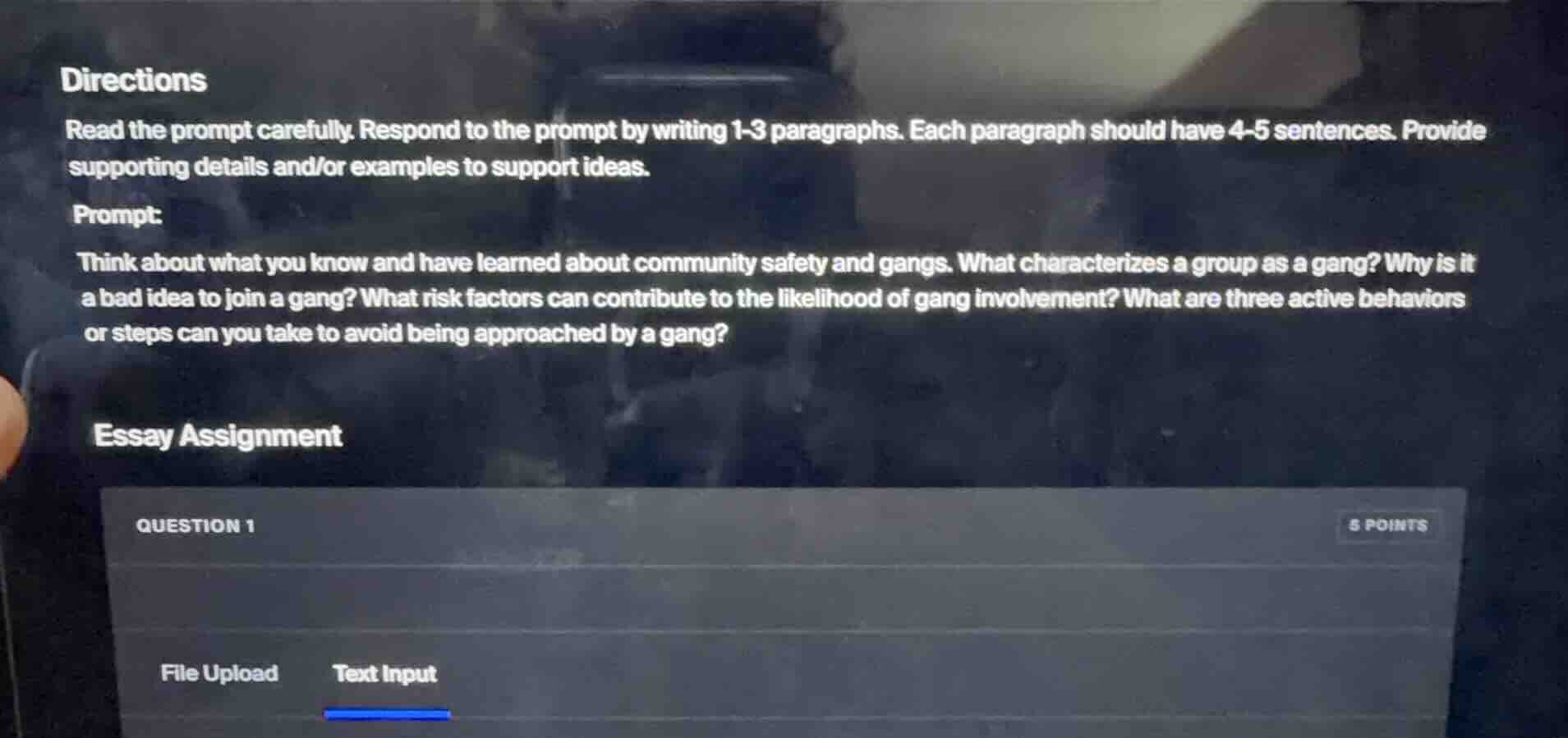
read the prompt carefully. respond to the prompt by writing 1-3 paragraphs. each paragraph should have 4-5 sentences. provide supporting details and/or examples to support ideas.
prompt:
think about what you know and have learned about community safety and gangs. what characterizes a group as a gang? why is it a bad idea to join a gang? what risk factors can contribute to the likelihood of gang involvement? what are three active behaviors or steps can you take to avoid being approached by a gang?
essay assignment
question 1
5 points
file upload
text input
Analyze the essay prompt requirements
The prompt requires a 1-3 paragraph response (4-5 sentences per paragraph) addressing four key points:
- Characteristics of a gang (e.g., formal/informal association, shared identity/symbols, involvement in illegal activities).
- Risks of joining a gang (e.g., violence, criminal record, loss of personal freedom, danger to family).
- Risk factors contributing to gang involvement (e.g., lack of parental supervision, academic failure, peer pressure, community poverty).
- Three active behaviors/steps to avoid being approached (e.g., participating in extracurricular activities, choosing positive peer groups, staying in well-lit public areas/avoiding known gang hangouts).
Draft Paragraph 1: Gang Characteristics and Risks
A gang is typically characterized as an organized group of individuals who share a common identity, name, or symbols, and collectively engage in criminal or delinquent activities to claim territory or power. Joining such a group is highly dangerous because it exposes members to severe physical violence, substance abuse, and a high probability of arrest or incarceration. Furthermore, gang involvement often isolates individuals from positive support systems like family and school, trapping them in a cycle of fear and retaliation. Ultimately, membership compromises personal safety and severely limits future educational and career opportunities.
Draft Paragraph 2: Risk Factors and Prevention Strategies
Several risk factors can increase the likelihood of gang involvement, including academic difficulties, lack of positive adult role models, peer pressure, and living in neighborhoods with high crime rates. To actively avoid being approached by gangs, youth can take three decisive steps to protect themselves and stay safe. First, they should actively participate in structured extracurricular activities, such as sports, arts, or school clubs, which provide positive social outlets. Second, it is crucial to build a supportive network of friends who share positive goals and avoid peer groups associated with delinquent behavior. Finally, individuals should stay aware of their surroundings, avoid known gang hangouts, and report any safety concerns to trusted adults or school authorities.

Snap & solve any problem in the app
Get step-by-step solutions on Sovi AI
Photo-based solutions with guided steps
Explore more problems and detailed explanations
A gang is typically characterized as an organized group of individuals who share a common identity, name, or symbols, and collectively engage in criminal or delinquent activities to claim territory or power. Joining such a group is highly dangerous because it exposes members to severe physical violence, substance abuse, and a high probability of arrest or incarceration. Furthermore, gang involvement often isolates individuals from positive support systems like family and school, trapping them in a cycle of fear and retaliation. Ultimately, membership compromises personal safety and severely limits future educational and career opportunities.
Several risk factors can increase the likelihood of gang involvement, including academic difficulties, lack of positive adult role models, peer pressure, and living in neighborhoods with high crime rates. To actively avoid being approached by gangs, youth can take three decisive steps to protect themselves and stay safe. First, they should actively participate in structured extracurricular activities, such as sports, arts, or school clubs, which provide positive social outlets. Second, it is crucial to build a supportive network of friends who share positive goals and avoid peer groups associated with delinquent behavior. Finally, individuals should stay aware of their surroundings, avoid known gang hangouts, and report any safety concerns to trusted adults or school authorities.