QUESTION IMAGE
Question
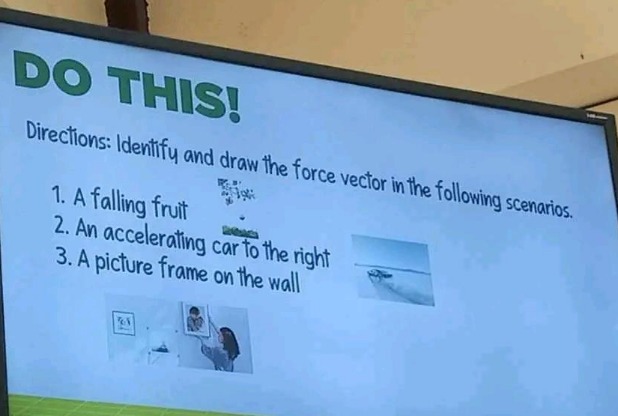
do this!
directions: identify and draw the force vector in the following scenarios.
- a falling fruit
- an accelerating car to the right
- a picture frame on the wall
🆕 New Concept Discovered: Force Vectors and Free-Body Diagrams
Representing forces as arrows with direction and magnitude
Step 1: Analyze Scenario 1 (A falling fruit)
When a fruit is falling, the primary force acting on it (neglecting air resistance) is gravity.
- Force Identified: Gravitational force (weight), which acts vertically downward toward the center of the Earth.
- Vector Representation: Draw an arrow pointing straight down from the center of the fruit.
Step 2: Analyze Scenario 2 (An accelerating car to the right)
For a car accelerating to the right, we look at the horizontal forces causing this motion, as well as the vertical forces keeping it stable.
- Forces Identified:
- Applied/Thrust Force (or static friction from the road pushing the tires forward): Acts to the right, causing the acceleration.
- Gravity: Acts vertically downward.
- Normal Force: Acts vertically upward from the road, balancing gravity.
- Air Resistance/Friction (optional): Acts to the left (smaller than the forward force).
- Vector Representation:
- A long arrow pointing to the right (\(\vec{F}_{\text{thrust}}\) or \(\vec{F}_{\text{friction, road}}\)).
- A downward arrow (\(\vec{F}_g\)) and an equal-length upward arrow (\(\vec{F}_N\)).
Step 3: Analyze Scenario 3 (A picture frame on the wall)
A picture frame hanging on a wall is at rest (in static equilibrium). This means the upward forces must perfectly balance the downward forces.
- Forces Identified:
- Gravity: Pulls the frame vertically downward.
- Tension (from the hanging wire/string) or Normal/Friction Force (from the nail/hook): Supports the frame by pulling or pushing vertically upward.
- Vector Representation:
- An arrow pointing straight down (\(\vec{F}_g\)).
- An equal-length arrow pointing straight up (\(\vec{F}_T\) or \(\vec{F}_{\text{support}}\)) to show that the forces are balanced and there is no motion.

Snap & solve any problem in the app
Get step-by-step solutions on Sovi AI
Photo-based solutions with guided steps
Explore more problems and detailed explanations
Here are the descriptions of the force vectors you should draw for each scenario:
- A falling fruit:
- Vector to draw: A single arrow pointing straight down from the fruit, labeled as gravity (\(\vec{F}_g\)).
- An accelerating car to the right:
- Vector to draw: A dominant arrow pointing to the right (representing the forward force driving the car, \(\vec{F}_{\text{forward}}\)). You can also draw balanced vertical arrows: one pointing straight up (\(\vec{F}_N\)) and one pointing straight down (\(\vec{F}_g\)).
- A picture frame on the wall:
- Vector to draw: Two equal-length arrows in opposite directions: one pointing straight up (representing the supporting tension or hook force, \(\vec{F}_{\text{support}}\)) and one pointing straight down (representing gravity, \(\vec{F}_g\)).