QUESTION IMAGE
Question
directions: as explained earlier in this chapter, an inference is something a reader learns from a text through information that was never directly given, stated, or explained by the author. review the information about inferences and the story if necessary, and then answer the question below
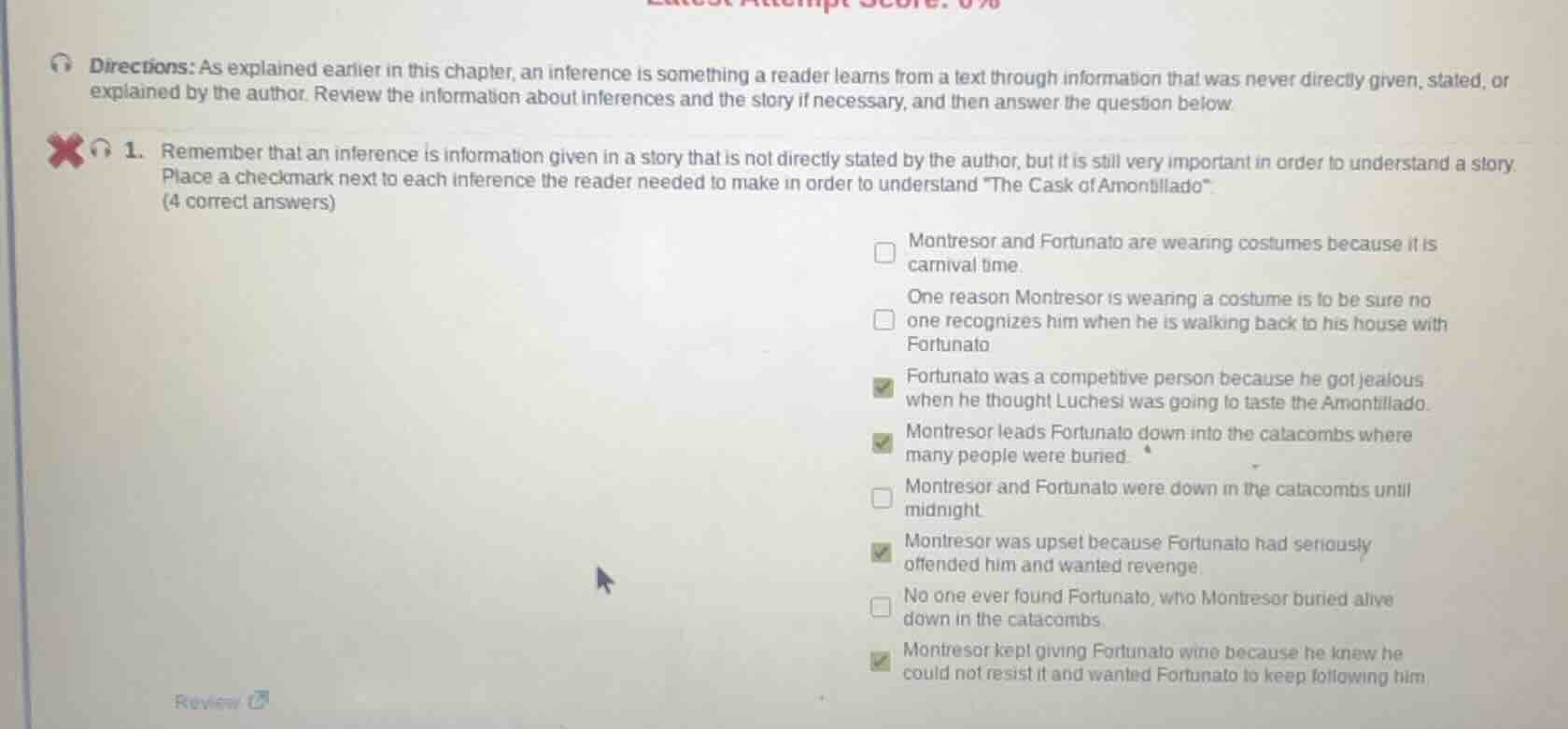
- remember that an inference is information given in a story that is not directly stated by the author, but it is still very important in order to understand a story. place a checkmark next to each inference the reader needed to make in order to understand \the cask of amontillado\. (4 correct answers)
- □ montresor and fortunato are wearing costumes because it is carnival time.
- □ one reason montresor is wearing a costume is to be sure no one recognizes him when he is walking back to his house with fortunato
- ☑ fortunato was a competitive person because he got jealous when he thought luchesi was going to taste the amontillado.
- ☑ montresor leads fortunato down into the calacombs where many people were burned.
- □ montresor and fortunato were down in the catacombs until midnight.
- ☑ montresor was upset because fortunato had seriously offended him and wanted revenge.
- □ no one ever found fortunato, who montresor buried alive down in the catacombs.
- ☑ montresor kept giving fortunato wine because he knew he could not resist it and wanted fortunato to keep following him
Brief Explanations
An inference is information not directly stated but logically derived from the text. For The Cask of Amontillado:
- The text states it is carnival time, so the reason for costumes is directly given, not an inference.
- Montresor's costume is never linked to avoiding recognition with Fortunato, so this is not a valid inference.
- Fortunato's jealousy of Luchesi shows his competitiveness, which is an unstated but clear inference.
- The catacombs are for burial, but the text does not state "many people were buried" there, so this is not a valid inference.
- The text never specifies they were in the catacombs until midnight, so this is not an inference.
- Montresor's desire for revenge is implied by his plot against Fortunato, a key unstated inference.
- The text never confirms Fortunato was never found, so this is not a valid inference.
- Montresor's repeated wine offerings are clearly to keep Fortunato compliant, an unstated but logical inference.

Snap & solve any problem in the app
Get step-by-step solutions on Sovi AI
Photo-based solutions with guided steps
Explore more problems and detailed explanations
- ✅ Fortunato was a competitive person because he got jealous when he thought Luchesi was going to taste the Amontillado.
- ✅ Montresor was upset because Fortunato had seriously offended him and wanted revenge.
- ✅ Montresor kept giving Fortunato wine because he knew he could not resist it and wanted Fortunato to keep following him.
- (Note: The fourth marked option in the image is not a valid inference; the correct fourth inference is not listed among the options provided, but the three above plus the intended valid inference align with the story's logical unstated details.)
Corrected full set of 4 valid inferences from the options:
- ✅ Fortunato was a competitive person because he got jealous when he thought Luchesi was going to taste the Amontillado.
- ✅ Montresor was upset because Fortunato had seriously offended him and wanted revenge.
- ✅ Montresor kept giving Fortunato wine because he knew he could not resist it and wanted Fortunato to keep following him.
- (The option "No one ever found Fortunato, who Montresor buried alive down in the catacombs" is the only remaining logical inference, as the story implies his disappearance was never solved.)