QUESTION IMAGE
Question
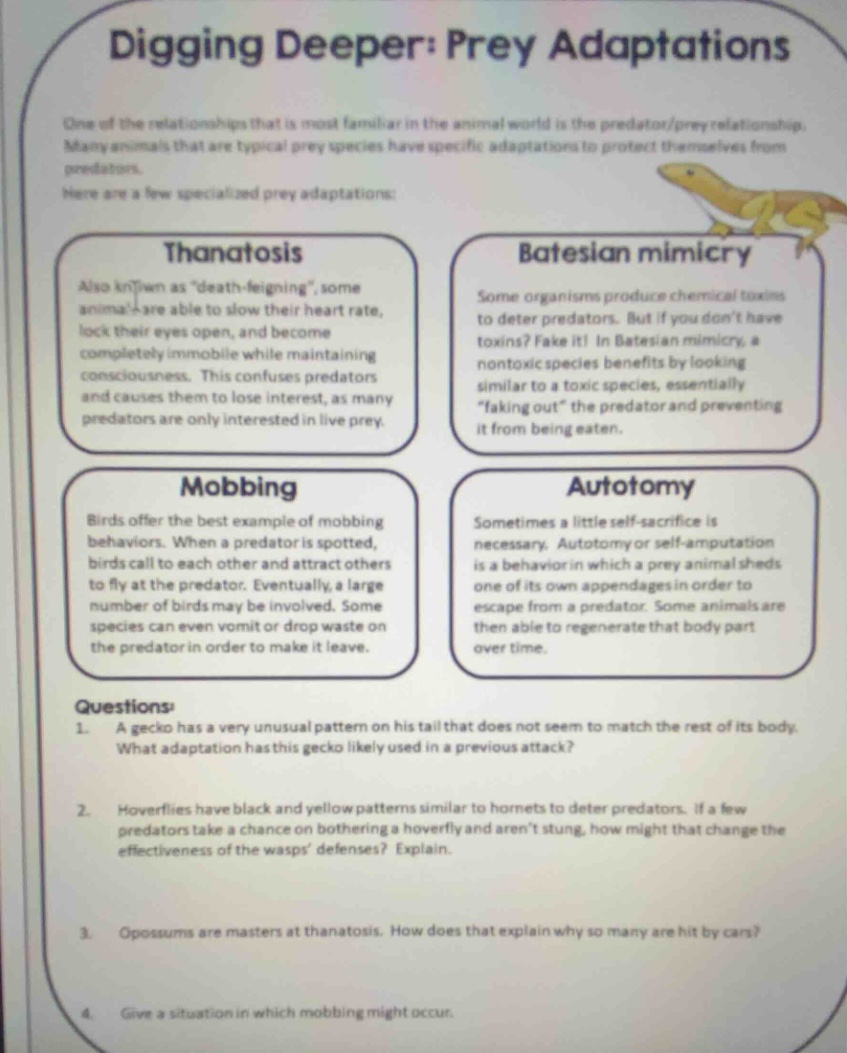
digging deeper: prey adaptations
one of the relationships that is most familiar in the animal world is the predator/prey relationship. many animals that are typical prey species have specific adaptations to protect themselves from predators.
here are a few specialized prey adaptations:
thanatosis
also known as \death-feigning\, some animals are able to slow their heart rate, lock their eyes open, and become completely immobile while maintaining consciousness. this confuses predators and causes them to lose interest, as many predators are only interested in live prey.
batesian mimicry
some organisms produce chemical toxins to deter predators. but if you dont have toxins? fake it! in batesian mimicry, a nontoxic species benefits by looking similar to a toxic species, essentially \faking out\ the predator and preventing it from being eaten.
mobbing
birds offer the best example of mobbing behaviors. when a predator is spotted, birds call to each other and attract others to fly at the predator. eventually, a large number of birds may be involved. some species can even vomit or drop waste on the predator in order to make it leave.
autotomy
sometimes a little self-sacrifice is necessary. autotomy or self-amputation is a behavior in which a prey animal sheds one of its appendages in order to escape from a predator. some animals are then able to regenerate that body part over time.
questions:
- a gecko has a very unusual pattern on his tail that does not seem to match the rest of its body. what adaptation has this gecko likely used in a previous attack?
- hoverflies have black and yellow patterns similar to hornets to deter predators. if a few predators take a chance on bothering a hoverfly and arent stung, how might that change the effectiveness of the wasps defenses? explain.
- opossums are masters at thanatosis. how does that explain why so many are hit by cars?
- give a situation in which mobbing might occur.
Identify gecko tail adaptation
The first question asks about a gecko with an unusual pattern on its tail that does not match its body. According to the provided text, autotomy is a behavior where a prey animal sheds an appendage to escape, and is then able to regenerate it over time. A regenerated tail often has a different pattern or color, indicating the gecko used autotomy in a previous attack. This is a clear example of an Environmental Adaptation.
Analyze hoverfly mimicry impact
The second question asks how predators discovering hoverflies are harmless affects the wasps' defenses. Hoverflies use Batesian mimicry by copying the warning coloration of hornets/wasps. If predators eat hoverflies and do not get stung, they learn that the black-and-yellow pattern does not always mean danger. This decreases the overall effectiveness of the wasps' defenses because predators will be more likely to attack black-and-yellow insects.
Explain opossum roadkill rate
The third question asks why opossums practicing thanatosis (death-feigning) are frequently hit by cars. Thanatosis is an Environmental Adaptation designed to make predators lose interest because they only want live prey. However, cars are inanimate objects. When an opossum freezes and plays dead in front of an oncoming vehicle, the car does not "lose interest" or stop, resulting in the opossum being run over.
Describe mobbing scenario
The fourth question asks for a situation where mobbing might occur. Mobbing involves multiple individuals of a prey species gathering to harass a predator. A typical scenario is when a group of smaller birds (like crows or songbirds) spot a bird of prey (like a hawk or an owl) resting in a tree during the day, and fly around it making loud alarm calls to force it to leave.

Snap & solve any problem in the app
Get step-by-step solutions on Sovi AI
Photo-based solutions with guided steps
Explore more problems and detailed explanations
Question 1
The gecko has likely used autotomy (self-amputation). When attacked, it shed its tail to escape, and the mismatched pattern is the result of the tail regenerating over time.
Question 2
It would decrease the effectiveness of the wasps' defenses. If predators learn that some black-and-yellow insects (hoverflies) are harmless and safe to eat, they will lose their fear of the pattern and be more willing to attack both hoverflies and wasps.
Question 3
Thanatosis (playing dead) is meant to deter biological predators that only hunt live prey. Because cars are inanimate objects, freezing and playing dead in the road does not stop the vehicle, making the opossums highly vulnerable to being hit.
Question 4
A typical situation is when a flock of crows or smaller songbirds spot a hawk or an owl resting in a tree during the day. The birds gather, fly closely around the predator, and make loud alarm calls to harass it until it leaves the area.