QUESTION IMAGE
Question
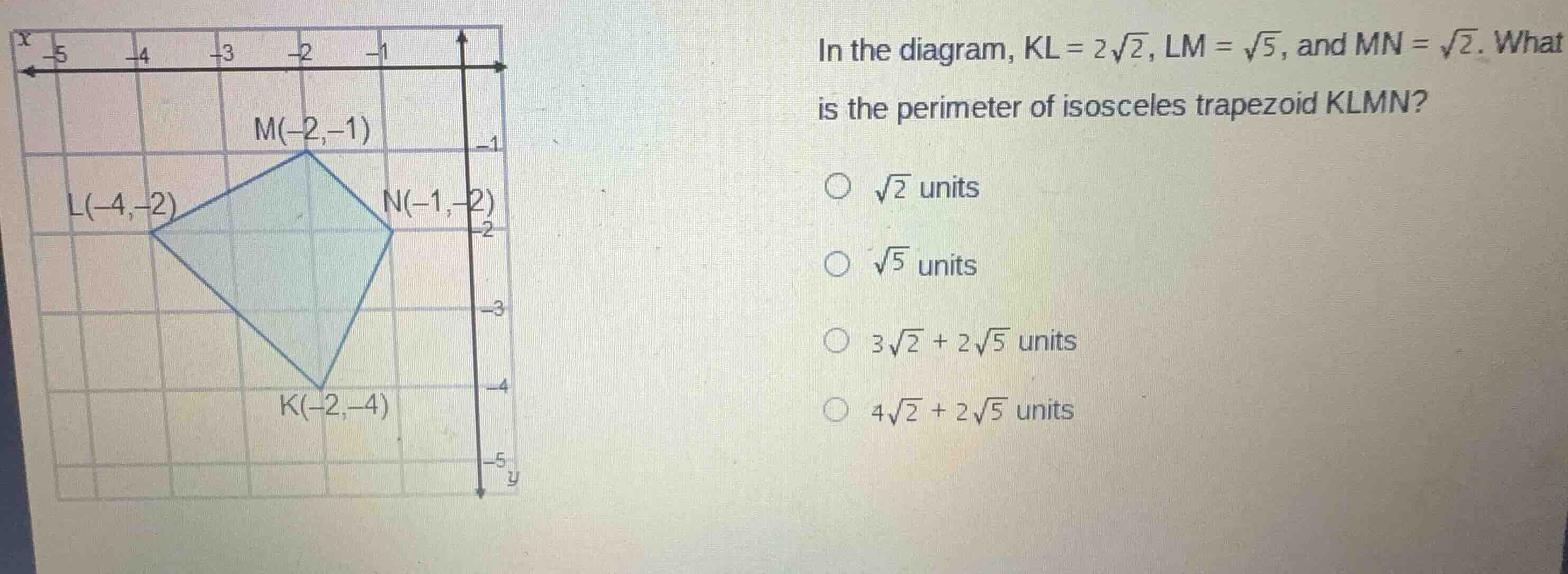
in the diagram, \\(kl = 2\sqrt{2}\\), \\(lm = \sqrt{5}\\), and \\(mn = \sqrt{2}\\). what is the perimeter of isosceles trapezoid klmn?
\\(\sqrt{2}\\) units
\\(\sqrt{5}\\) units
\\(3\sqrt{2} + 2\sqrt{5}\\) units
\\(4\sqrt{2} + 2\sqrt{5}\\) units
<pre_analysis>
{
"quality": "clear",
"question_count": 1,
"skills_matched": [
"step_cot",
"multiple_choice_formatter",
"explain_then_answer",
"tutor",
"mastery_adaptive_brevity"
],
"needs_drawing": false,
"concepts_used": [
"Isosceles Trapezoid Definition",
"Perimeter in Coordinate Plane"
],
"new_concepts": [],
"current_concepts": [
"Isosceles Trapezoid Definition",
"Perimeter in Coordinate Plane"
]
}
</pre_analysis>
<reasoning>
Identify the given side lengths
Using the Isosceles Trapezoid Definition knowledge point
We are given three side lengths of the trapezoid \(KLMN\):
- \(KL = 2\sqrt{2}\)
- \(LM = \sqrt{5}\)
- \(MN = \sqrt{2}\)
Determine the missing side length
Using the Isosceles Trapezoid Definition knowledge point
An isosceles trapezoid has two non-parallel sides (legs) that are equal in length.
- The parallel bases are \(KL\) and \(MN\) because their slopes are equal:
\[
\text{Slope of } KL = \frac{-4 - (-2)}{-2 - (-4)} = \frac{-2}{2} = -1
\]
\[
\text{Slope of } MN = \frac{-2 - (-1)}{-1 - (-2)} = \frac{-1}{1} = -1
\]
- Since \(KL \parallel MN\), the legs are \(LM\) and \(NK\).
- In an isosceles trapezoid, the legs are congruent:
\[
NK = LM = \sqrt{5}
\]
Calculate the perimeter
Using the Perimeter in Coordinate Plane knowledge point
The perimeter is the sum of all four side lengths:
\[
\text{Perimeter} = KL + LM + MN + NK
\]
\[
\text{Perimeter} = 2\sqrt{2} + \sqrt{5} + \sqrt{2} + \sqrt{5}
\]
\[
\text{Perimeter} = (2\sqrt{2} + \sqrt{2}) + (\sqrt{5} + \sqrt{5}) = 3\sqrt{2} + 2\sqrt{5}
\]
</reasoning>
<answer>
<mcq-option>(A) \(\sqrt{2}\) units</mcq-option>
<mcq-option>(B) \(\sqrt{5}\) units</mcq-option>
<mcq-correct>(C) \(3\sqrt{2} + 2\sqrt{5}\) units</mcq-correct>
<mcq-option>(D) \(4\sqrt{2} + 2\sqrt{5}\) units</mcq-option>
</answer>
<post_analysis>
{
"subject": "Mathematics",
"question_type": "Multiple Choice",
"knowledge_point": [
"Mathematics",
"Geometry",
"Perimeter in Coordinate Plane"
]
}
</post_analysis>
Snap & solve any problem in the app
Get step-by-step solutions on Sovi AI
Photo-based solutions with guided steps
Explore more problems and detailed explanations
<pre_analysis>
{
"quality": "clear",
"question_count": 1,
"skills_matched": [
"step_cot",
"multiple_choice_formatter",
"explain_then_answer",
"tutor",
"mastery_adaptive_brevity"
],
"needs_drawing": false,
"concepts_used": [
"Isosceles Trapezoid Definition",
"Perimeter in Coordinate Plane"
],
"new_concepts": [],
"current_concepts": [
"Isosceles Trapezoid Definition",
"Perimeter in Coordinate Plane"
]
}
</pre_analysis>
<reasoning>
Identify the given side lengths
Using the Isosceles Trapezoid Definition knowledge point
We are given three side lengths of the trapezoid \(KLMN\):
- \(KL = 2\sqrt{2}\)
- \(LM = \sqrt{5}\)
- \(MN = \sqrt{2}\)
Determine the missing side length
Using the Isosceles Trapezoid Definition knowledge point
An isosceles trapezoid has two non-parallel sides (legs) that are equal in length.
- The parallel bases are \(KL\) and \(MN\) because their slopes are equal:
\[
\text{Slope of } KL = \frac{-4 - (-2)}{-2 - (-4)} = \frac{-2}{2} = -1
\]
\[
\text{Slope of } MN = \frac{-2 - (-1)}{-1 - (-2)} = \frac{-1}{1} = -1
\]
- Since \(KL \parallel MN\), the legs are \(LM\) and \(NK\).
- In an isosceles trapezoid, the legs are congruent:
\[
NK = LM = \sqrt{5}
\]
Calculate the perimeter
Using the Perimeter in Coordinate Plane knowledge point
The perimeter is the sum of all four side lengths:
\[
\text{Perimeter} = KL + LM + MN + NK
\]
\[
\text{Perimeter} = 2\sqrt{2} + \sqrt{5} + \sqrt{2} + \sqrt{5}
\]
\[
\text{Perimeter} = (2\sqrt{2} + \sqrt{2}) + (\sqrt{5} + \sqrt{5}) = 3\sqrt{2} + 2\sqrt{5}
\]
</reasoning>
<answer>
<mcq-option>(A) \(\sqrt{2}\) units</mcq-option>
<mcq-option>(B) \(\sqrt{5}\) units</mcq-option>
<mcq-correct>(C) \(3\sqrt{2} + 2\sqrt{5}\) units</mcq-correct>
<mcq-option>(D) \(4\sqrt{2} + 2\sqrt{5}\) units</mcq-option>
</answer>
<post_analysis>
{
"subject": "Mathematics",
"question_type": "Multiple Choice",
"knowledge_point": [
"Mathematics",
"Geometry",
"Perimeter in Coordinate Plane"
]
}
</post_analysis>