Sovi.AI - AI Math Tutor

Scan to solve math questions

QUESTION IMAGE

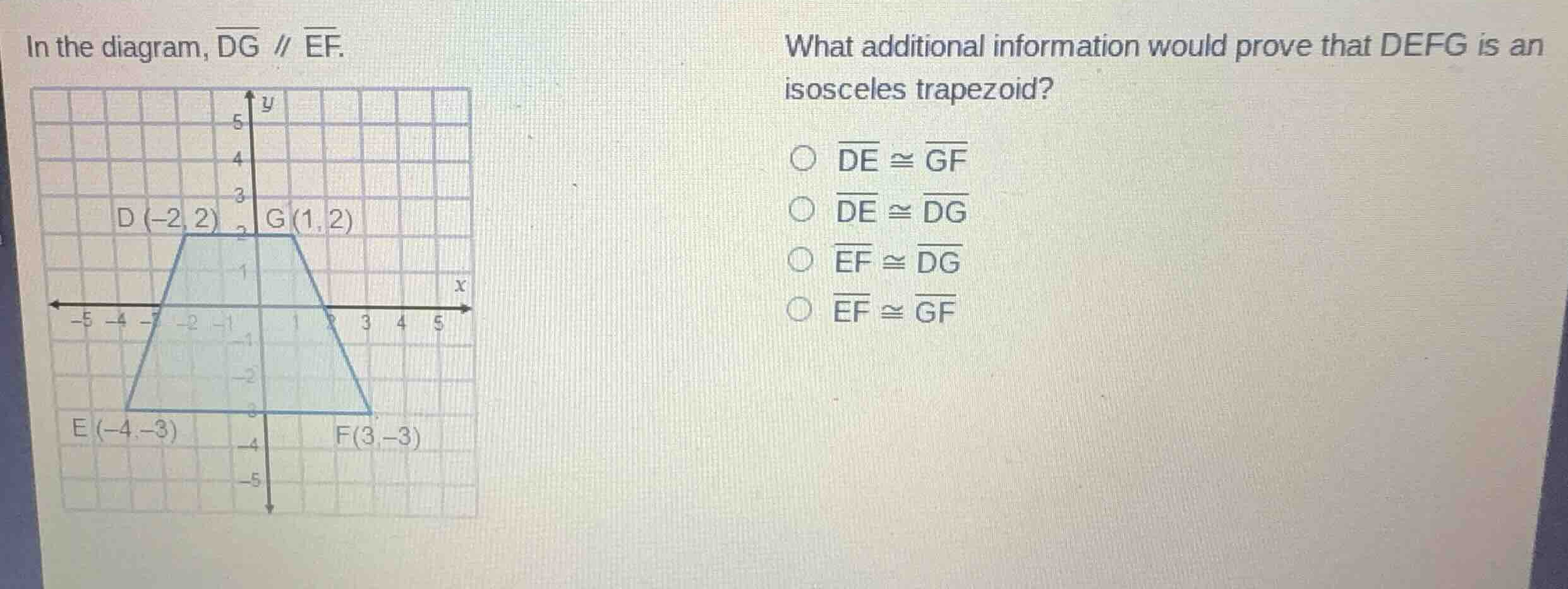
in the diagram, \\(\\overline{dg} \\parallel \\overline{ef}\\). what ad…

Question

in the diagram, \\(\overline{dg} \parallel \overline{ef}\\).

what additional information would prove that \\(defg\\) is an isosceles trapezoid?

\\(\bigcirc\\) \\(\overline{de} \cong \overline{gf}\\)
\\(\bigcirc\\) \\(\overline{de} \cong \overline{dg}\\)
\\(\bigcirc\\) \\(\overline{ef} \cong \overline{dg}\\)
\\(\bigcirc\\) \\(\overline{ef} \cong \overline{gf}\\)

Explanation:

Response

<pre_analysis>
{
"quality": "clear",
"question_count": 1,
"skills_matched": [
"step_cot",
"multiple_choice_formatter",
"explain_then_answer",
"tutor",
"mastery_adaptive_brevity"
],
"needs_drawing": false,
"concepts_used": [
"Trapezoid Properties"
],
"new_concepts": [
"Isosceles Trapezoid Definition"
],
"current_concepts": [
"Trapezoid Properties",
"Isosceles Trapezoid Definition"
]
}
</pre_analysis>

<reasoning>

Identify the given geometric properties

Using the Trapezoid Properties knowledge point

  • The problem states that \(\overline{DG} \parallel \overline{EF}\).
  • Since one pair of opposite sides is parallel, quadrilateral \(DEFG\) is a trapezoid.
  • The parallel sides \(\overline{DG}\) and \(\overline{EF}\) are the bases of the trapezoid.
  • The non-parallel sides \(\overline{DE}\) and \(\overline{GF}\) are the legs of the trapezoid.

Apply the definition of an isosceles trapezoid

  • By definition, a trapezoid is an isosceles trapezoid if its non-parallel sides (legs) are congruent.
  • The legs of trapezoid \(DEFG\) are \(\overline{DE}\) and \(\overline{GF}\).
  • Therefore, to prove that \(DEFG\) is an isosceles trapezoid, we must show that \(\overline{DE} \cong \overline{GF}\).

Match with the given options

  • Option 1: \(\overline{DE} \cong \overline{GF}\) (This states that the legs are congruent).
  • Option 2: \(\overline{DE} \cong \overline{DG}\) (This relates a leg to a base).
  • Option 3: \(\overline{EF} \cong \overline{DG}\) (This relates the two bases).
  • Option 4: \(\overline{EF} \cong \overline{GF}\) (This relates a base to a leg).
  • Thus, Option 1 is the correct choice.

</reasoning>

<answer>
<mcq-correct>(A) \(\overline{DE} \cong \overline{GF}\)</mcq-correct>
<mcq-option>(B) \(\overline{DE} \cong \overline{DG}\)</mcq-option>
<mcq-option>(C) \(\overline{EF} \cong \overline{DG}\)</mcq-option>
<mcq-option>(D) \(\overline{EF} \cong \overline{GF}\)</mcq-option>
</answer>

<post_analysis>
{
"subject": "Mathematics",
"question_type": "Multiple Choice",
"knowledge_point": [
"Mathematics",
"Geometry",
"Isosceles Trapezoid Definition"
]
}
</post_analysis>

Answer:

<pre_analysis>
{
"quality": "clear",
"question_count": 1,
"skills_matched": [
"step_cot",
"multiple_choice_formatter",
"explain_then_answer",
"tutor",
"mastery_adaptive_brevity"
],
"needs_drawing": false,
"concepts_used": [
"Trapezoid Properties"
],
"new_concepts": [
"Isosceles Trapezoid Definition"
],
"current_concepts": [
"Trapezoid Properties",
"Isosceles Trapezoid Definition"
]
}
</pre_analysis>

<reasoning>

Identify the given geometric properties

Using the Trapezoid Properties knowledge point

  • The problem states that \(\overline{DG} \parallel \overline{EF}\).
  • Since one pair of opposite sides is parallel, quadrilateral \(DEFG\) is a trapezoid.
  • The parallel sides \(\overline{DG}\) and \(\overline{EF}\) are the bases of the trapezoid.
  • The non-parallel sides \(\overline{DE}\) and \(\overline{GF}\) are the legs of the trapezoid.

Apply the definition of an isosceles trapezoid

  • By definition, a trapezoid is an isosceles trapezoid if its non-parallel sides (legs) are congruent.
  • The legs of trapezoid \(DEFG\) are \(\overline{DE}\) and \(\overline{GF}\).
  • Therefore, to prove that \(DEFG\) is an isosceles trapezoid, we must show that \(\overline{DE} \cong \overline{GF}\).

Match with the given options

  • Option 1: \(\overline{DE} \cong \overline{GF}\) (This states that the legs are congruent).
  • Option 2: \(\overline{DE} \cong \overline{DG}\) (This relates a leg to a base).
  • Option 3: \(\overline{EF} \cong \overline{DG}\) (This relates the two bases).
  • Option 4: \(\overline{EF} \cong \overline{GF}\) (This relates a base to a leg).
  • Thus, Option 1 is the correct choice.

</reasoning>

<answer>
<mcq-correct>(A) \(\overline{DE} \cong \overline{GF}\)</mcq-correct>
<mcq-option>(B) \(\overline{DE} \cong \overline{DG}\)</mcq-option>
<mcq-option>(C) \(\overline{EF} \cong \overline{DG}\)</mcq-option>
<mcq-option>(D) \(\overline{EF} \cong \overline{GF}\)</mcq-option>
</answer>

<post_analysis>
{
"subject": "Mathematics",
"question_type": "Multiple Choice",
"knowledge_point": [
"Mathematics",
"Geometry",
"Isosceles Trapezoid Definition"
]
}
</post_analysis>