Sovi.AI - AI Math Tutor

Scan to solve math questions

QUESTION IMAGE

the diagram shows the foreign policy spectrum. responses range from lea…

Question

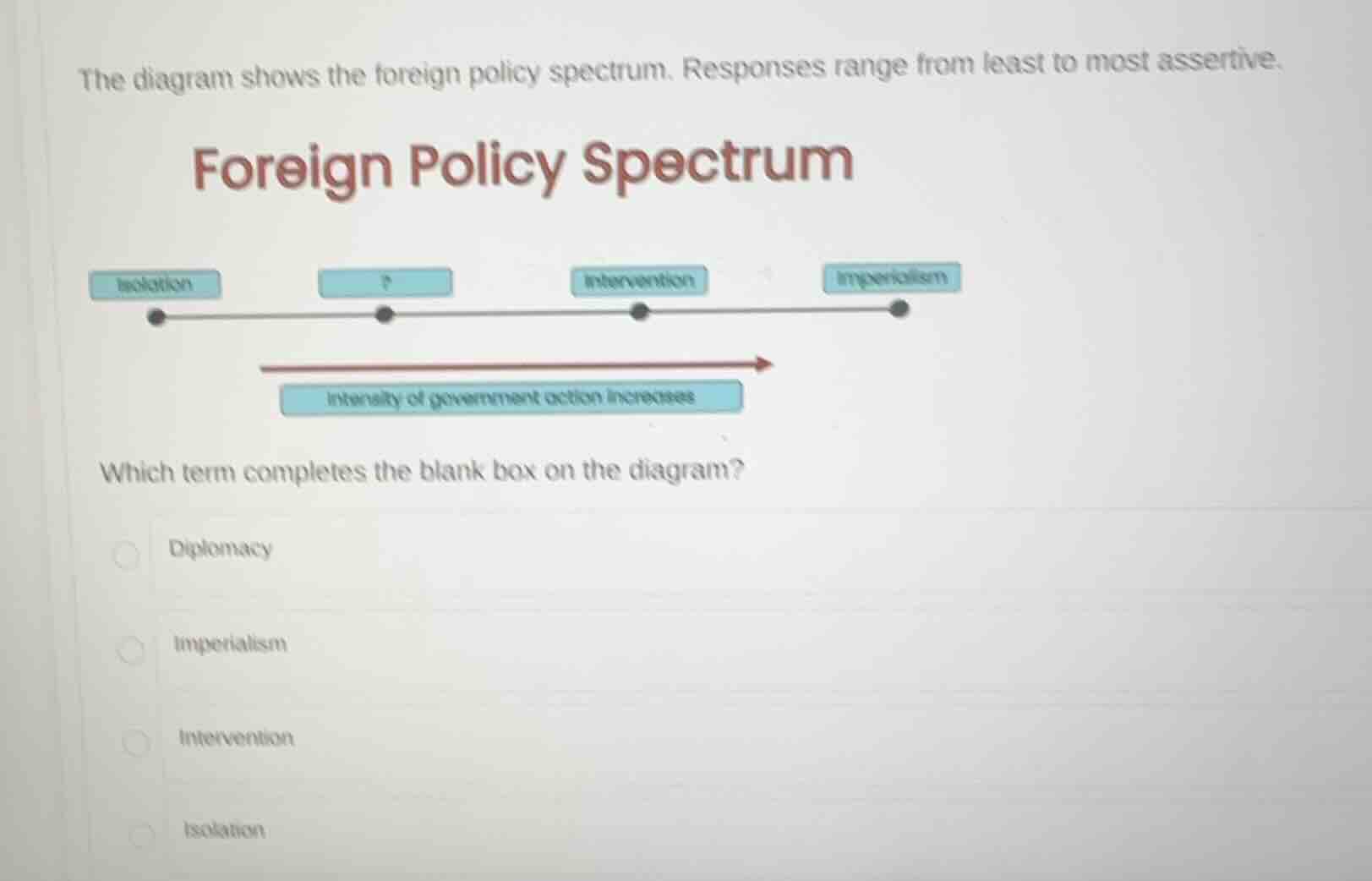
the diagram shows the foreign policy spectrum. responses range from least to most assertive.

foreign policy spectrum

which term completes the blank box on the diagram?

diplomacy
imperialism
intervention
isolation

Explanation:

Response

<pre_analysis>
{
"quality": "clear",
"question_count": 1,
"skills_matched": [
"direct_cot",
"multiple_choice_formatter",
"explain_then_answer",
"tutor",
"mastery_adaptive_brevity"
],
"needs_drawing": false,
"concepts_used": [
"Isolationism",
"US Foreign Policy"
],
"new_concepts": [
"Foreign Policy Spectrum",
"Diplomacy"
],
"current_concepts": [
"Isolationism",
"US Foreign Policy",
"Foreign Policy Spectrum",
"Diplomacy"
]
}
</pre_analysis>

<reasoning>

Analyze the foreign policy spectrum

Using the Isolationism and US Foreign Policy knowledge points, we analyze the spectrum of government action intensity. The spectrum ranges from the least assertive, non-involved stance to the most assertive, dominant stance:

  1. Isolationism: Complete non-involvement in international affairs (lowest intensity).
  2. ?: Peaceful engagement, negotiation, and building relationships without military force.
  3. Intervention: Direct political or military involvement in another nation's affairs.
  4. Imperialism: Extending a nation's authority by territorial acquisition or political/economic dominance (highest intensity).

Identify the missing term

Using the US Foreign Policy knowledge point, the term that represents peaceful engagement and negotiation between isolationism and intervention is Diplomacy. It represents a moderate level of government action, more active than isolationism but less intrusive than direct intervention.
</reasoning>

<answer>
<mcq-correct>Diplomacy</mcq-correct>
<mcq-option>Imperialism</mcq-option>
<mcq-option>Intervention</mcq-option>
<mcq-option>Isolation</mcq-option>
</answer>

<post_analysis>
{
"subject": "Social Science",
"question_type": "Multiple Choice",
"knowledge_point": [
"Social Science",
"Political Science",
"US Foreign Policy"
]
}
</post_analysis>

Answer:

<pre_analysis>
{
"quality": "clear",
"question_count": 1,
"skills_matched": [
"direct_cot",
"multiple_choice_formatter",
"explain_then_answer",
"tutor",
"mastery_adaptive_brevity"
],
"needs_drawing": false,
"concepts_used": [
"Isolationism",
"US Foreign Policy"
],
"new_concepts": [
"Foreign Policy Spectrum",
"Diplomacy"
],
"current_concepts": [
"Isolationism",
"US Foreign Policy",
"Foreign Policy Spectrum",
"Diplomacy"
]
}
</pre_analysis>

<reasoning>

Analyze the foreign policy spectrum

Using the Isolationism and US Foreign Policy knowledge points, we analyze the spectrum of government action intensity. The spectrum ranges from the least assertive, non-involved stance to the most assertive, dominant stance:

  1. Isolationism: Complete non-involvement in international affairs (lowest intensity).
  2. ?: Peaceful engagement, negotiation, and building relationships without military force.
  3. Intervention: Direct political or military involvement in another nation's affairs.
  4. Imperialism: Extending a nation's authority by territorial acquisition or political/economic dominance (highest intensity).

Identify the missing term

Using the US Foreign Policy knowledge point, the term that represents peaceful engagement and negotiation between isolationism and intervention is Diplomacy. It represents a moderate level of government action, more active than isolationism but less intrusive than direct intervention.
</reasoning>

<answer>
<mcq-correct>Diplomacy</mcq-correct>
<mcq-option>Imperialism</mcq-option>
<mcq-option>Intervention</mcq-option>
<mcq-option>Isolation</mcq-option>
</answer>

<post_analysis>
{
"subject": "Social Science",
"question_type": "Multiple Choice",
"knowledge_point": [
"Social Science",
"Political Science",
"US Foreign Policy"
]
}
</post_analysis>