QUESTION IMAGE
Question
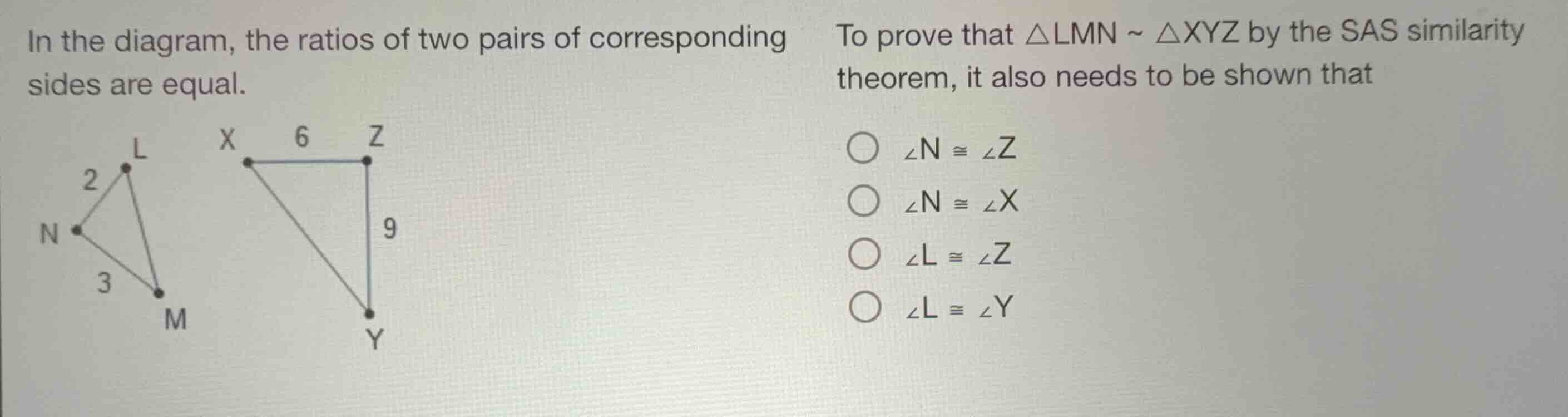
in the diagram, the ratios of two pairs of corresponding sides are equal. to prove that \\(\delta lmn \sim \delta xyz\\) by the sas similarity theorem, it also needs to be shown that
\\(\bigcirc\\) \\(\angle n \cong \angle z\\)
\\(\bigcirc\\) \\(\angle n \cong \angle x\\)
\\(\bigcirc\\) \\(\angle l \cong \angle z\\)
\\(\bigcirc\\) \\(\angle l \cong \angle y\\)
Identify the given side lengths and corresponding ratios
We are given two triangles, \(\Delta LMN\) and \(\Delta XYZ\).
The side lengths shown in the diagram are:
- For \(\Delta LMN\): \(LN = 2\), \(MN = 3\)
- For \(\Delta XYZ\): \(XZ = 6\), \(YZ = 9\)
The ratios of the corresponding sides are:
Thus, the ratios of these two pairs of corresponding sides are equal:
Determine the included angles
The SAS (Side-Angle-Side) similarity theorem states that if two sides of one triangle are proportional to two sides of another triangle, and their included angles are congruent, then the triangles are similar.
- For \(\Delta LMN\), the sides forming the proportional ratio are \(LN\) and \(MN\). The included angle between these two sides is \(\angle N\) (or \(\angle LNM\)).
- For \(\Delta XYZ\), the sides forming the proportional ratio are \(XZ\) and \(YZ\). The included angle between these two sides is \(\angle Z\) (or \(\angle XZY\)).
Apply the SAS similarity theorem
To prove that \(\Delta LMN \sim \Delta XYZ\) by the SAS similarity theorem, the included angles must be congruent:
Comparing this to the given options, the correct statement is \(\angle N \cong \angle Z\).

Snap & solve any problem in the app
Get step-by-step solutions on Sovi AI
Photo-based solutions with guided steps
Explore more problems and detailed explanations
- (A) \(\angle N \cong \angle Z\) (Correct answer)
- (B) \(\angle N \cong \angle X\)
- (C) \(\angle L \cong \angle Z\)
- (D) \(\angle L \cong \angle Y\)