QUESTION IMAGE
Question
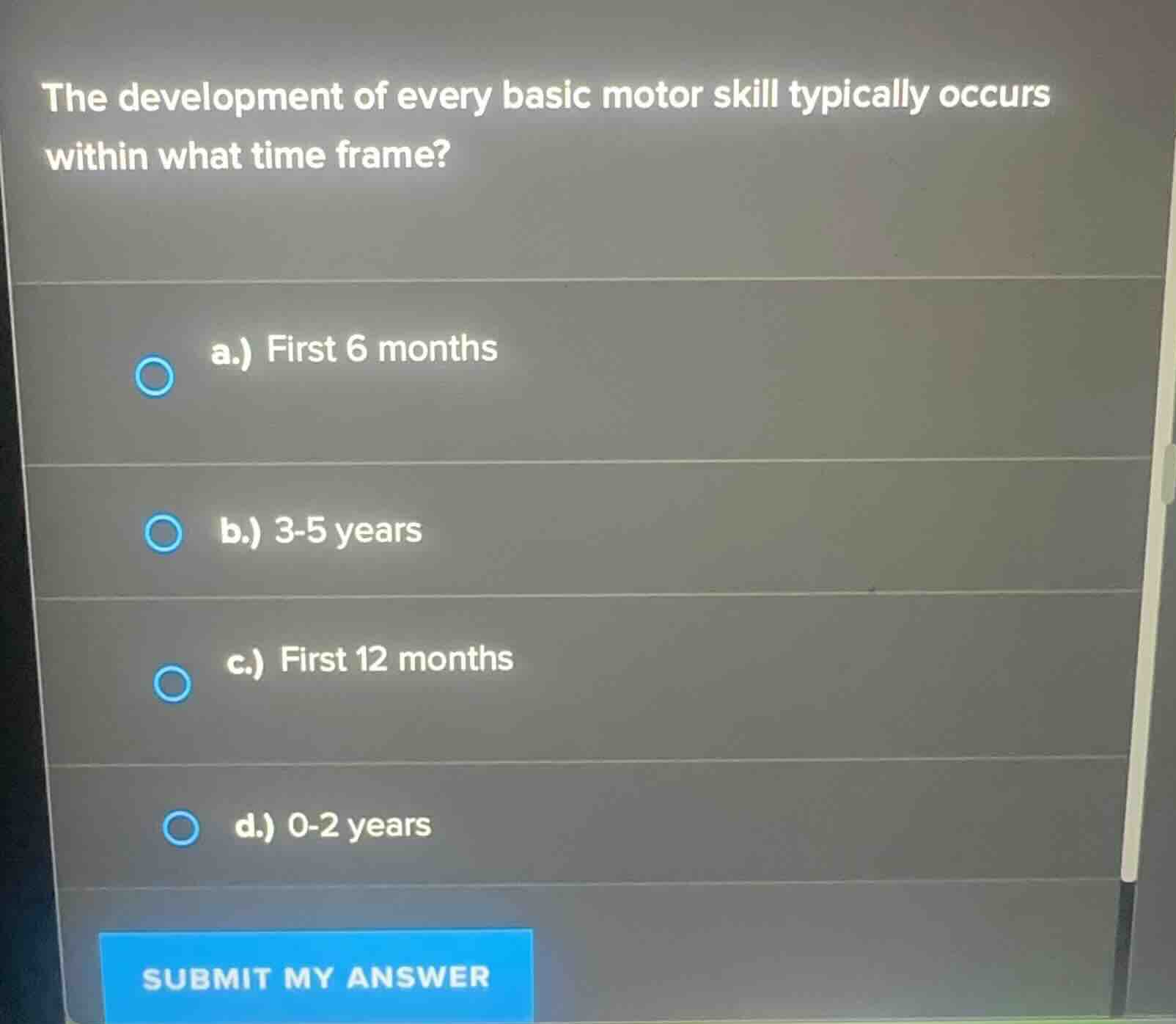
the development of every basic motor skill typically occurs within what time frame?
a.) first 6 months
b.) 3-5 years
c.) first 12 months
d.) 0-2 years
Analyze the developmental timeline of basic motor skills
In Developmental Stages, basic motor skills (also known as gross motor milestones) include actions such as lifting the head, rolling over, sitting up without support, crawling, standing, and walking.
Evaluate the options against developmental milestones
- First 6 months: Infants typically master head control, rolling, and beginning to sit with support, but walking and standing independently occur later.
- First 12 months: While many infants learn to walk by 12 months, the normal range for independent walking and stable standing extends well into the second year (up to 18 months or more).
- 0-2 years: This range (infancy and toddlerhood) fully encompasses the normal developmental windows for all basic gross motor skills, including independent walking, running, and climbing stairs.
- 3-5 years: This period is associated with fine-tuning motor skills (like hopping, skipping, and throwing), which are considered advanced rather than basic foundational motor skills.
Determine the most comprehensive and accurate range
The timeframe of 0-2 years (option d) is the standard developmental window during which every basic motor skill typically emerges and is established.

Snap & solve any problem in the app
Get step-by-step solutions on Sovi AI
Photo-based solutions with guided steps
Explore more problems and detailed explanations
- a.) First 6 months
- b.) 3-5 years
- c.) First 12 months
- d.) 0-2 years (Correct answer)