QUESTION IMAGE
Question
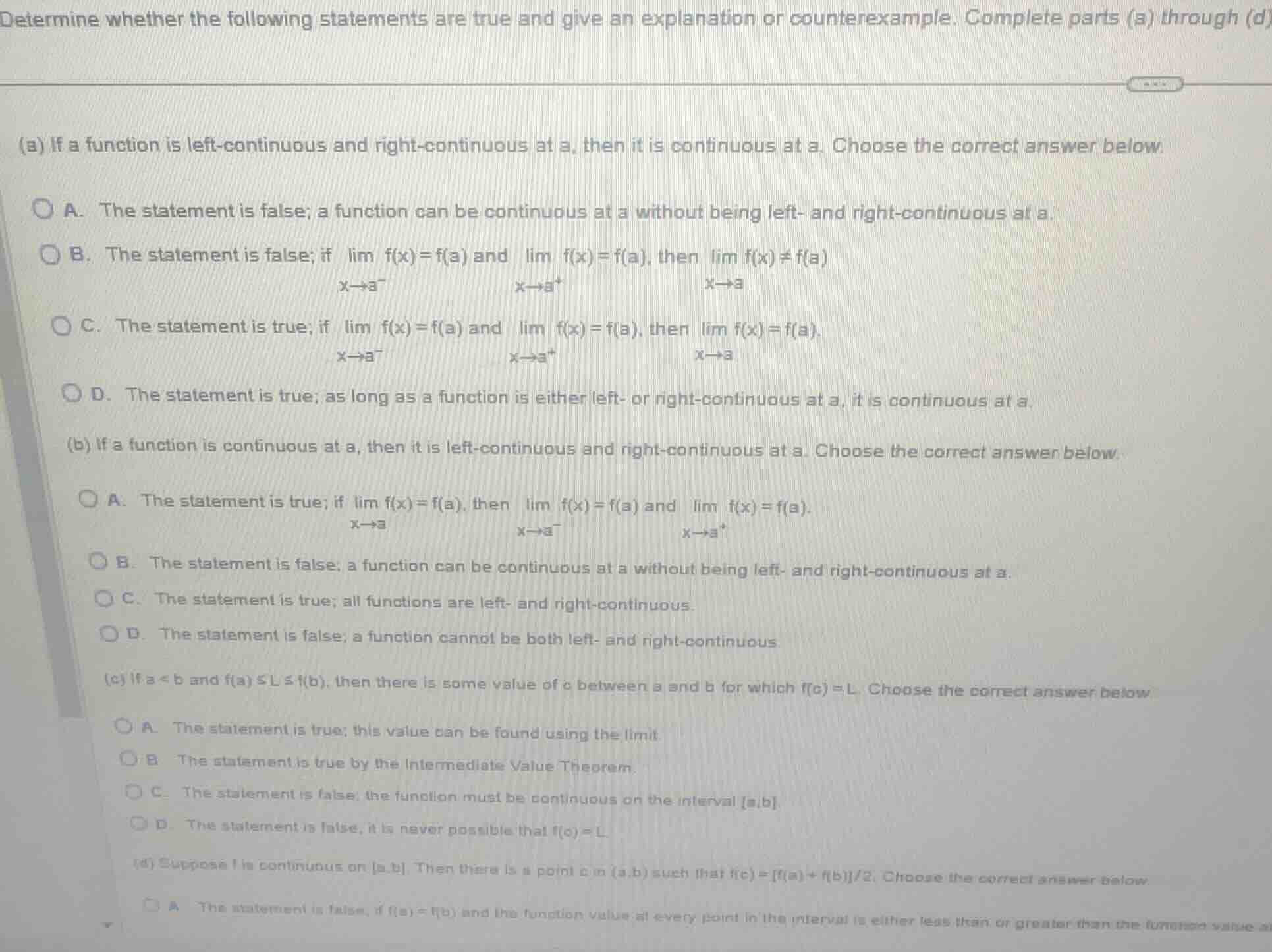
determine whether the following statements are true and give an explanation or counterexample. complete parts (a) through (d).
(a) if a function is left-continuous and right-continuous at a, then it is continuous at a. choose the correct answer below.
a. the statement is false; a function can be continuous at a without being left- and right-continuous at a.
b. the statement is false; if \\(\lim_{x \to a^-} f(x) = f(a)\\) and \\(\lim_{x \to a^+} f(x) = f(a)\\), then \\(\lim_{x \to a} f(x) \
eq f(a)\\).
c. the statement is true; if \\(\lim_{x \to a^-} f(x) = f(a)\\) and \\(\lim_{x \to a^+} f(x) = f(a)\\), then \\(\lim_{x \to a} f(x) = f(a)\\).
d. the statement is true; as long as a function is either left- or right-continuous at a, it is continuous at a.
(b) if a function is continuous at a, then it is left-continuous and right-continuous at a. choose the correct answer below.
a. the statement is true; if \\(\lim_{x \to a} f(x) = f(a)\\), then \\(\lim_{x \to a^-} f(x) = f(a)\\) and \\(\lim_{x \to a^+} f(x) = f(a)\\).
b. the statement is false; a function can be continuous at a without being left- and right-continuous at a.
c. the statement is true; all functions are left- and right-continuous.
d. the statement is false; a function cannot be both left- and right-continuous.
(c) if \\(a < b\\) and \\(f(a) \le l \le f(b)\\), then there is some value of c between a and b for which \\(f(c) = l\\). choose the correct answer below.
a. the statement is true; this value can be found using the limit.
b. the statement is true by the intermediate value theorem.
c. the statement is false; the function must be continuous on the interval \\(a, b\\).
d. the statement is false; it is never possible that \\(f(c) = l\\).
(d) suppose f is continuous on \\(a, b\\). then there is a point c in \\((a, b)\\) such that \\(f(c) = f(a) + f(b)/2\\). choose the correct answer below.
a. the statement is false, if \\(f(a) = f(b)\\) and the function value at every point in the interval is either less than or greater than the function value at
Analyze part (a)
The statement is: "If a function is left-continuous and right-continuous at \(a\), then it is continuous at \(a\)."
- Left-continuous at \(a\) means \(\lim_{x \to a^-} f(x) = f(a)\).
- Right-continuous at \(a\) means \(\lim_{x \to a^+} f(x) = f(a)\).
- If both hold, then \(\lim_{x \to a^-} f(x) = \lim_{x \to a^+} f(x) = f(a)\), which implies \(\lim_{x \to a} f(x) = f(a)\). Thus, the function is continuous at \(a\).
- This matches option C.
Analyze part (b)
The statement is: "If a function is continuous at \(a\), then it is left-continuous and right-continuous at \(a\)."
- Continuity at \(a\) means \(\lim_{x \to a} f(x) = f(a)\).
- This implies both one-sided limits exist and equal \(f(a)\): \(\lim_{x \to a^-} f(x) = f(a)\) and \(\lim_{x \to a^+} f(x) = f(a)\).
- This matches option A.
Analyze part (c)
The statement is: "If \(a < b\) and \(f(a) \le L \le f(b)\), then there is some value of \(c\) between \(a\) and \(b\) for which \(f(c) = L\)."
- This statement describes the Intermediate Value Theorem, but it lacks the crucial assumption that \(f\) must be continuous on the closed interval \([a, b]\).
- Without continuity, a function can jump over the value \(L\). Thus, the statement is false, and the counterexample requires the function to be continuous.
- This matches option C.
Analyze part (d)
The statement is: "Suppose \(f\) is continuous on \([a, b]\). Then there is a point \(c\) in \((a, b)\) such that \(f(c) = [f(a) + f(b)]/2\)."
- The value \(M = \frac{f(a) + f(b)}{2}\) is the average of \(f(a)\) and \(f(b)\), which lies strictly between \(f(a)\) and \(f(b)\) if \(f(a)
e f(b)\).
- If \(f(a) = f(b)\), then \(M = f(a) = f(b)\). If \(f\) is a constant function, then \(f(c) = f(a)\) for all \(c \in (a, b)\). If \(f\) is not constant but \(f(a) = f(b)\), there might not be a point \(c \in (a, b)\) where \(f(c) = f(a)\) (for example, a symmetric dome shape where the peak is above \(f(a)\) and no other point equals \(f(a)\) except the endpoints).
- Specifically, if \(f(a) = f(b)\), the function value at every point in the interval could be strictly greater than or less than \(f(a)\) (except at the endpoints), meaning no such \(c\) exists in the open interval \((a, b)\).
- This matches option A.

Snap & solve any problem in the app
Get step-by-step solutions on Sovi AI
Photo-based solutions with guided steps
Explore more problems and detailed explanations
Question 1
- A. The statement is false; a function can be continuous at a without being left- and right-continuous at a.
- B. The statement is false; if \(\lim_{x \to a^-} f(x) = f(a)\) and \(\lim_{x \to a^+} f(x) = f(a)\), then \(\lim_{x \to a} f(x)
e f(a)\)
- C. The statement is true; if \(\lim_{x \to a^-} f(x) = f(a)\) and \(\lim_{x \to a^+} f(x) = f(a)\), then \(\lim_{x \to a} f(x) = f(a)\). (Correct answer)
- D. The statement is true; as long as a function is either left- or right-continuous at a, it is continuous at a.
Question 2
- A. The statement is true; if \(\lim_{x \to a} f(x) = f(a)\), then \(\lim_{x \to a^-} f(x) = f(a)\) and \(\lim_{x \to a^+} f(x) = f(a)\). (Correct answer)
- B. The statement is false; a function can be continuous at a without being left- and right-continuous at a.
- C. The statement is true; all functions are left- and right-continuous.
- D. The statement is false; a function cannot be both left- and right-continuous.
Question 3
- A. The statement is true; this value can be found using the limit.
- B. The statement is true by the Intermediate Value Theorem.
- C. The statement is false; the function must be continuous on the interval \([a, b]\). (Correct answer)
- D. The statement is false; it is never possible that f(c) = L.
Question 4
- A. The statement is false; if \(f(a) = f(b)\) and the function value at every point in the interval is either less than or greater than the function value at the endpoints, then no such \(c\) exists. (Correct answer)