QUESTION IMAGE
Question
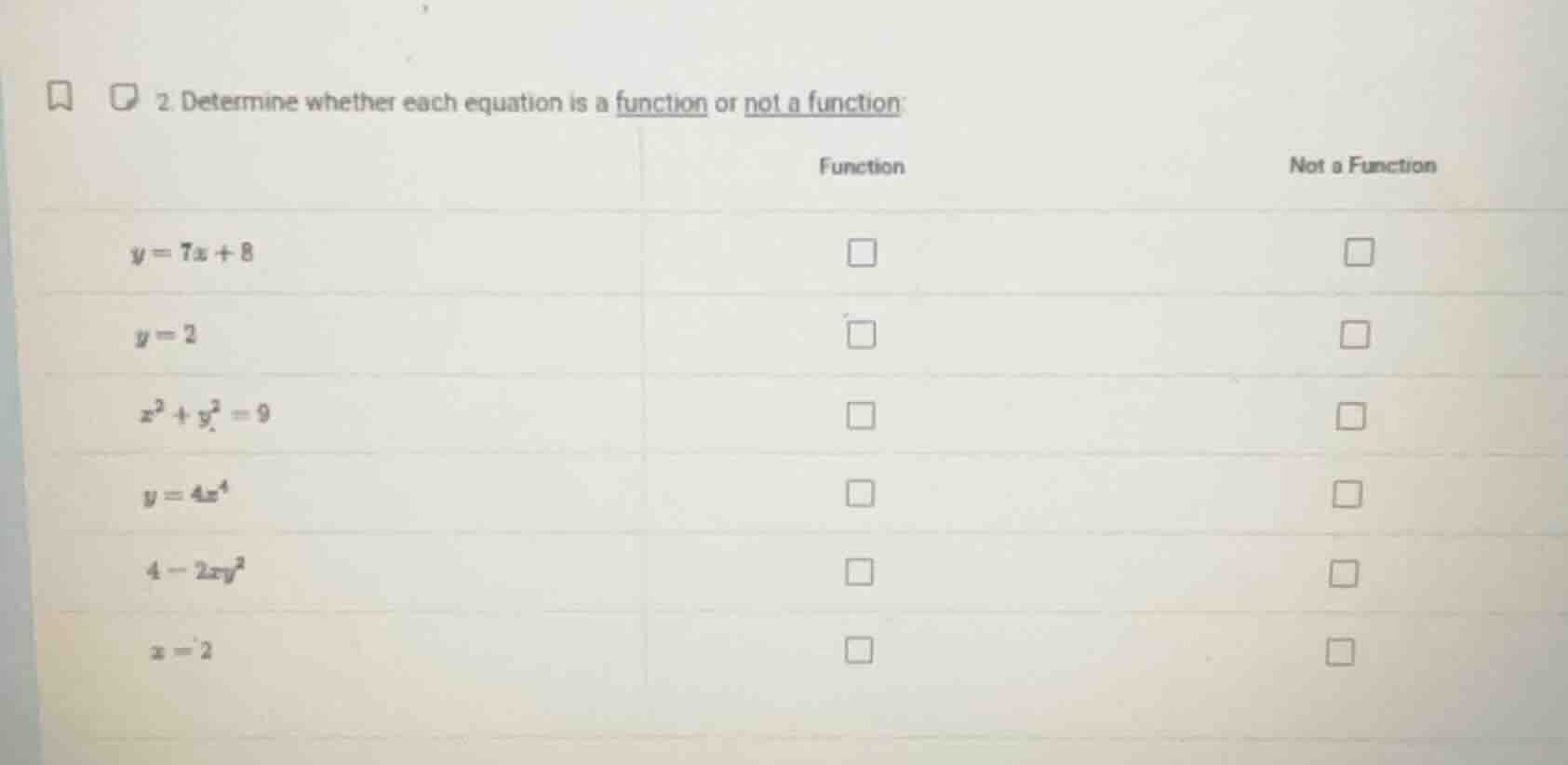
- determine whether each equation is a function or not a function:
| function | not a function | |
|---|---|---|
| $y = 2$ | $\square$ | $\square$ |
| $x^2 + y^2 = 9$ | $\square$ | $\square$ |
| $y = 4x^4$ | $\square$ | $\square$ |
| $4 - 2xy^2$ | $\square$ | $\square$ |
| $x = 2$ | $\square$ | $\square$ |
To determine if an equation is a function, we use the vertical line test: a relation is a function if every vertical line intersects its graph at most once. A function must assign exactly one output (\(y\)-value) for each input (\(x\)-value).
1. \( y = 7x + 8 \)
This is a linear equation (slope-intercept form). For any \( x \), there is exactly one \( y \). Passes the vertical line test.
Classification: Function
2. \( y = 2 \)
This is a horizontal line. For any \( x \), \( y = 2 \) (only one \( y \)-value). Passes the vertical line test.
Classification: Function
3. \( x^2 + y^2 = 9 \)
This is the equation of a circle (radius 3, center at the origin). A vertical line (e.g., \( x = 0 \)) intersects the circle at two points (\( y = 3 \) and \( y = -3 \)). Fails the vertical line test.
Classification: Not a Function
4. \( y = 4x^4 \)
This is a polynomial equation. For any \( x \), there is exactly one \( y \) (since \( x^4 \) is non-negative, and multiplying by 4 and taking the 4th power gives a unique \( y \)). Passes the vertical line test.
Classification: Function
5. \( 4 = 2xy^2 \) (rewritten: \( y^2 = \frac{2}{x} \))
For a given \( x \) (e.g., \( x = 1 \)), \( y^2 = 2 \) implies \( y = \sqrt{2} \) or \( y = -\sqrt{2} \). Two \( y \)-values for one \( x \). Fails the vertical line test.
Classification: Not a Function
6. \( x = 2 \)
This is a vertical line. For \( x = 2 \), \( y \) can be any real number (infinite \( y \)-values for one \( x \)). Fails the vertical line test.
Classification: Not a Function
Final Classifications:
| Equation | Function | Not a Function |
|---|---|---|
| \( y = 2 \) | ✅ | ❌ |
| \( x^2 + y^2 = 9 \) | ❌ | ✅ |
| \( y = 4x^4 \) | ✅ | ❌ |
| \( 4 = 2xy^2 \) | ❌ | ✅ |
| \( x = 2 \) | ❌ | ✅ |
(Mark the appropriate boxes in the table with ✅ for the correct category.)

Snap & solve any problem in the app
Get step-by-step solutions on Sovi AI
Photo-based solutions with guided steps
Explore more problems and detailed explanations
To determine if an equation is a function, we use the vertical line test: a relation is a function if every vertical line intersects its graph at most once. A function must assign exactly one output (\(y\)-value) for each input (\(x\)-value).
1. \( y = 7x + 8 \)
This is a linear equation (slope-intercept form). For any \( x \), there is exactly one \( y \). Passes the vertical line test.
Classification: Function
2. \( y = 2 \)
This is a horizontal line. For any \( x \), \( y = 2 \) (only one \( y \)-value). Passes the vertical line test.
Classification: Function
3. \( x^2 + y^2 = 9 \)
This is the equation of a circle (radius 3, center at the origin). A vertical line (e.g., \( x = 0 \)) intersects the circle at two points (\( y = 3 \) and \( y = -3 \)). Fails the vertical line test.
Classification: Not a Function
4. \( y = 4x^4 \)
This is a polynomial equation. For any \( x \), there is exactly one \( y \) (since \( x^4 \) is non-negative, and multiplying by 4 and taking the 4th power gives a unique \( y \)). Passes the vertical line test.
Classification: Function
5. \( 4 = 2xy^2 \) (rewritten: \( y^2 = \frac{2}{x} \))
For a given \( x \) (e.g., \( x = 1 \)), \( y^2 = 2 \) implies \( y = \sqrt{2} \) or \( y = -\sqrt{2} \). Two \( y \)-values for one \( x \). Fails the vertical line test.
Classification: Not a Function
6. \( x = 2 \)
This is a vertical line. For \( x = 2 \), \( y \) can be any real number (infinite \( y \)-values for one \( x \)). Fails the vertical line test.
Classification: Not a Function
Final Classifications:
| Equation | Function | Not a Function |
|---|---|---|
| \( y = 2 \) | ✅ | ❌ |
| \( x^2 + y^2 = 9 \) | ❌ | ✅ |
| \( y = 4x^4 \) | ✅ | ❌ |
| \( 4 = 2xy^2 \) | ❌ | ✅ |
| \( x = 2 \) | ❌ | ✅ |
(Mark the appropriate boxes in the table with ✅ for the correct category.)