QUESTION IMAGE
Question
determine the limit of the sequence or show that the sequence diverges. if it converges, find its limit.
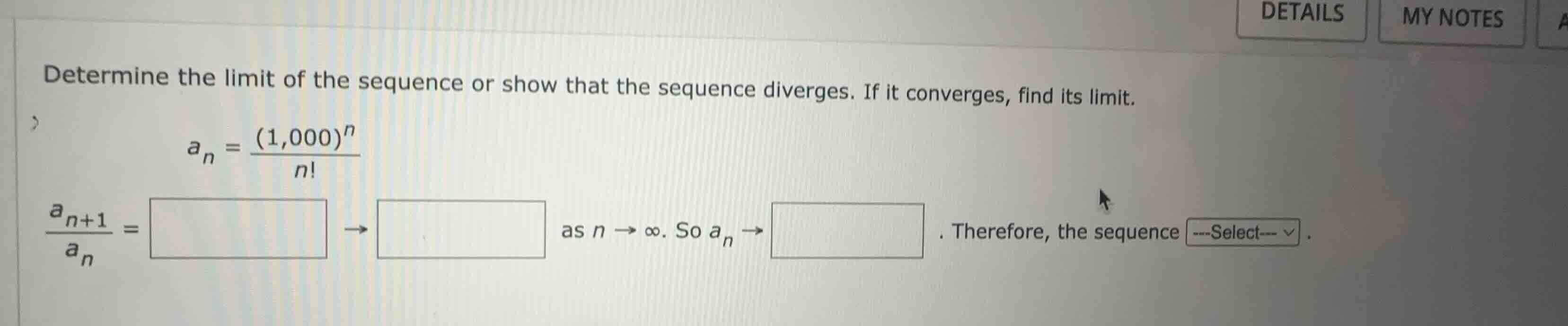
\\a_n = \frac{(1,000)^n}{n!}\\
\\\frac{a_{n+1}}{a_n} = \text{box} \to \text{box} \text{ as } n \to \infty. \text{ so } a_n \to \text{box}. \text{ therefore, the sequence } \text{select}.\\
Compute the ratio of consecutive terms
Evaluate the limit of the ratio
Determine sequence convergence

Snap & solve any problem in the app
Get step-by-step solutions on Sovi AI
Photo-based solutions with guided steps
Explore more problems and detailed explanations
Determine the limit of the sequence or show that the sequence diverges. If it converges, find its limit.
\(\frac{a_{n+1}}{a_n} =\) <blank>\(\frac{1,000}{n+1}\)</blank> \(\to\) <blank>\(0\)</blank> as \(n \to \infty\). So \(a_n \to\) <blank>\(0\)</blank>. Therefore, the sequence <blank>converges</blank>.