QUESTION IMAGE
Question
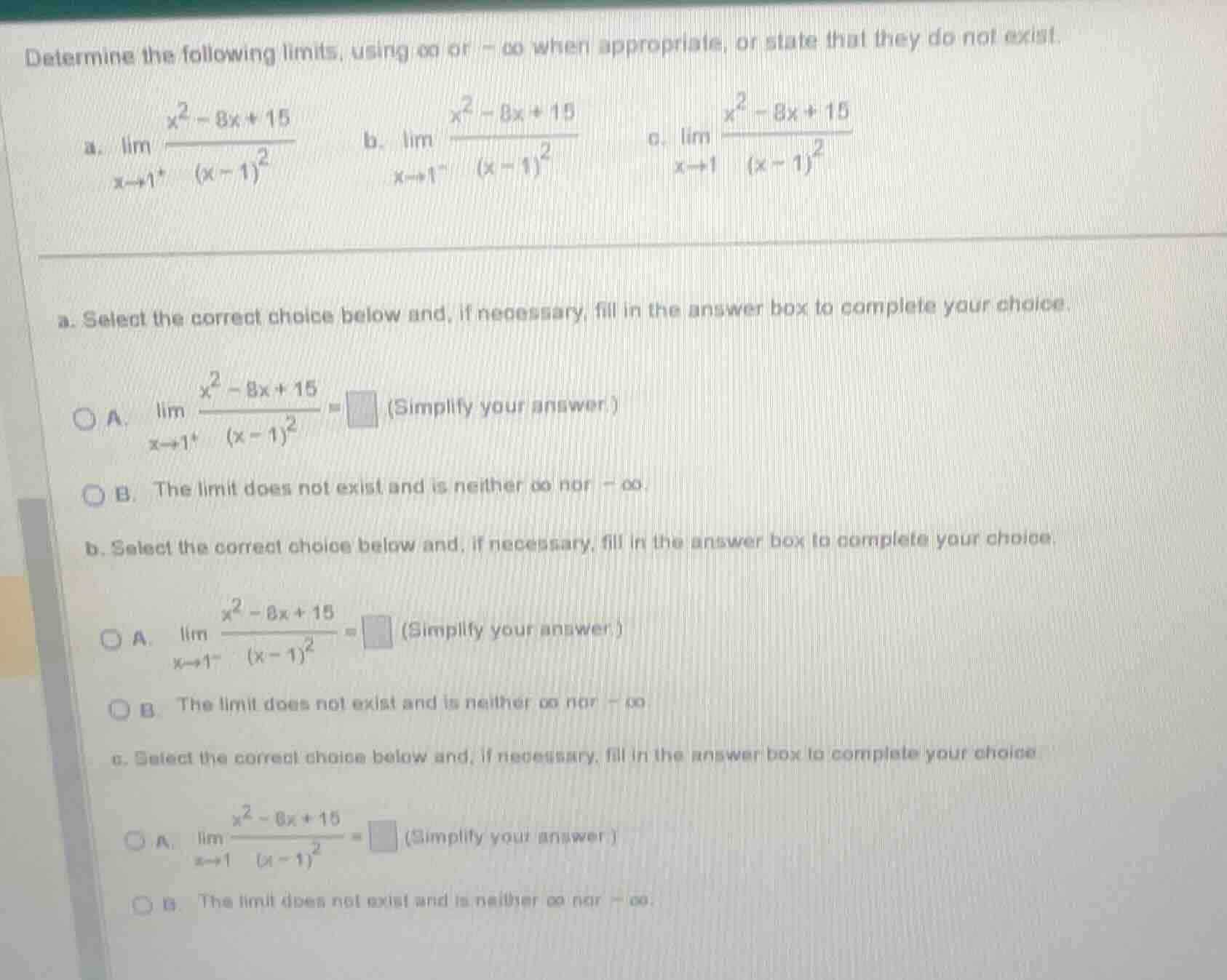
determine the following limits, using \\(\infty\\) or \\(-\infty\\) when appropriate, or state that they do not exist.
a. \\(\lim_{x \to 1^+} \frac{x^2 - 8x + 15}{(x - 1)^2}\\)
b. \\(\lim_{x \to 1^-} \frac{x^2 - 8x + 15}{(x - 1)^2}\\)
c. \\(\lim_{x \to 1} \frac{x^2 - 8x + 15}{(x - 1)^2}\\)
a. select the correct choice below and, if necessary, fill in the answer box to complete your choice.
a. \\(\lim_{x \to 1^+} \frac{x^2 - 8x + 15}{(x - 1)^2} = \\) (simplify your answer.)
b. the limit does not exist and is neither \\(\infty\\) nor \\(-\infty\\).
b. select the correct choice below and, if necessary, fill in the answer box to complete your choice.
a. \\(\lim_{x \to 1^-} \frac{x^2 - 8x + 15}{(x - 1)^2} = \\) (simplify your answer.)
b. the limit does not exist and is neither \\(\infty\\) nor \\(-\infty\\).
c. select the correct choice below and, if necessary, fill in the answer box to complete your choice.
a. \\(\lim_{x \to 1} \frac{x^2 - 8x + 15}{(x - 1)^2} = \\) (simplify your answer.)
b. the limit does not exist and is neither \\(\infty\\) nor \\(-\infty\\).
Evaluate the limit of the numerator and denominator as \(x \to 1\)
Analyze the sign of the function near \(x = 1\)
For all \(x
eq 1\), \((x - 1)^2 > 0\).
Since the numerator is positive (\(8 > 0\)) and the denominator is positive and approaches \(0\) as \(x \to 1^+\) and \(x \to 1^-\):
Determine the two-sided limit
Since both one-sided limits are \(\infty\):

Snap & solve any problem in the app
Get step-by-step solutions on Sovi AI
Photo-based solutions with guided steps
Explore more problems and detailed explanations
Question a
- A. \(\lim_{x \to 1^+} \frac{x^2 - 8x + 15}{(x - 1)^2} = \infty\) (Correct answer)
- B. The limit does not exist and is neither \(\infty\) nor \(-\infty\).
Question b
- A. \(\lim_{x \to 1^-} \frac{x^2 - 8x + 15}{(x - 1)^2} = \infty\) (Correct answer)
- B. The limit does not exist and is neither \(\infty\) nor \(-\infty\).
Question c
- A. \(\lim_{x \to 1} \frac{x^2 - 8x + 15}{(x - 1)^2} = \infty\) (Correct answer)
- B. The limit does not exist and is neither \(\infty\) nor \(-\infty\).