QUESTION IMAGE
Question
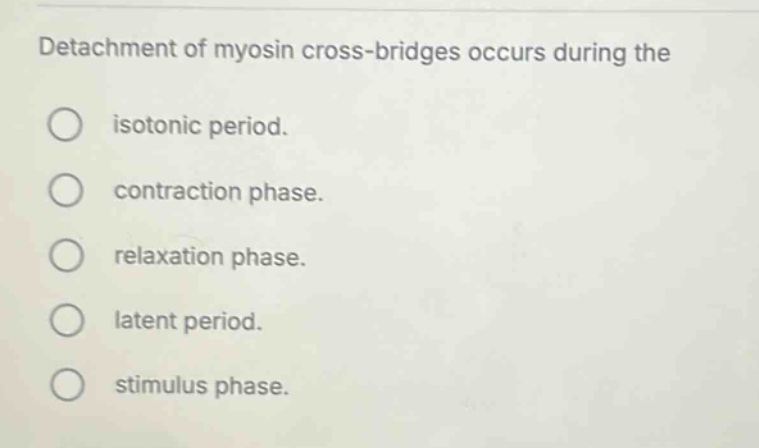
detachment of myosin cross-bridges occurs during the
isotonic period.
contraction phase.
relaxation phase.
latent period.
stimulus phase.
🆕 New Concept Discovered: Muscle Twitch Phases
Understanding the physiological stages of a muscle contraction.
Step 1: Understand the phases of a muscle twitch
A muscle twitch is a single, rapid contraction and relaxation cycle of a muscle fiber in response to a single stimulus. It consists of three main phases:
- Latent period: The delay between the stimulus and the start of tension generation. During this time, the action potential propagates and calcium ions are released from the sarcoplasmic reticulum.
- Contraction phase: Calcium binds to troponin, active sites on actin are exposed, cross-bridges form, and the muscle shortens or develops tension.
- Relaxation phase: Calcium ions are actively pumped back into the sarcoplasmic reticulum, troponin returns to its original shape, and myosin cross-bridges detach from actin, causing muscle tension to decrease.
Step 2: Identify when cross-bridge detachment occurs
During the relaxation phase, the active transport of calcium back into the sarcoplasmic reticulum leads to a decrease in sarcoplasmic calcium concentration. Without calcium bound to troponin, tropomyosin moves back to cover the active binding sites on actin. This prevents new cross-bridges from forming and leads to the detachment of existing myosin cross-bridges, allowing the muscle to return to its resting length.

Snap & solve any problem in the app
Get step-by-step solutions on Sovi AI
Photo-based solutions with guided steps
Explore more problems and detailed explanations
relaxation phase.