QUESTION IMAGE
Question
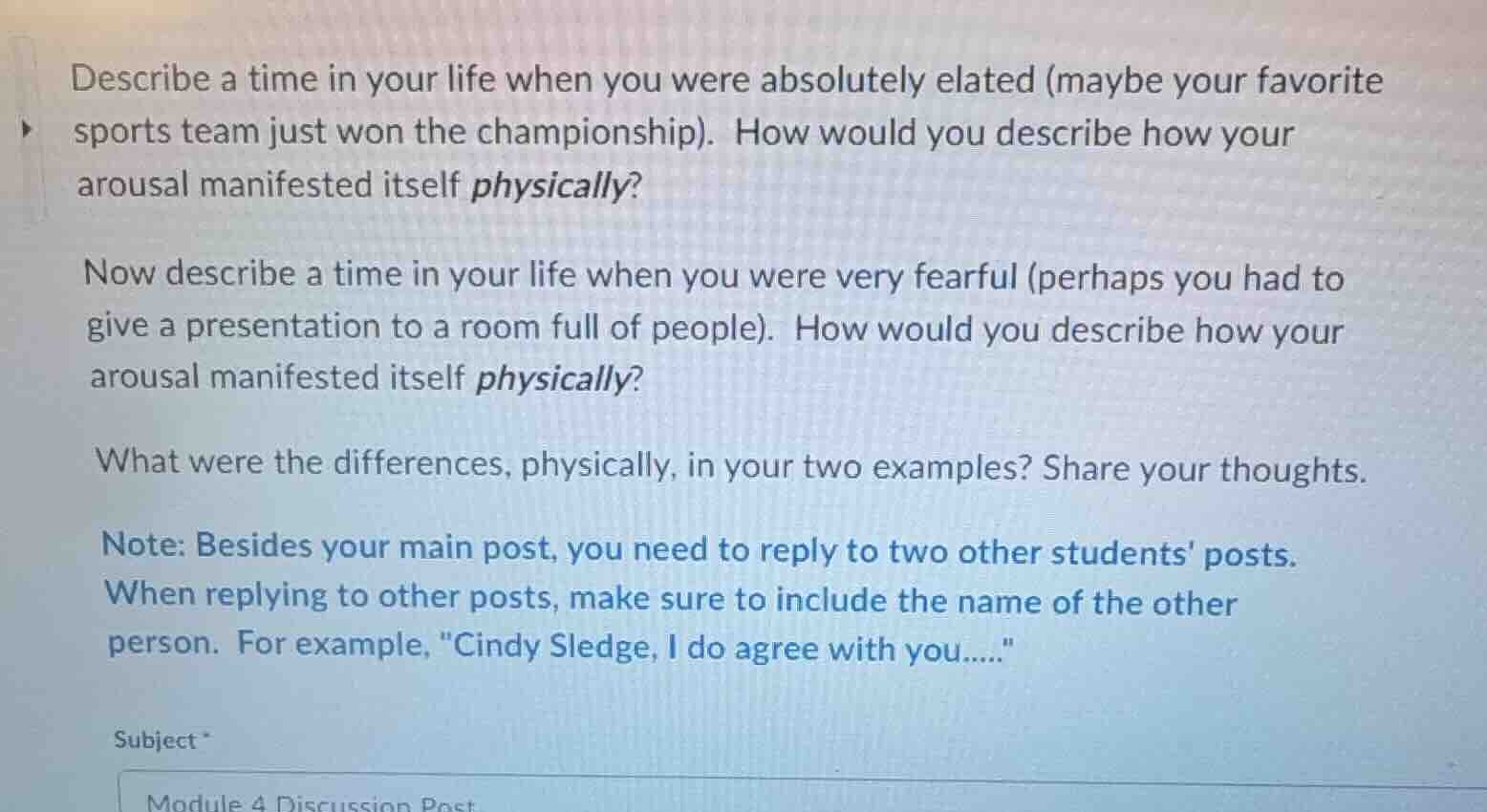
describe a time in your life when you were absolutely elated (maybe your favorite sports team just won the championship). how would you describe how your arousal manifested itself physically?
now describe a time in your life when you were very fearful (perhaps you had to give a presentation to a room full of people). how would you describe how your arousal manifested itself physically?
what were the differences, physically, in your two examples? share your thoughts.
note: besides your main post, you need to reply to two other students posts. when replying to other posts, make sure to include the name of the other person. for example, \cindy sledge, i do agree with you.....\
Identify the core psychological concepts
This discussion prompt asks us to analyze physiological arousal during two distinct emotional states: extreme joy (elation) and extreme fear. In psychology, physiological arousal is regulated by the autonomic nervous system, specifically the sympathetic and parasympathetic divisions.
Analyze physiological response to elation
When experiencing high elation (e.g., a favorite sports team winning), the sympathetic nervous system is activated. This results in physiological changes such as an increased heart rate, rapid breathing, a surge of adrenaline, and physical behaviors like jumping, shouting, or smiling.
Analyze physiological response to fear
When experiencing high fear (e.g., public speaking), the sympathetic nervous system is also activated, triggering the fight-or-flight response. This results in a rapid heart rate, shallow breathing, sweating (especially palms), muscle tension, and sometimes trembling or a dry mouth.
Compare the physical differences
While both states involve high sympathetic arousal (elevated heart rate and respiration), they differ in muscle tension, facial expressions, and cognitive appraisal. Elation is associated with approach behaviors (open posture, smiling, high energy release), whereas fear is associated with avoidance or protective behaviors (muscle tightness, trembling, closed posture).
Formulate a structured response
To fully address the prompt, we will structure a model discussion post that covers:
- An example of elation and its physical manifestation.
- An example of fear and its physical manifestation.
- A comparison of the physical differences between the two states.

Snap & solve any problem in the app
Get step-by-step solutions on Sovi AI
Photo-based solutions with guided steps
Explore more problems and detailed explanations
Here is a model response for your discussion post:
Elated State (Joy/Excitement):
- Scenario: When my school's basketball team won the state championship in the final second of the game.
- Physical Manifestation: My heart immediately began racing, and I felt a sudden surge of warm energy throughout my body. I instinctively jumped up and down, pumped my fists in the air, and screamed with excitement. My face felt warm, and I had a wide, uncontrollable smile.
Fearful State (Anxiety/Apprehension):
- Scenario: Giving a major presentation in front of a large school assembly.
- Physical Manifestation: My heart was pounding heavily in my chest, but instead of feeling warm, my hands and feet felt cold and clammy. My stomach felt like it was knotted up, my throat felt dry, and my hands trembled slightly when holding my notes. My breathing was shallow and rapid.
Physical Differences and Comparison:
While both experiences triggered high physiological arousal (a rapid heart rate and increased breathing due to the activation of the sympathetic nervous system), the physical sensations felt very different. During elation, the arousal manifested as an outward release of positive energy, muscle relaxation after jumping, and approach-oriented behaviors (smiling, shouting). In contrast, during fear, the arousal felt restrictive, manifesting as intense muscle tension, trembling, cold sweat, and a protective, closed-off posture.