QUESTION IMAGE
Question
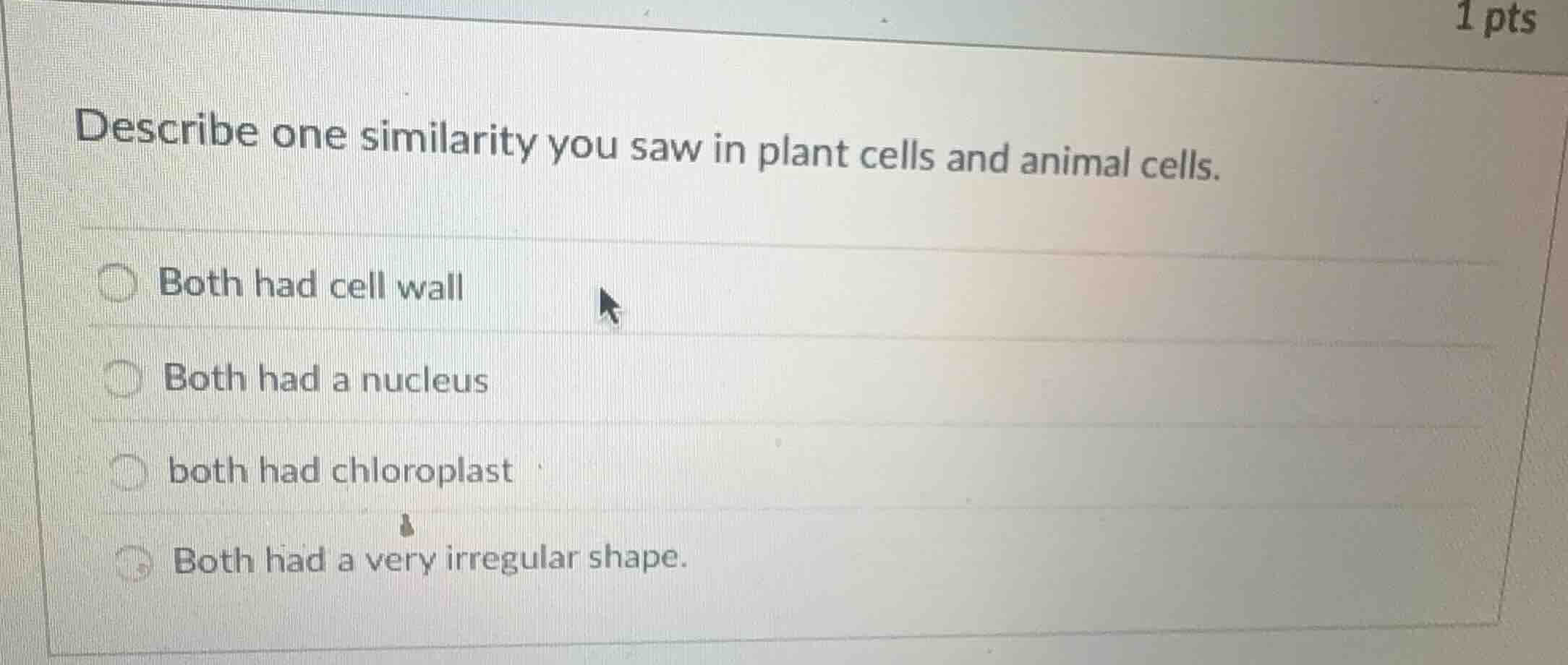
describe one similarity you saw in plant cells and animal cells.
both had cell wall
both had a nucleus
both had chloroplast
both had a very irregular shape.
🆕 New Concept Discovered: Eukaryotic Cell Structures
Comparing plant and animal cell organelles.
Step 1: Analyze the options for unique plant structures
Plant cells and animal cells are both eukaryotic, meaning they share many internal structures, but they also have distinct differences:
- Cell wall: This is a rigid outer layer found in plant cells to provide structural support. Animal cells do not have a cell wall; they only have a flexible cell membrane.
- Chloroplast: These are the organelles responsible for photosynthesis (converting sunlight into chemical energy). Since animals do not perform photosynthesis, animal cells do not contain chloroplasts.
Therefore, the options "Both had cell wall" and "both had chloroplast" are incorrect.
Step 2: Analyze cell shapes
- Cell shape: Plant cells typically have a fixed, rigid, and rectangular shape due to the presence of the cell wall. Animal cells generally have an irregular, round, or flexible shape because they lack a cell wall.
Therefore, the option "Both had a very irregular shape" is incorrect.
Step 3: Identify the shared structure
- Nucleus: Both plant and animal cells are eukaryotic cells. A defining feature of eukaryotic cells is that they store their genetic material (DNA) inside a membrane-bound nucleus.
Therefore, both plant and animal cells have a nucleus.

Snap & solve any problem in the app
Get step-by-step solutions on Sovi AI
Photo-based solutions with guided steps
Explore more problems and detailed explanations
Both had a nucleus