QUESTION IMAGE
Question
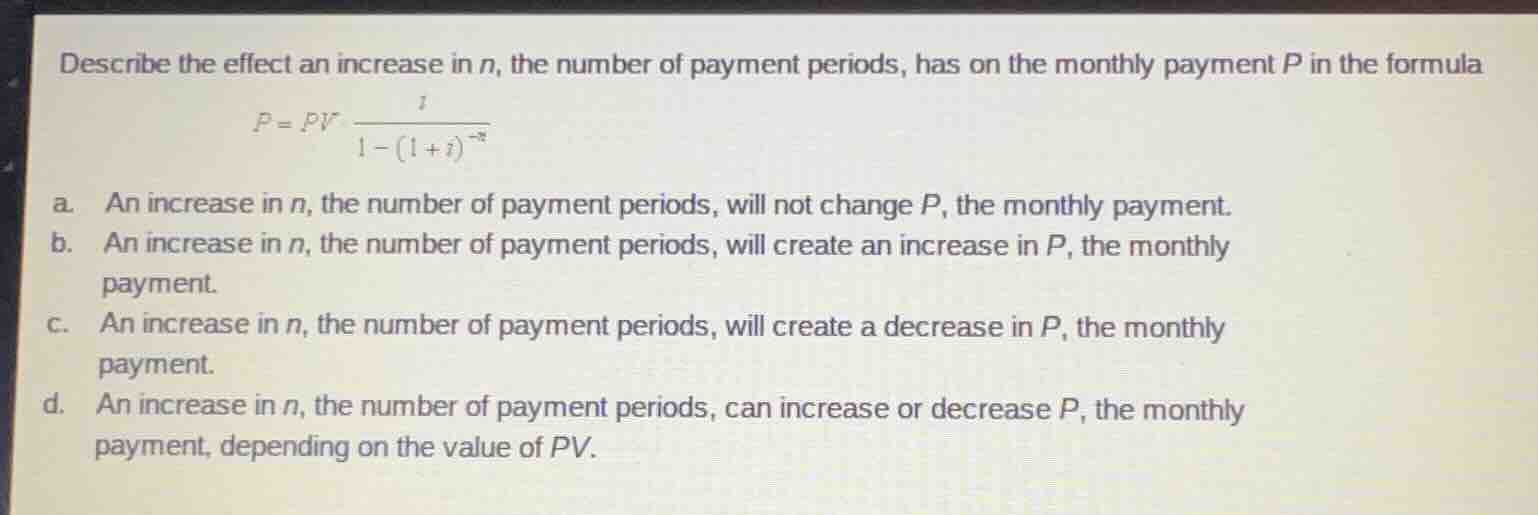
describe the effect an increase in (n), the number of payment periods, has on the monthly payment (p) in the formula
\\p = pv \frac{i}{1 - (1 + i)^{-n}}\\
a. an increase in (n), the number of payment periods, will not change (p), the monthly payment.
b. an increase in (n), the number of payment periods, will create an increase in (p), the monthly payment.
c. an increase in (n), the number of payment periods, will create a decrease in (p), the monthly payment.
d. an increase in (n), the number of payment periods, can increase or decrease (p), the monthly payment, depending on the value of (pv).
Analyze the given formula
Using the Loan Monthly Payment knowledge point
where \(PV > 0\), \(i > 0\), and \(n > 0\).
Determine the effect of increasing \(n\)
Using the Loan Monthly Payment knowledge point
Thus, an increase in \(n\) creates a decrease in \(P\).

Snap & solve any problem in the app
Get step-by-step solutions on Sovi AI
Photo-based solutions with guided steps
Explore more problems and detailed explanations
- a. An increase in \(n\), the number of payment periods, will not change \(P\), the monthly payment.
- b. An increase in \(n\), the number of payment periods, will create an increase in \(P\), the monthly payment.
- c. An increase in \(n\), the number of payment periods, will create a decrease in \(P\), the monthly payment. (Correct answer)
- d. An increase in \(n\), the number of payment periods, can increase or decrease \(P\), the monthly payment, depending on the value of \(PV\).