QUESTION IMAGE
Question
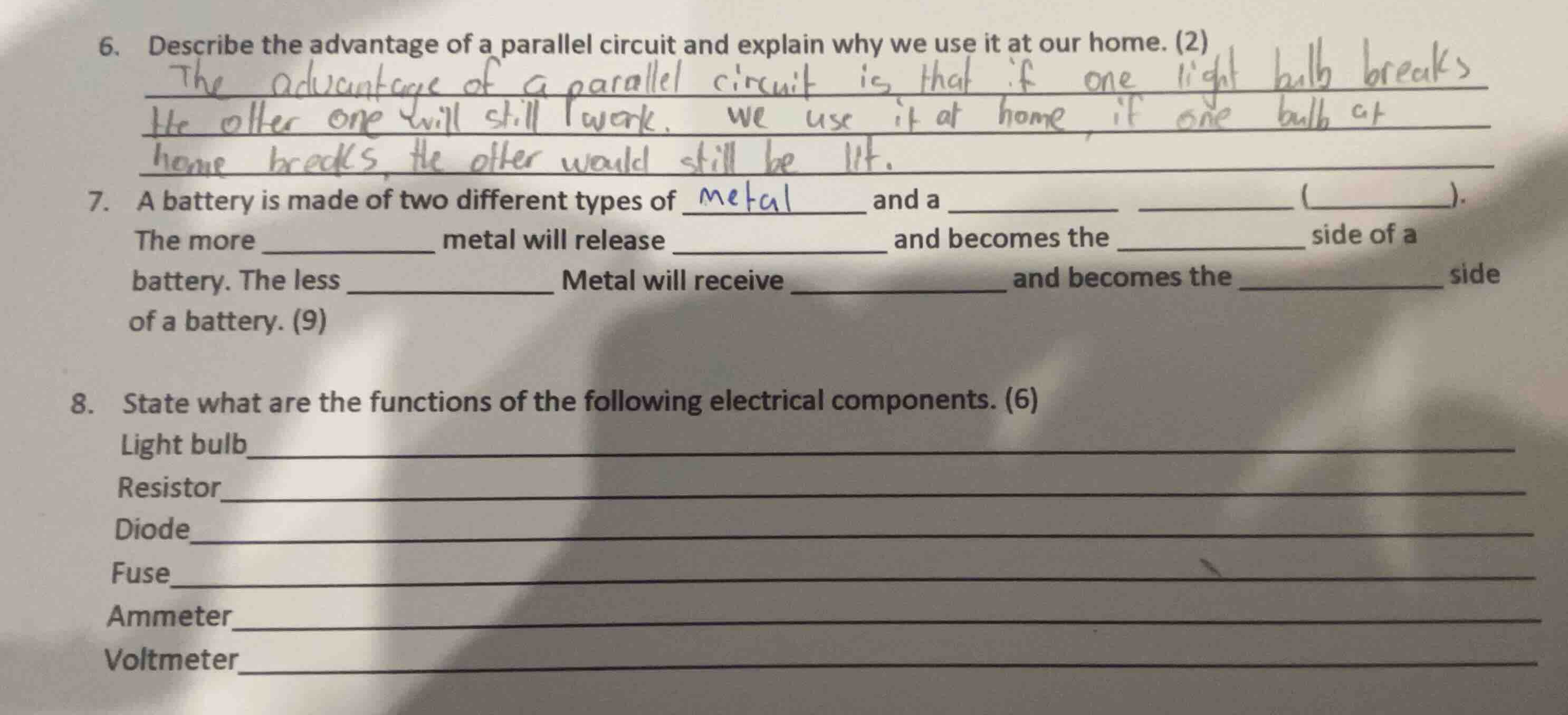
- describe the advantage of a parallel circuit and explain why we use it at our home. (2)
- a battery is made of two different types of metal and a ( ).
the more metal will release and becomes the side of a battery. the less metal will receive and becomes the side of a battery. (9)
- state what are the functions of the following electrical components. (6)
light bulb
resistor
diode
fuse
ammeter
voltmeter
Brief Explanations
The questions cover fundamental concepts in introductory physics and electrical engineering.
- Question 6 addresses parallel circuits, where components are connected along multiple paths, ensuring independent operation and constant voltage across each branch, which is ideal for household wiring.
- Question 7 describes the electrochemical principles of a simple galvanic cell (battery), where oxidation occurs at the more reactive metal (anode/negative terminal) releasing electrons, and reduction occurs at the less reactive metal (cathode/positive terminal) receiving electrons through an electrolyte.
- Question 8 defines the standard functions of basic passive and active electronic components, as well as electrical measurement instruments.

Snap & solve any problem in the app
Get step-by-step solutions on Sovi AI
Photo-based solutions with guided steps
Explore more problems and detailed explanations
- An advantage of a parallel circuit is that each electrical appliance can be operated independently; if one component breaks or is switched off, the other components in the circuit continue to function. We use it at home so that turning off or breaking one appliance (like a light bulb) does not shut down all other appliances in the house.
- A battery is made of two different types of metal and a chemical solution (electrolyte). The more reactive metal will release electrons and becomes the negative side of a battery. The less reactive metal will receive electrons and becomes the positive side of a battery.
8.
- Light bulb: Converts electrical energy into light (and heat) energy to provide illumination.
- Resistor: Limits or regulates the flow of electrical current in a circuit.
- Diode: Allows electric current to flow in only one direction.
- Fuse: Protects a circuit from excessive current by melting and breaking the circuit when the current exceeds a safe level.
- Ammeter: Measures the electric current flowing through a circuit.
- Voltmeter: Measures the electrical potential difference (voltage) between two points in a circuit.