QUESTION IMAGE
Question
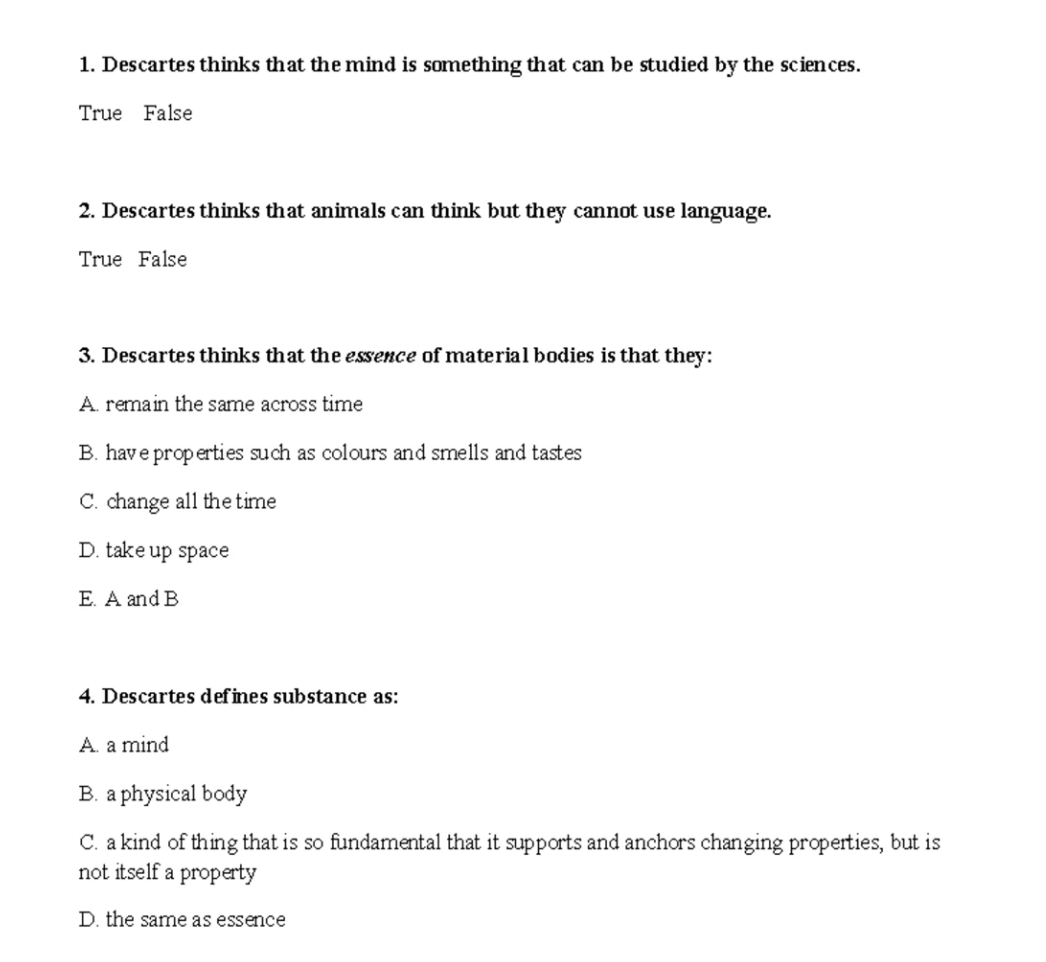
- descartes thinks that the mind is something that can be studied by the sciences.
true false
- descartes thinks that animals can think but they cannot use language.
true false
- descartes thinks that the essence of material bodies is that they:
a. remain the same across time
b. have properties such as colours and smells and tastes
c. change all the time
d. take up space
e. a and b
- descartes defines substance as:
a. a mind
b. a physical body
c. a kind of thing that is so fundamental that it supports and anchors changing properties, but is not itself a property
d. the same as essence
🆕 New Concept Discovered: Cartesian Dualism
The separation of mind (thinking) and body (extended matter).
Step 1: Analyze Question 1 (Mind and Science)
René Descartes is famous for Cartesian Dualism, which splits reality into two distinct substances:
- Res cogitans (thinking substance / the mind): Non-physical, lacks spatial extension, and cannot be measured or studied by the physical sciences of his time (which rely on geometry and mechanics).
- Res extensa (extended substance / physical matter): Can be measured, divided, and studied by the physical sciences.
Because the mind is non-physical and has no spatial extension, Descartes believed it cannot be studied by the physical sciences.
- Answer 1: False
Step 2: Analyze Question 2 (Animal Thought and Language)
Descartes viewed non-human animals as complex biological machines ("automata"). Because they lack a rational soul (mind):
- They cannot think or reason.
- They cannot use true language to express thoughts (though they can make mechanical sounds or reactions).
Therefore, the statement that animals can think but cannot use language is incorrect according to his philosophy.
- Answer 2: False
Step 3: Analyze Question 3 (Essence of Material Bodies)
For Descartes, the defining characteristic (essence) of all physical matter or material bodies is extension (taking up space in three dimensions: length, breadth, and depth).
- Sensory properties like colors, smells, and tastes (Option B) are secondary qualities and not the fundamental essence of matter (as demonstrated by his famous "wax argument," where these qualities change completely when wax melts, yet the wax remains).
- Therefore, the essence of material bodies is that they take up space.
- Answer 3: D. take up space
Step 4: Analyze Question 4 (Definition of Substance)
In Cartesian metaphysics, a substance is defined as an independent entity that can exist by itself and serves as the subject of various properties (modes or attributes), without being a property of something else. It is the underlying reality that supports and anchors changing properties (like shape, color, or size).
- Answer 4: C. a kind of thing that is so fundamental that it supports and anchors changing properties, but is not itself a property

Snap & solve any problem in the app
Get step-by-step solutions on Sovi AI
Photo-based solutions with guided steps
Explore more problems and detailed explanations
- False
- False
- D. take up space
- C. a kind of thing that is so fundamental that it supports and anchors changing properties, but is not itself a property