QUESTION IMAGE
Question
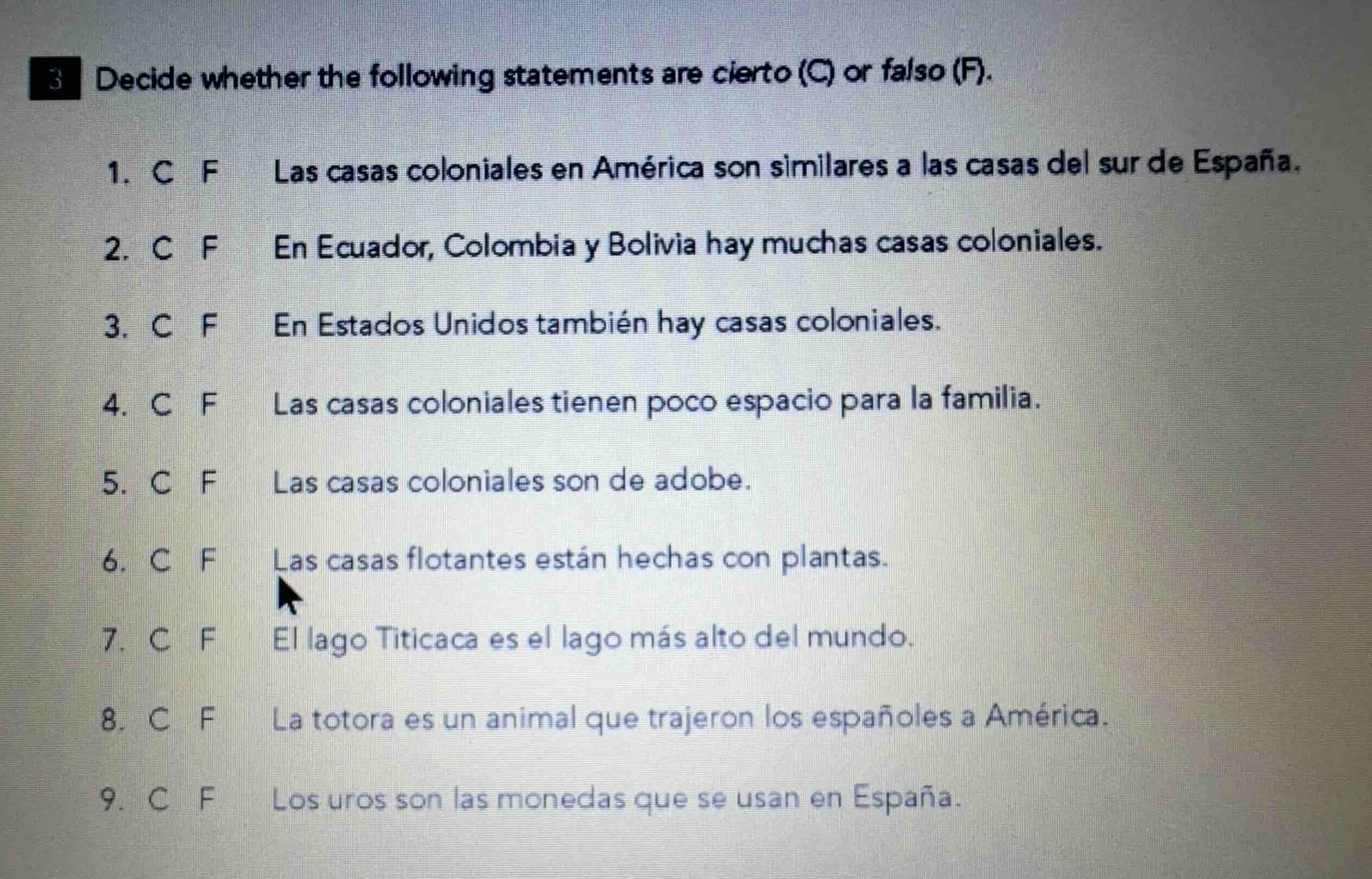
3 decide whether the following statements are cierto (c) or falso (f).
- c f las casas coloniales en américa son similares a las casas del sur de españa.
- c f en ecuador, colombia y bolivia hay muchas casas coloniales.
- c f en estados unidos también hay casas coloniales.
- c f las casas coloniales tienen poco espacio para la familia.
- c f las casas coloniales son de adobe.
- c f las casas flotantes están hechas con plantas.
- c f el lago titicaca es el lago más alto del mundo.
- c f la totora es un animal que trajeron los españoles a américa.
- c f los uros son las monedas que se usan en españa.
Analyze colonial housing statements
Using the Spanish Reading Comprehension knowledge point, we evaluate statements 1 through 5 regarding colonial architecture:
- Statement 1: "Las casas coloniales en América son similares a las casas del sur de España." (Colonial houses in America are similar to houses in southern Spain.) This is true (Cierto), as Spanish colonial architecture was heavily influenced by Andalusian (southern Spanish) styles, featuring central patios and white walls.
- Statement 2: "En Ecuador, Colombia y Bolivia hay muchas casas colonialies." (In Ecuador, Colombia, and Bolivia there are many colonial houses.) This is true (Cierto), as cities like Quito, Cartagena, and Sucre are famous for preserving colonial architecture.
- Statement 3: "En Estados Unidos también hay casas coloniales." (In the United States there are also colonial houses.) This is true (Cierto), particularly in areas with Spanish colonial history (like Florida, New Mexico, and California) as well as British colonial homes in the East.
- Statement 4: "Las casas coloniales tienen poco espacio para la familia." (Colonial houses have little space for the family.) This is false (Falso), as colonial homes were typically large, spacious, and built around central courtyards to accommodate extended families.
- Statement 5: "Las casas coloniales son de adobe." (Colonial houses are made of adobe.) This is true (Cierto), as adobe (sun-dried mud brick) was a primary building material used during the colonial period in many regions of the Americas.
Analyze Lake Titicaca and Uros statements
Using the Spanish Reading Comprehension knowledge point, we evaluate statements 6 through 9 regarding Lake Titicaca and the Uros people:
- Statement 6: "Las casas flotantes están hechas con plantas." (The floating houses are made of plants.) This is true (Cierto), as the floating islands and houses of the Uros people on Lake Titicaca are constructed using totora reeds (a wetland plant).
- Statement 7: "El lago Titicaca es el lago más alto del mundo." (Lake Titicaca is the highest lake in the world.) This is false (Falso) in absolute terms, though it is famously the highest navigable lake in the world. In general school curricula, it is often simplified, but strictly speaking, there are higher non-navigable lakes. However, in standard Spanish cultural readings, it is celebrated as the highest navigable body of water. Let's look at the exact phrasing: "el lago más alto del mundo" is technically false because smaller crater lakes are higher, but in the context of standard textbook readings, it is often marked as true if referring to navigable lakes. Let's evaluate standard textbook facts: "El lago Titicaca es el lago navegable más alto del mundo." Without "navegable", the statement is technically false (F).
- Statement 8: "La totora es un animal que trajeron los españoles a América." (Totora is an animal that the Spaniards brought to America.) This is false (Falso). Totora is a native aquatic plant (reed), not an animal.
- Statement 9: "Los uros son las monedas que se…

Snap & solve any problem in the app
Get step-by-step solutions on Sovi AI
Photo-based solutions with guided steps
Explore more problems and detailed explanations
| No. | Answer |
|---|---|
| 2 | C |
| 3 | C |
| 4 | F |
| 5 | C |
| 6 | C |
| 7 | F |
| 8 | F |
| 9 | F |