QUESTION IMAGE
Question
day 3
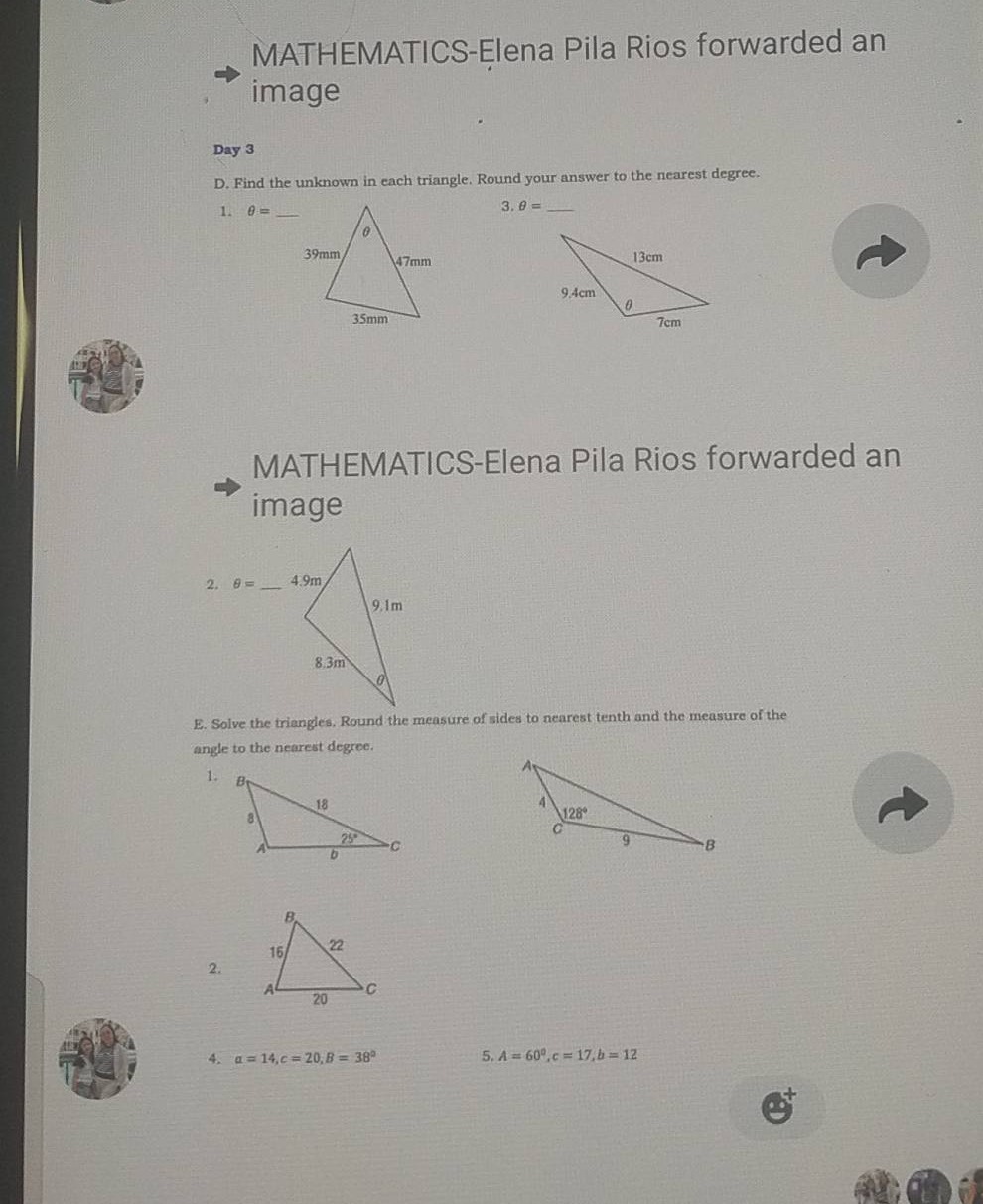
d. find the unknown in each triangle. round your answer to the nearest degree.
- \\(\theta = \underline{\quad\quad}\\)
- \\(\theta = \underline{\quad\quad}\\)
- \\(\theta = \underline{\quad\quad}\\)
e. solve the triangles. round the measure of sides to nearest tenth and the measure of the angle to the nearest degree.
1.
2.
3.
- \\(a = 14, c = 20, b = 38^{\circ}\\)
- \\(a = 60^{\circ}, c = 17, b = 12\\)
🆕 New Concept Discovered: Law of Cosines
Solving non-right triangles using side lengths
---
Step 1: Identify the appropriate rule
The given triangles are oblique (non-right) triangles where all three side lengths are known, and we need to find an unknown angle \(\theta\).
When we know all three sides of a triangle (Side-Side-Side, or SSS), we cannot use basic right-triangle trigonometry (SOH CAH TOA). Instead, we use the Law of Cosines:
To find an angle, we can rearrange this formula to solve for the cosine of the angle:
Here, the "opposite side" is the side directly across from the angle \(\theta\), while \(\text{side}_1\) and \(\text{side}_2\) are the two sides adjacent to (touching) the angle \(\theta\).
---
Step 2: Solve Problem 1
For the first triangle:
- The angle we want to find is \(\theta\).
- The side opposite to \(\theta\) is \(35\text{ mm}\).
- The two adjacent sides are \(39\text{ mm}\) and \(47\text{ mm}\).
Substitute these values into the rearranged Law of Cosines:
Calculate the terms:
Substitute back into the equation:
Find the inverse cosine to get \(\theta\):
Rounding to the nearest degree gives:
---
Step 3: Solve Problem 2
For the second triangle:
- The angle we want to find is \(\theta\).
- The side opposite to \(\theta\) is \(4.9\text{ m}\).
- The two adjacent sides are \(9.1\text{ m}\) and \(8.3\text{ m}\).
Substitute these values into the formula:
Calculate the terms:
Substitute back into the equation:
Find the inverse cosine to get \(\theta\):
Rounding to the nearest degree gives:
---
Step 4: Solve Problem 3
For the third triangle:
- The angle we want to find is \(\theta\).
- The side opposite to \(\theta\) is \(13\text{ cm}\).
- The two adjacent sides are \(9.4\text{ cm}\) and \(7\text{ cm}\).
Substitute these values into the formula:
Calculate the terms:
Substitute back into the equation:
(Note: A negative cosine value means the angle is obtuse, or greater than \(90^\circ\).)
Find the inverse cosine to get \(\theta\):
Rounding to the nearest degree gives:
---

Snap & solve any problem in the app
Get step-by-step solutions on Sovi AI
Photo-based solutions with guided steps
Explore more problems and detailed explanations
- \(\theta = 47^\circ\)
- \(\theta = 32^\circ\)
- \(\theta = 104^\circ\)