QUESTION IMAGE
Question
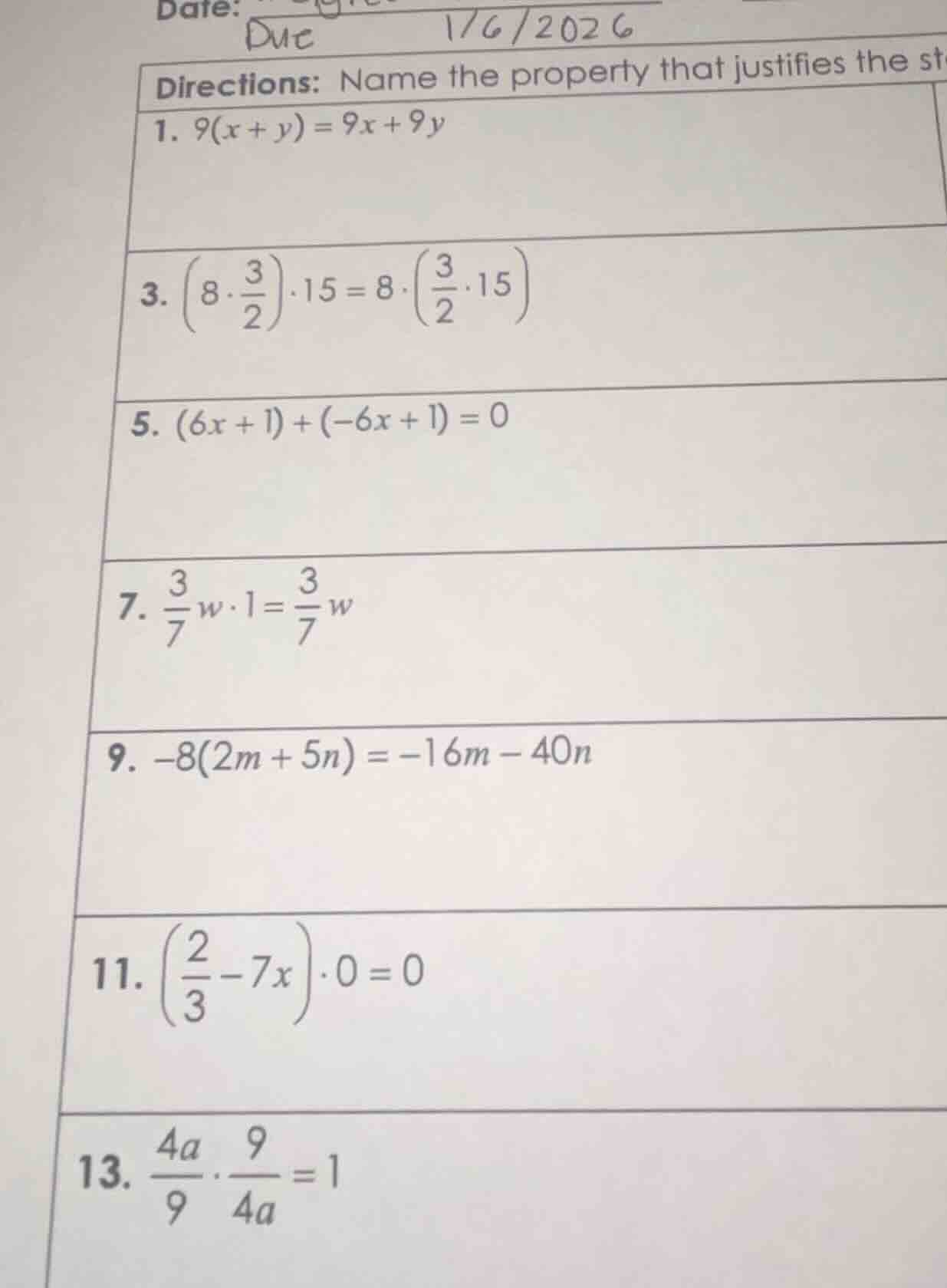
date: due 1/6/2026 directions: name the property that justifies the st 1. $9(x + y) = 9x + 9y$ 3. $left(8 cdot \frac{3}{2}
ight) cdot 15 = 8 cdot left(\frac{3}{2} cdot 15
ight)$ 5. $(6x + 1) + (-6x + 1) = 0$ 7. $\frac{3}{7}w cdot 1 = \frac{3}{7}w$ 9. $-8(2m + 5n) = -16m - 40n$ 11. $left(\frac{2}{3} - 7x
ight) cdot 0 = 0$ 13. $\frac{4a}{9} cdot \frac{9}{4a} = 1$
Brief Explanations
- The equation distributes a factor over a sum.
- The equation rearranges grouping of multiplication terms.
- The equation shows two terms adding to zero (note: this equation is only true if $x=0$, but the property refers to additive inverses when simplified).
- The equation shows multiplying by 1 leaves the value unchanged.
- The equation distributes a negative factor over a sum.
- The equation shows multiplying any term by 0 equals 0.
- The equation shows multiplying a term by its reciprocal equals 1.

Snap & solve any problem in the app
Get step-by-step solutions on Sovi AI
Photo-based solutions with guided steps
Explore more problems and detailed explanations
- Distributive Property of Multiplication over Addition
- Associative Property of Multiplication
- Additive Inverse Property (when simplified: $(6x-6x)+(1+1)=2$, correction: the equation as written is not equal to 0, but the intended property is Additive Inverse for the $6x$ and $-6x$ terms)
- Multiplicative Identity Property
- Distributive Property of Multiplication over Addition
- Multiplicative Property of Zero
- Multiplicative Inverse Property