QUESTION IMAGE
Question
data analysis: cell cycle
discussion questions:
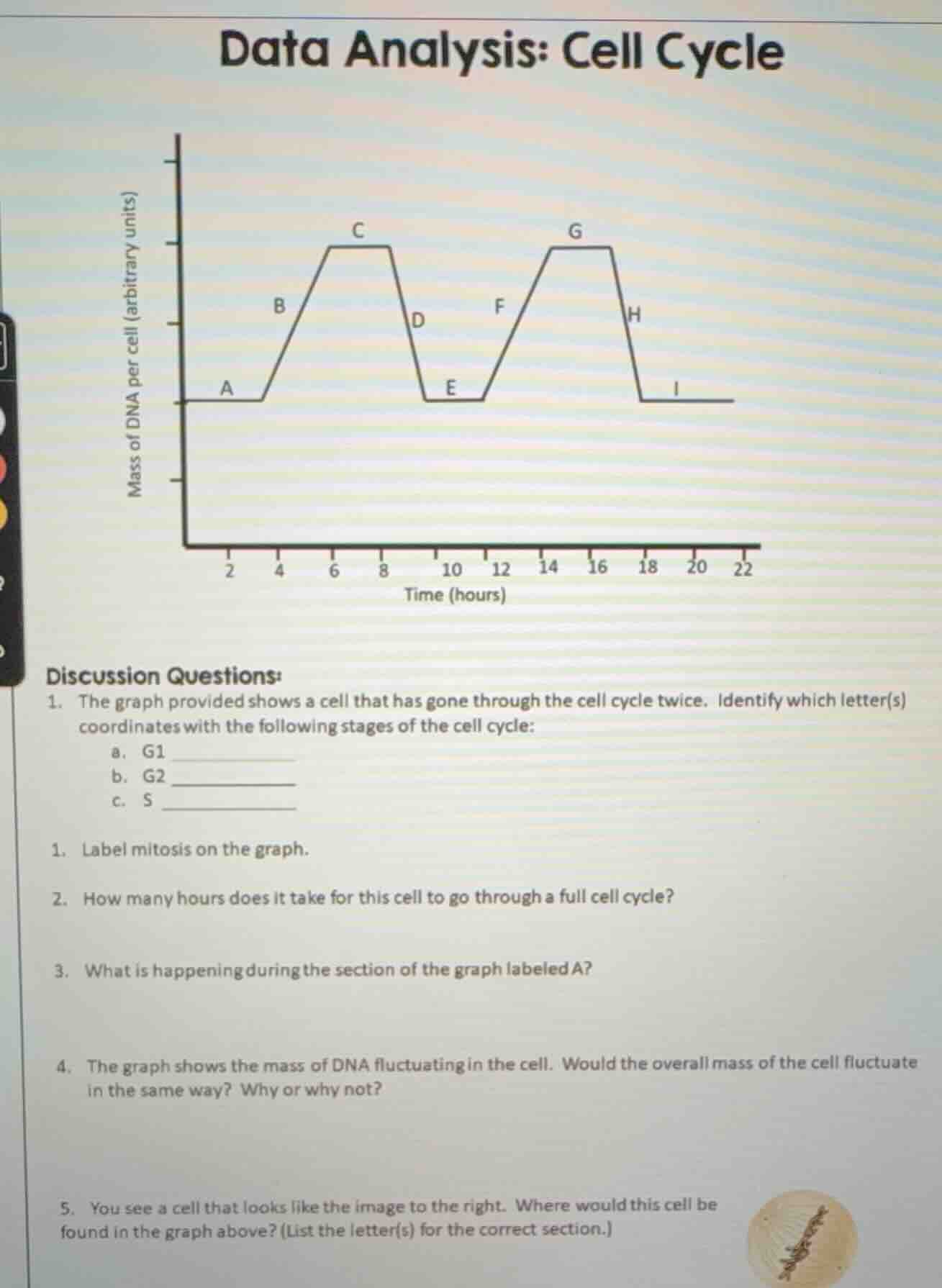
- the graph provided shows a cell that has gone through the cell cycle twice. identify which letter(s) coordinates with the following stages of the cell cycle:
a. g1 _______
b. g2 _______
c. s _______
- label mitosis on the graph.
- how many hours does it take for this cell to go through a full cell cycle?
- what is happening during the section of the graph labeled a?
- the graph shows the mass of dna fluctuating in the cell. would the overall mass of the cell fluctuate in the same way? why or why not?
- you see a cell that looks like the image to the right. where would this cell be found in the graph above? (list the letter(s) for the correct section.)
Identify cell cycle stages from the DNA mass graph
- G1 phase: DNA mass is at its baseline level before replication. This corresponds to sections A, E, and I.
- S phase: DNA replication occurs, causing the DNA mass to double. This corresponds to the rising sections B and F.
- G2 phase: DNA mass remains doubled after replication and before division. This corresponds to the high plateaus C and G.
Determine mitosis, cycle duration, and G1 activity
- Mitosis (and cytokinesis): The division phase where DNA mass is halved back to baseline. This corresponds to the falling sections D and H.
- Full cell cycle duration: The time from the start of one G1 phase to the start of the next G1 phase. The first cycle starts at \(t = 0\) hours (start of A) and ends when the second cycle begins at \(t = 9.5\) hours (start of E). Thus, one full cycle takes approximately \(9.5\) hours (or \(10\) hours if estimating from the middle of the plateaus: \(11.5 - 2 = 9.5\) hours).
- Section A activity: The cell is in the G1 phase, where it undergoes normal metabolic processes, active protein synthesis, and cell growth.
Analyze overall cell mass fluctuations and identify the cell division image
- Overall cell mass: Unlike DNA mass, which doubles rapidly during S phase and halves during division, overall cell mass increases continuously and gradually throughout interphase (G1, S, G2) as the cell grows and duplicates organelles, rather than fluctuating in a step-like manner.
- Microscopic image: The image shows chromosomes aligned at the metaphase plate during mitosis. This corresponds to the late G2/mitosis transition, which occurs at the end of the high plateau and during the drop, represented by letters C (late) / D or G (late) / H.

Snap & solve any problem in the app
Get step-by-step solutions on Sovi AI
Photo-based solutions with guided steps
Explore more problems and detailed explanations
Question 1
a. G1: A, E, I
b. G2: C, G
c. S: B, F
Question 1 (Label Mitosis)
Mitosis corresponds to the sections where the DNA mass is halved, which are labeled D and H.
Question 2
It takes approximately 9.5 hours (or about 9 to 10 hours) for this cell to go through a full cell cycle (e.g., from the start of section A at \(t = 0\) to the start of section E at \(t = 9.5\)).
Question 3
During section A (G1 phase), the cell is growing, performing normal metabolic functions, and synthesizing proteins and organelles in preparation for DNA replication.
Question 4
No, the overall mass of the cell would not fluctuate in the same way. While DNA mass doubles rapidly during S phase and halves abruptly during cytokinesis, overall cell mass increases gradually and continuously throughout interphase (G1, S, and G2) as the cell synthesizes proteins, lipids, and organelles.
Question 5
The image shows a cell in metaphase (mitosis), where chromosomes are aligned along the metaphase plate. This stage occurs at the end of the high plateau and during the division phase, corresponding to letters C and D (or G and H).