QUESTION IMAGE
Question
- cultural significance and reflection
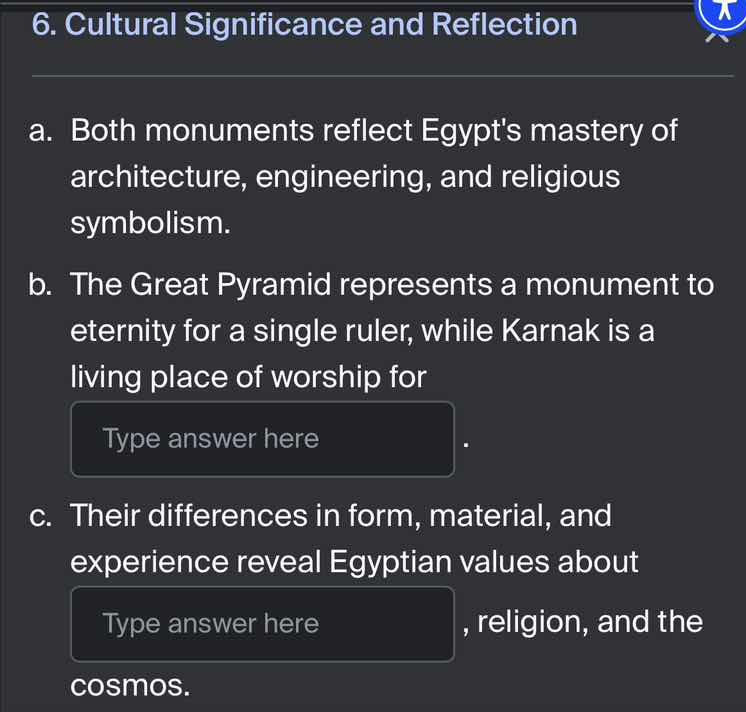
a. both monuments reflect egypts mastery of architecture, engineering, and religious symbolism.
b. the great pyramid represents a monument to eternity for a single ruler, while karnak is a living place of worship for type answer here.
c. their differences in form, material, and experience reveal egyptian values about type answer here, religion, and the cosmos.
Analyze the context of Karnak Temple
The Great Pyramid of Giza was built as a monumental tomb for a single pharaoh (Khufu) to secure his eternal afterlife. In contrast, the Temple of Karnak was a massive, continuously expanded state sanctuary dedicated to the gods (primarily Amun-Re, Mut, and Khonsu) and served as a living place of worship for the gods and the community/priests over many generations.
Analyze the comparative values of the monuments
The differences in architectural form (pyramid vs. temple complex), materials, and spatial experience (restricted tomb chamber vs. processional colonnades and hypostyle halls) reveal core Egyptian cultural values. These values center on the relationship between earthly authority (kingship/the pharaoh), divine worship (religion), and the order of the universe (the cosmos).

Snap & solve any problem in the app
Get step-by-step solutions on Sovi AI
Photo-based solutions with guided steps
Explore more problems and detailed explanations
Question 1
b. The Great Pyramid represents a monument to eternity for a single ruler, while Karnak is a living place of worship for <blank>the gods</blank>.
Question 2
c. Their differences in form, material, and experience reveal Egyptian values about <blank>kingship</blank>, religion, and the cosmos.