QUESTION IMAGE
Question
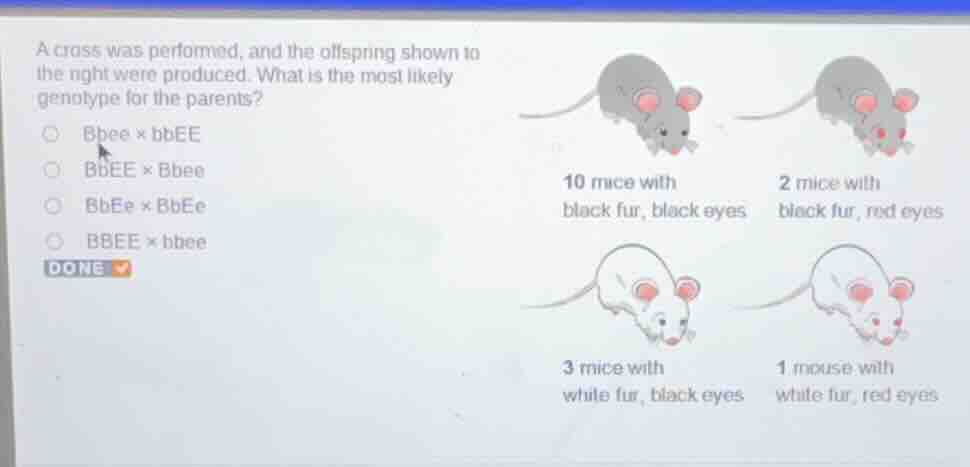
a cross was performed, and the offspring shown to the right were produced. what is the most likely genotype for the parents?
bbee x bbee
bbee x bbee
bbee x bbee
bbee x bbee
Analyze the offspring phenotypes and counts
We observe the following offspring counts and phenotypes from the cross:
- 10 mice with black fur, black eyes
- 2 mice with black fur, red eyes
- 3 mice with white fur, black eyes
- 1 mouse with white fur, red eyes
The total number of offspring is:
The observed phenotypic ratio is approximately \(10 : 2 : 3 : 1\).
Analyze individual trait segregation
Let's look at each trait individually to determine parental genotypes:
- Fur Color (Black vs. White):
- Black fur: \(10 + 2 = 12\) mice
- White fur: \(3 + 1 = 4\) mice
- Ratio: \(12 : 4 = 3 : 1\)
- A \(3:1\) ratio in a monohybrid cross indicates that both parents must be heterozygous for the fur color gene. Let \(B\) represent the dominant allele (black fur) and \(b\) represent the recessive allele (white fur). Thus, both parents must have the genotype \(Bb\).
- Eye Color (Black vs. Red):
- Black eyes: \(10 + 3 = 13\) mice
- Red eyes: \(2 + 1 = 3\) mice
- Ratio: \(13 : 3 \approx 3 : 1\)
- A ratio close to \(3:1\) indicates that both parents are likely heterozygous for the eye color gene. Let \(E\) represent the dominant allele (black eyes) and \(e\) represent the recessive allele (red eyes). Thus, both parents must have the genotype \(Ee\).
Using Dihybrid Cross principles, if both traits assort independently, crossing two double heterozygotes (\(BbEe \times BbEe\)) yields a classic Phenotypic Ratio of \(9:3:3:1\). The observed counts of \(10:2:3:1\) are extremely close to this theoretical expectation, with minor statistical deviation.
Evaluate the given options
Let's test the proposed parental genotypes from the options:
- Option 1: \(Bbee \times bbEE\)
- All offspring would receive a \(b\) from the second parent and an \(E\) from the second parent.
- No offspring could have white fur (\(bb\)) because the first parent only has \(B\) or \(b\), but the second parent is \(bb\), which would yield a \(1:1\) ratio of black to white, not \(3:1\).
- No offspring could have red eyes (\(ee\)) because the second parent is homozygous dominant (\(EE\)), so all offspring would have black eyes (\(Ee\)). This does not match the data.
- Option 2: \(BbEE \times Bbee\)
- Since one parent is \(EE\) and the other is \(ee\), all offspring will inherit at least one dominant \(E\) allele (\(Ee\)) and have black eyes. No red-eyed offspring (\(ee\)) could be produced, which contradicts the observed red-eyed mice.
- Option 3: \(BbEe \times BbEe\)
- This cross represents two double heterozygotes.
- The expected phenotypic ratio is \(9\) black/black : \(3\) black/red : \(3\) white/black : \(1\) white/red.
- Our observed counts (\(10 : 2 : 3 : 1\)) fit this distribution perfectly within normal genetic variation.
- Option 4: \(BBEE \times bbee\)
- This cross would produce \(100\%\) heterozygous offspring (\(BbEe\)), all displaying the dominant phenotypes (black fur, black eyes). No white-furred or red-eyed offspring would be produced.
Therefore, the most likely genotype for the parents is \(BbEe \…

Snap & solve any problem in the app
Get step-by-step solutions on Sovi AI
Photo-based solutions with guided steps
Explore more problems and detailed explanations
- Bbee × bbEE
- BbEE × Bbee
- BbEe × BbEe (Correct answer)
- BBEE × bbee