QUESTION IMAGE
Question
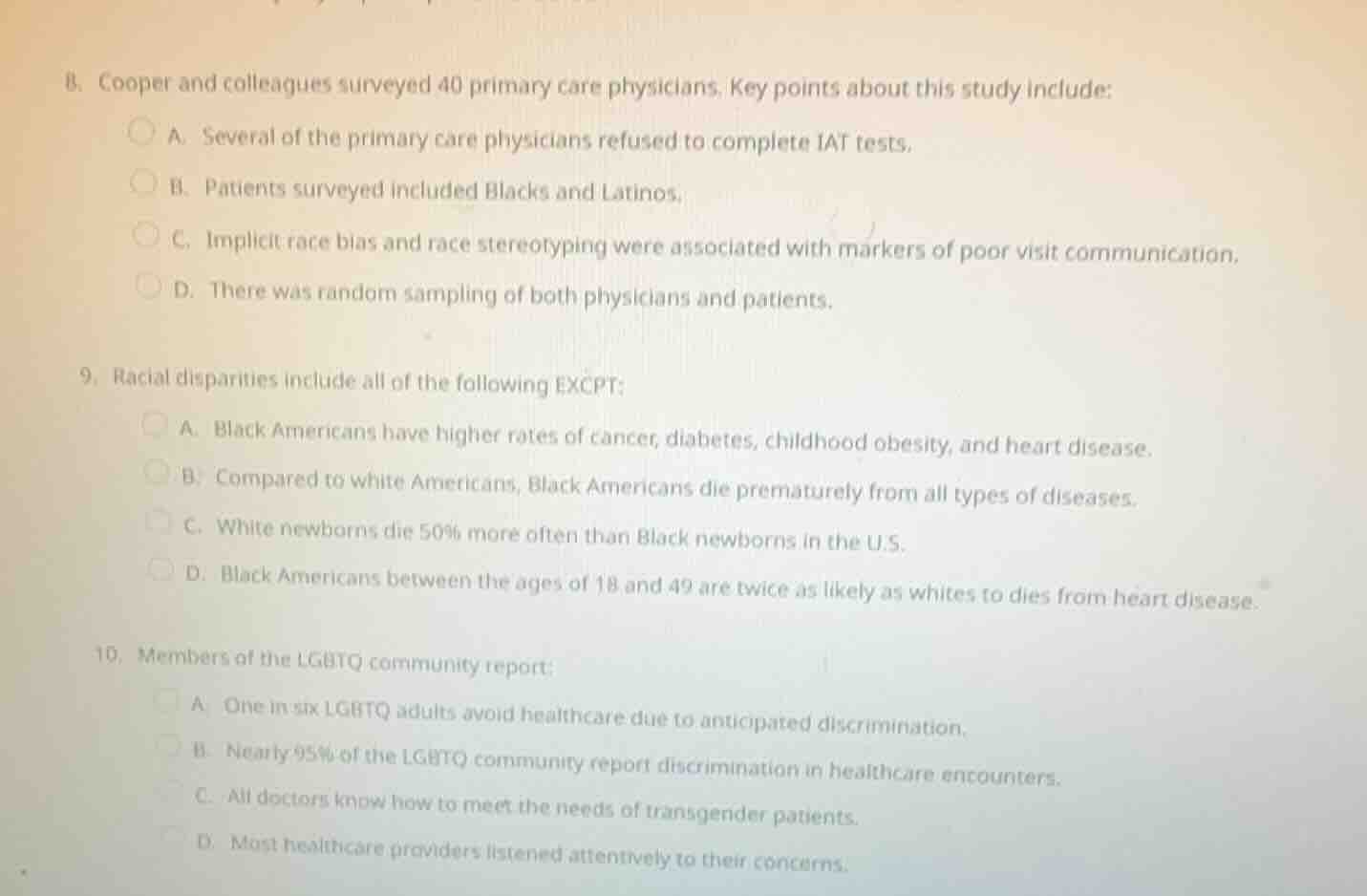
- cooper and colleagues surveyed 40 primary care physicians. key points about this study include:
a. several of the primary care physicians refused to complete iat tests.
b. patients surveyed included blacks and latinos.
c. implicit race bias and race stereotyping were associated with markers of poor visit communication.
d. there was random sampling of both physicians and patients.
- racial disparities include all of the following excpt:
a. black americans have higher rates of cancer, diabetes, childhood obesity, and heart disease.
b. compared to white americans, black americans die prematurely from all types of diseases.
c. white newborns die 50% more often than black newborns in the u.s.
d. black americans between the ages of 18 and 49 are twice as likely as whites to dies from heart disease.
- members of the lgbtq community report:
a. one in six lgbtq adults avoid healthcare due to anticipated discrimination.
b. nearly 95% of the lgbtq community report discrimination in healthcare encounters.
c. all doctors know how to meet the needs of transgender patients.
d. most healthcare providers listened attentively to their concerns.
Analyze Cooper and colleagues' study
Using the Healthcare Disparities Studies knowledge point, we analyze the study by Cooper et al. (2012) which investigated implicit bias among primary care physicians. The study surveyed 40 primary care physicians and their patients (which included Black patients). The key finding was that clinicians with higher implicit bias (measured via the Implicit Association Test, or IAT) had more clinician-dominated visits, lower patient positive affect, and poorer ratings of visit communication by patients. Therefore, option C is the correct key point.
Analyze racial disparities in healthcare
Using the Healthcare Disparities knowledge point, we evaluate the statements regarding racial health disparities in the United States to find the exception. Black Americans experience significantly higher rates of chronic conditions, premature mortality, and infant mortality compared to white Americans. In fact, Black infant mortality is over twice as high as white infant mortality (meaning Black newborns die more often, not white newborns). Thus, statement C is factually incorrect and is the "EXCEPT" choice.
Analyze LGBTQ healthcare experiences
We examine the documented experiences of LGBTQ individuals in healthcare settings. Research shows that discrimination and fear of discrimination act as major barriers to care. Specifically, studies (such as those by the Center for American Progress) indicate that about one in six LGBTQ adults report avoiding medical care due to anticipation of discrimination. Other options are incorrect because 95% is an overstatement, not all doctors are trained in transgender care, and many providers fail to listen attentively.

Snap & solve any problem in the app
Get step-by-step solutions on Sovi AI
Photo-based solutions with guided steps
Explore more problems and detailed explanations
Question 8
- (A) Several of the primary care physicians refused to complete IAT tests.
- (B) Patients surveyed included Blacks and Latinos.
- (C) Implicit race bias and race stereotyping were associated with markers of poor visit communication. (Correct answer)
- (D) There was random sampling of both physicians and patients.
Question 9
- (A) Black Americans have higher rates of cancer, diabetes, childhood obesity, and heart disease.
- (B) Compared to white Americans, Black Americans die prematurely from all types of diseases.
- (C) White newborns die 50% more often than Black newborns in the U.S. (Correct answer)
- (D) Black Americans between the ages of 18 and 49 are twice as likely as whites to die from heart disease.
Question 10
- (A) One in six LGBTQ adults avoid healthcare due to anticipated discrimination. (Correct answer)
- (B) Nearly 95% of the LGBTQ community report discrimination in healthcare encounters.
- (C) All doctors know how to meet the needs of transgender patients.
- (D) Most healthcare providers listened attentively to their concerns.