QUESTION IMAGE
Question
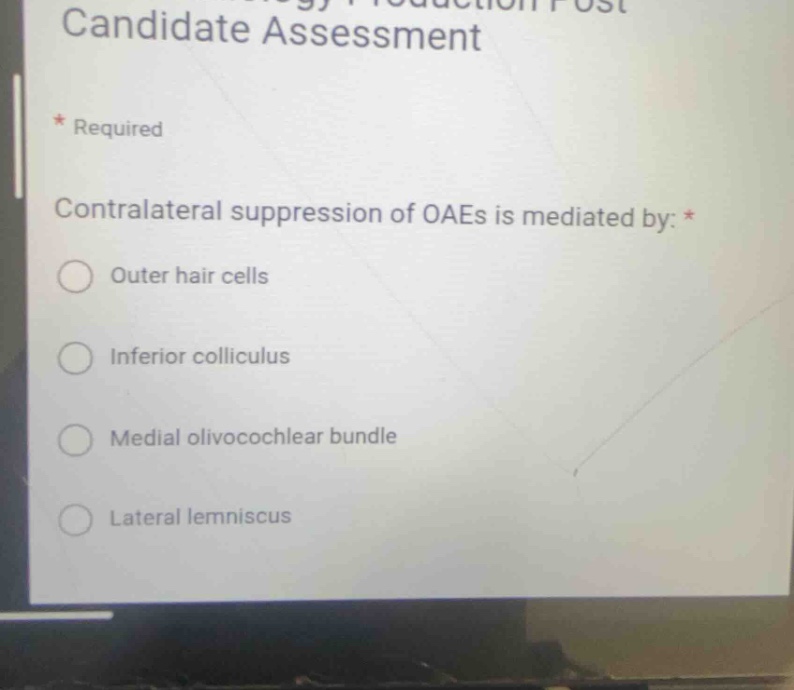
contralateral suppression of oaes is mediated by: *
outer hair cells
inferior colliculus
medial olivocochlear bundle
lateral lemniscus
<pre_analysis>
{
"quality": "clear",
"question_count": 1,
"skills_matched": [
"direct_cot",
"multiple_choice_formatter",
"explain_then_answer",
"tutor"
],
"needs_drawing": false,
"concepts_used": [],
"new_concepts": [
"Contralateral Suppression",
"Otoacoustic Emissions",
"Medial Olivocochlear Bundle"
],
"current_concepts": [
"Contralateral Suppression",
"Otoacoustic Emissions",
"Medial Olivocochlear Bundle"
]
}
</pre_analysis>
<reasoning>
Define contralateral suppression of OAEs
Otoacoustic emissions (OAEs) are sounds generated by the outer hair cells of the cochlea. When a masking noise is presented to the opposite (contralateral) ear, the amplitude of these emissions decreases. This phenomenon is known as contralateral suppression of OAEs.
Identify the neural pathway involved
The suppression effect is mediated by an efferent auditory pathway. Specifically, the auditory reflex pathway projects from the superior olivary complex back to the cochlea.
Determine the specific anatomical structure
The medial olivocochlear (MOC) system, or medial olivocochlear bundle, originates in the medial portion of the superior olivary complex. It projects primarily to the contralateral cochlea, terminating directly on the outer hair cells to modulate their electromotility and suppress OAEs.
Evaluate the given options
- Outer hair cells: These generate OAEs and are the effectors, but they do not mediate the contralateral suppression reflex pathway itself.
- Inferior colliculus: This is a midbrain auditory structure, not the primary mediator of this efferent reflex.
- Medial olivocochlear bundle: This efferent pathway directly innervates outer hair cells and mediates contralateral suppression.
- Lateral lemniscus: This is an ascending auditory tract, not an efferent pathway.
</reasoning>
<answer>
<mcq-option>Outer hair cells</mcq-option>
<mcq-option>Inferior colliculus</mcq-option>
<mcq-correct>Medial olivocochlear bundle</mcq-correct>
<mcq-option>Lateral lemniscus</mcq-option>
</answer>
<post_analysis>
{
"subject": "Natural Science",
"question_type": "Multiple Choice",
"knowledge_point": [
"Natural Science",
"Medicine",
"Audiology"
]
}
</post_analysis>
Snap & solve any problem in the app
Get step-by-step solutions on Sovi AI
Photo-based solutions with guided steps
Explore more problems and detailed explanations
<pre_analysis>
{
"quality": "clear",
"question_count": 1,
"skills_matched": [
"direct_cot",
"multiple_choice_formatter",
"explain_then_answer",
"tutor"
],
"needs_drawing": false,
"concepts_used": [],
"new_concepts": [
"Contralateral Suppression",
"Otoacoustic Emissions",
"Medial Olivocochlear Bundle"
],
"current_concepts": [
"Contralateral Suppression",
"Otoacoustic Emissions",
"Medial Olivocochlear Bundle"
]
}
</pre_analysis>
<reasoning>
Define contralateral suppression of OAEs
Otoacoustic emissions (OAEs) are sounds generated by the outer hair cells of the cochlea. When a masking noise is presented to the opposite (contralateral) ear, the amplitude of these emissions decreases. This phenomenon is known as contralateral suppression of OAEs.
Identify the neural pathway involved
The suppression effect is mediated by an efferent auditory pathway. Specifically, the auditory reflex pathway projects from the superior olivary complex back to the cochlea.
Determine the specific anatomical structure
The medial olivocochlear (MOC) system, or medial olivocochlear bundle, originates in the medial portion of the superior olivary complex. It projects primarily to the contralateral cochlea, terminating directly on the outer hair cells to modulate their electromotility and suppress OAEs.
Evaluate the given options
- Outer hair cells: These generate OAEs and are the effectors, but they do not mediate the contralateral suppression reflex pathway itself.
- Inferior colliculus: This is a midbrain auditory structure, not the primary mediator of this efferent reflex.
- Medial olivocochlear bundle: This efferent pathway directly innervates outer hair cells and mediates contralateral suppression.
- Lateral lemniscus: This is an ascending auditory tract, not an efferent pathway.
</reasoning>
<answer>
<mcq-option>Outer hair cells</mcq-option>
<mcq-option>Inferior colliculus</mcq-option>
<mcq-correct>Medial olivocochlear bundle</mcq-correct>
<mcq-option>Lateral lemniscus</mcq-option>
</answer>
<post_analysis>
{
"subject": "Natural Science",
"question_type": "Multiple Choice",
"knowledge_point": [
"Natural Science",
"Medicine",
"Audiology"
]
}
</post_analysis>