QUESTION IMAGE
Question
contesta.
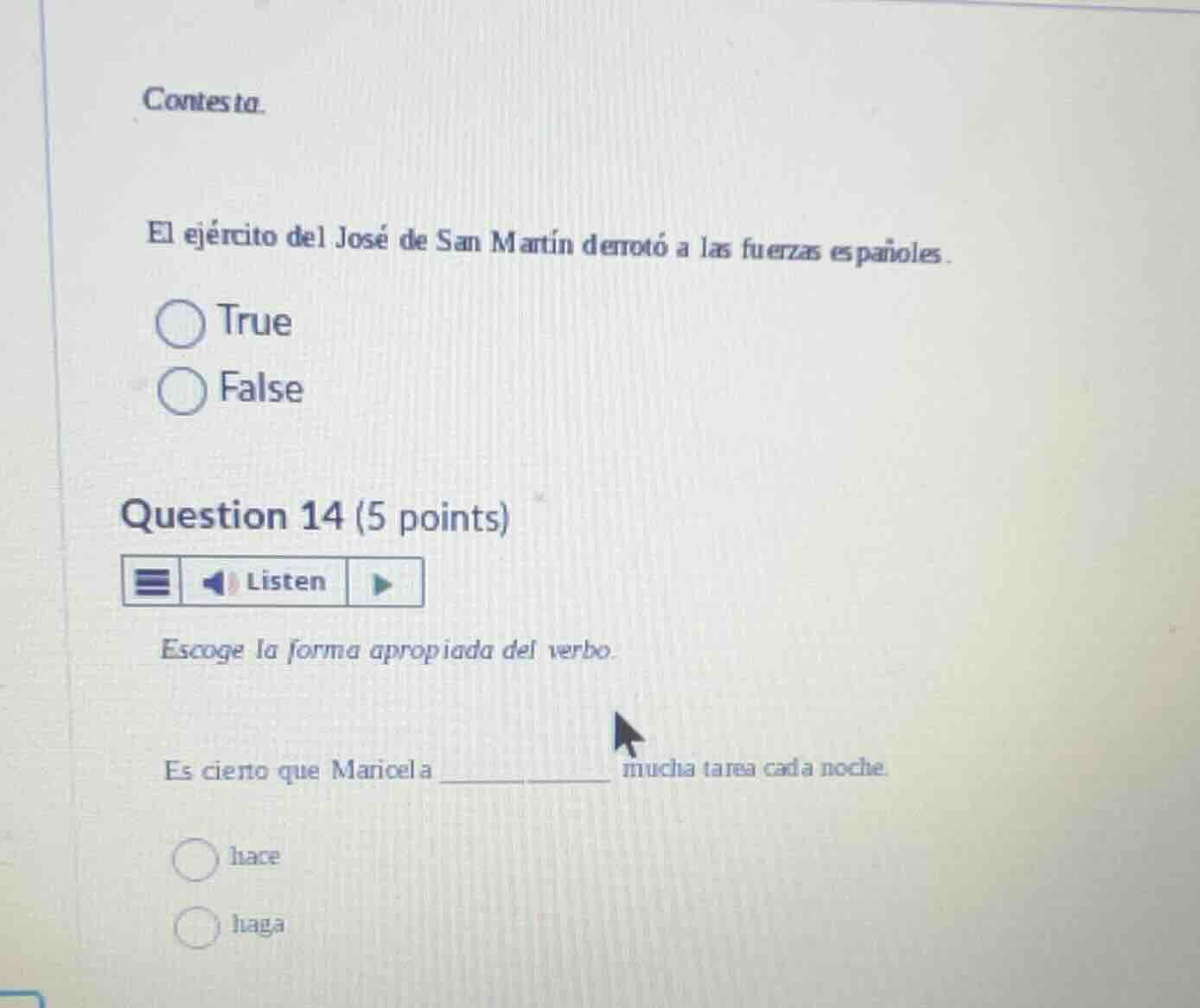
el ejército del josé de san martín derrotó a las fuerzas españolas.
true
false
question 14 (5 points)
escoge la forma apropiada del verbo.
es cierto que maricela ________ mucha tarea cada noche.
hace
haga
Analyze the historical statement
The first question asks to evaluate the statement: "El ejército de José de San Martín derrotó a las fuerzas españolas." (The army of José de San Martín defeated the Spanish forces). José de San Martín was a famous Argentine general and one of the primary liberators of Spanish South America. His armies successfully defeated Spanish royalist forces in Argentina, Chile, and Peru, leading to their independence. Therefore, this statement is historically true.
Analyze the grammatical structure
The second question (Question 14) asks to choose the correct verb form: "Es cierto que Maricela ________ mucha tarea cada noche."
The introductory clause is "Es cierto que..." (It is true/certain that...). In Spanish grammar, impersonal expressions that express certainty, truth, or belief (such as es cierto que, es verdad que, es obvio que) require the indicative mood in the subordinate clause because they declare a fact.
Compare the verb options
The verb to conjugate is hacer (to do/make) for the subject Maricela (third-person singular: ella).
- hace: This is the third-person singular present indicative form of hacer.
- haga: This is the third-person singular present subjunctive form of hacer.
Since the expression Verbs of Belief and Certainty and Spanish Indicative vs Subjunctive rules dictate using the indicative mood after expressions of certainty like "Es cierto que", the correct choice is hace.

Snap & solve any problem in the app
Get step-by-step solutions on Sovi AI
Photo-based solutions with guided steps
Explore more problems and detailed explanations
Question 1
- True (Correct answer)
- False
Question 14
- hace (Correct answer)
- haga