Sovi.AI - AI Math Tutor

Scan to solve math questions

QUESTION IMAGE

consumers usually prefer the cost of goods and services to be as low as…

Question

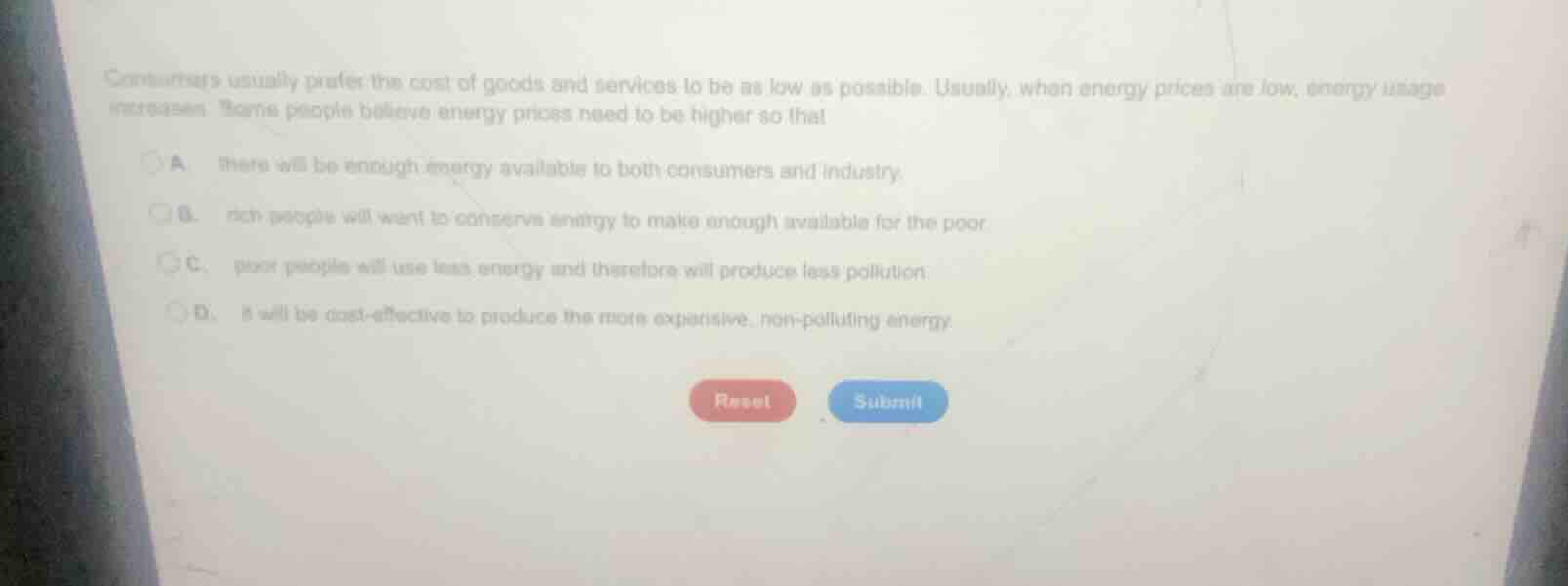
consumers usually prefer the cost of goods and services to be as low as possible. usually, when energy prices are low, energy usage increases. some people believe energy prices need to be higher so that

a. there will be enough energy available to both consumers and industry.
b. rich people will want to conserve energy to make enough available for the poor.
c. poor people will use less energy and therefore will produce less pollution.
d. it will be cost-effective to produce the more expensive, non-polluting energy.

Explanation:

Response

<pre_analysis>
{
"quality": "clear",
"question_count": 1,
"skills_matched": [
"direct_cot",
"multiple_choice_formatter",
"explain_then_answer",
"tutor"
],
"needs_drawing": false,
"concepts_used": [],
"new_concepts": [
"Energy Economics",
"Renewable Energy Cost",
"Market Incentives"
],
"current_concepts": [
"Energy Economics",
"Renewable Energy Cost",
"Market Incentives"
]
}
</pre_analysis>

<reasoning>

Analyze the prompt's premise

The question states that consumers prefer low costs, but low energy prices lead to increased usage. It introduces a counter-perspective: some people believe energy prices need to be higher. We must find the logical economic or environmental reason supporting higher energy prices among the choices.

Evaluate Option A

Option A suggests higher prices ensure enough energy is available for both consumers and industry. While high prices can reduce demand, simply raising prices does not automatically guarantee availability without considering production dynamics.

Evaluate Option B and Option C

Option B and Option C focus on wealth-based disparities (rich conserving for the poor, or poor using less to reduce pollution). These do not represent standard economic or environmental policy arguments for raising energy prices, as they target specific demographics unfairly rather than addressing systemic resource allocation.

Evaluate Option D

Option D states that higher prices make it cost-effective to produce more expensive, non-polluting energy. When conventional fossil-fuel energy prices are artificially low, cleaner alternative energy sources (like solar or wind) cannot compete. Raising energy prices (e.g., through carbon pricing or removing subsidies) makes investing in and producing cleaner, non-polluting energy economically viable.

Formulate the conclusion

Option D provides the most logically sound explanation aligned with environmental economics: higher market prices for energy allow cleaner, currently more expensive technologies to become competitive and cost-effective to produce.
</reasoning>

<answer>
<mcq-option>(A) there will be enough energy available to both consumers and industry.</mcq-option>
<mcq-option>(B) rich people will want to conserve energy to make enough available for the poor.</mcq-option>
<mcq-option>(C) poor people will use less energy and therefore will produce less pollution.</mcq-option>
<mcq-correct>(D) it will be cost-effective to produce the more expensive, non-polluting energy.</mcq-correct>
</answer>

<post_analysis>
{
"subject": "Natural Science",
"question_type": "Multiple Choice",
"knowledge_point": [
"Natural Science",
"Environmental Science",
"Energy Economics"
]
}
</post_analysis>

Answer:

<pre_analysis>
{
"quality": "clear",
"question_count": 1,
"skills_matched": [
"direct_cot",
"multiple_choice_formatter",
"explain_then_answer",
"tutor"
],
"needs_drawing": false,
"concepts_used": [],
"new_concepts": [
"Energy Economics",
"Renewable Energy Cost",
"Market Incentives"
],
"current_concepts": [
"Energy Economics",
"Renewable Energy Cost",
"Market Incentives"
]
}
</pre_analysis>

<reasoning>

Analyze the prompt's premise

The question states that consumers prefer low costs, but low energy prices lead to increased usage. It introduces a counter-perspective: some people believe energy prices need to be higher. We must find the logical economic or environmental reason supporting higher energy prices among the choices.

Evaluate Option A

Option A suggests higher prices ensure enough energy is available for both consumers and industry. While high prices can reduce demand, simply raising prices does not automatically guarantee availability without considering production dynamics.

Evaluate Option B and Option C

Option B and Option C focus on wealth-based disparities (rich conserving for the poor, or poor using less to reduce pollution). These do not represent standard economic or environmental policy arguments for raising energy prices, as they target specific demographics unfairly rather than addressing systemic resource allocation.

Evaluate Option D

Option D states that higher prices make it cost-effective to produce more expensive, non-polluting energy. When conventional fossil-fuel energy prices are artificially low, cleaner alternative energy sources (like solar or wind) cannot compete. Raising energy prices (e.g., through carbon pricing or removing subsidies) makes investing in and producing cleaner, non-polluting energy economically viable.

Formulate the conclusion

Option D provides the most logically sound explanation aligned with environmental economics: higher market prices for energy allow cleaner, currently more expensive technologies to become competitive and cost-effective to produce.
</reasoning>

<answer>
<mcq-option>(A) there will be enough energy available to both consumers and industry.</mcq-option>
<mcq-option>(B) rich people will want to conserve energy to make enough available for the poor.</mcq-option>
<mcq-option>(C) poor people will use less energy and therefore will produce less pollution.</mcq-option>
<mcq-correct>(D) it will be cost-effective to produce the more expensive, non-polluting energy.</mcq-correct>
</answer>

<post_analysis>
{
"subject": "Natural Science",
"question_type": "Multiple Choice",
"knowledge_point": [
"Natural Science",
"Environmental Science",
"Energy Economics"
]
}
</post_analysis>