QUESTION IMAGE
Question
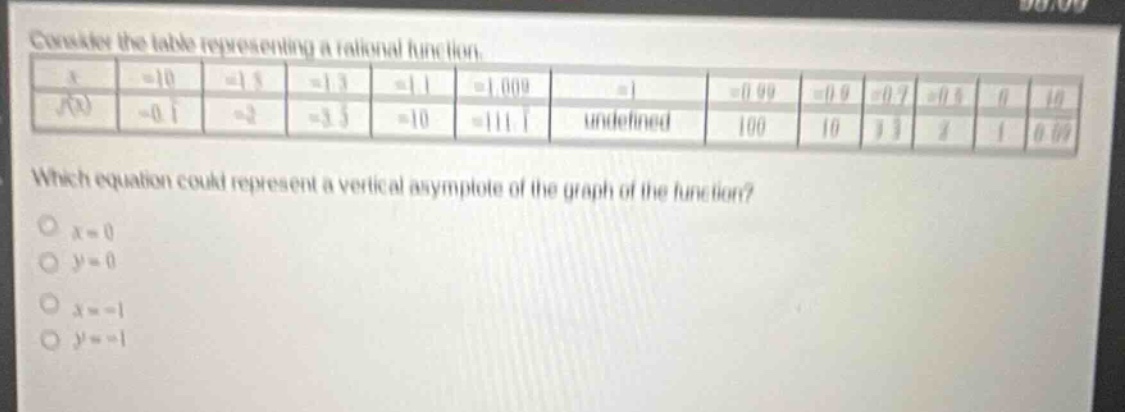
consider the table representing a rational function.
which equation could represent a vertical asymptote of the graph of the function?
- (x = 0)
- (y = 0)
- (x = -1)
- (y = -1)
⚡ Using what you learned: Identifying Restrictions and Asymptotes
Step 1: Analyze the behavior near the undefined value
A vertical asymptote occurs where a rational function's output approaches positive or negative infinity as the input \( x \) approaches a specific constant value from either side.
Looking at the table:
- As \( x \) approaches \(-1\) from the left (values like \(-1.1\), \(-1.009\)), the function values \( f(x) \) decrease rapidly toward negative infinity:
- At \( x = -1 \), the function is undefined.
- As \( x \) approaches \(-1\) from the right (values like \(-0.99\), \(-0.9\)), the function values \( f(x) \) increase rapidly toward positive infinity:
Step 2: Identify the vertical asymptote equation
Because the function values blow up to \(\pm\infty\) as \( x \) approaches \(-1\), there is a vertical asymptote at this boundary.
Vertical lines on a coordinate plane are always written in the form:
Since the behavior occurs at \( x = -1 \), the equation of the vertical asymptote is:

Snap & solve any problem in the app
Get step-by-step solutions on Sovi AI
Photo-based solutions with guided steps
Explore more problems and detailed explanations
\( x = -1 \)