QUESTION IMAGE
Question
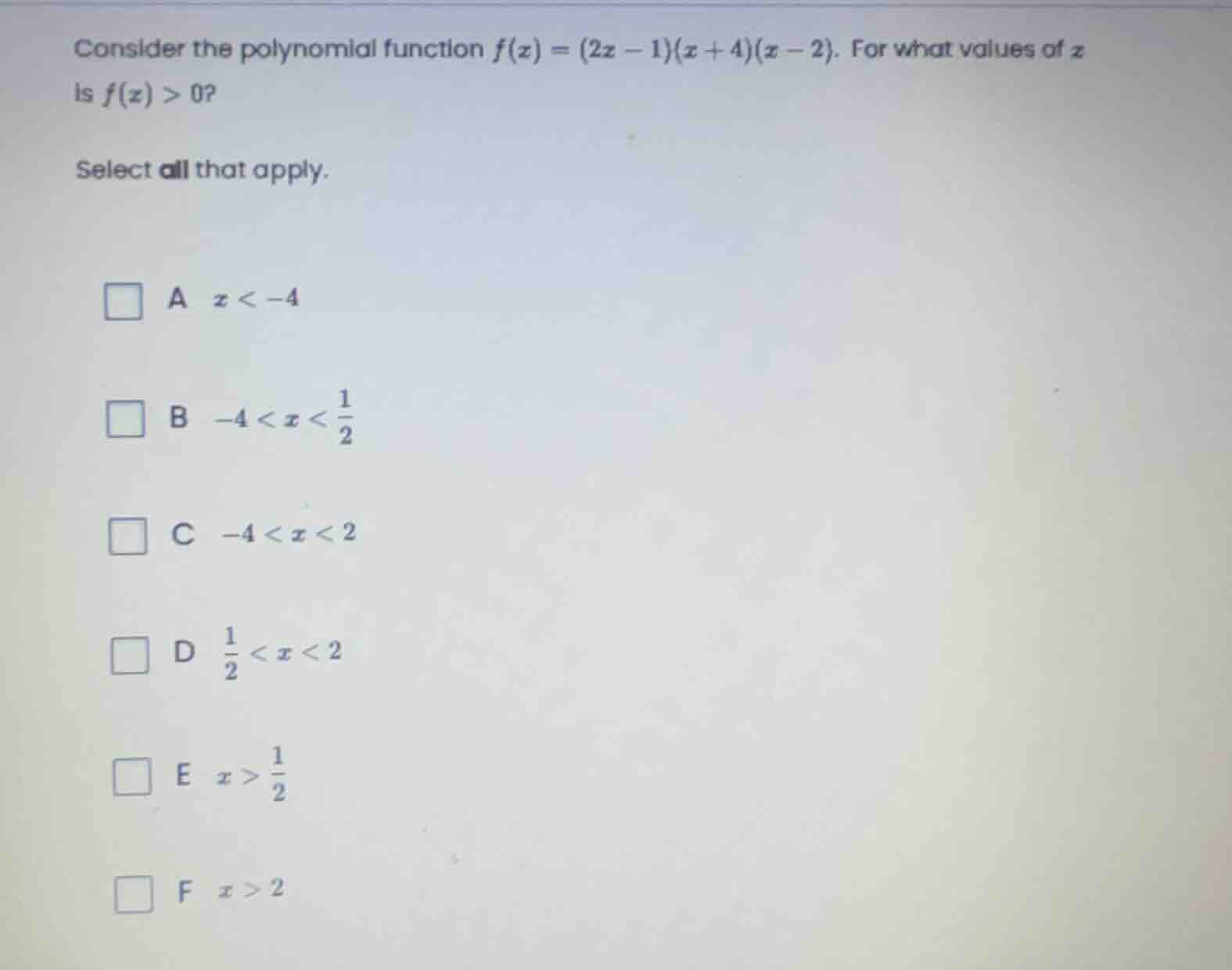
consider the polynomial function $f(x) = (2x - 1)(x + 4)(x - 2)$. for what values of $x$ is $f(x) > 0$? select all that apply. a $x < -4$ b $-4 < x < \frac{1}{2}$ c $-4 < x < 2$ d $\frac{1}{2} < x < 2$ e $x > \frac{1}{2}$ f $x > 2$
Step1: Find critical points
Set each factor equal to zero: \(2x - 1 = 0\Rightarrow x=\frac{1}{2}\), \(x + 4 = 0\Rightarrow x=-4\), \(x - 2 = 0\Rightarrow x = 2\). These critical points divide the number line into intervals: \((-\infty,-4)\), \((-4,\frac{1}{2})\), \((\frac{1}{2},2)\), \((2,\infty)\).
Step2: Test intervals
- For \(x < - 4\) (e.g., \(x=-5\)): \(2(-5)-1=-11<0\), \(-5 + 4=-1<0\), \(-5 - 2=-7<0\). Product: \((-11)\times(-1)\times(-7)=-77<0\).
- For \(-4 < x<\frac{1}{2}\) (e.g., \(x = 0\)): \(2(0)-1=-1<0\), \(0 + 4 = 4>0\), \(0 - 2=-2<0\). Product: \((-1)\times4\times(-2)=8>0\).
- For \(\frac{1}{2}
- For \(x>2\) (e.g., \(x = 3\)): \(2(3)-1 = 5>0\), \(3 + 4 = 7>0\), \(3 - 2 = 1>0\). Product: \(5\times7\times1 = 35>0\). Wait, no, earlier mistake. Wait, when \(x>2\), all three factors: \(2x - 1>0\), \(x + 4>0\), \(x - 2>0\), so product is positive? Wait no, wait in step 2, when \(x = 3\), product is positive, but wait let's re - check the interval \((\frac{1}{2},2)\) and \((2,\infty)\) again. Wait, no, when \(x>2\), \(x - 2>0\), so \(2x-1>0\), \(x + 4>0\), \(x - 2>0\), so product is positive. But wait the options: option F is \(x>2\), option B is \(-4 < x<\frac{1}{2}\), let's re - check the first interval: \(x < - 4\), product is negative. \(-4 < x<\frac{1}{2}\): positive. \(\frac{1}{2}

Snap & solve any problem in the app
Get step-by-step solutions on Sovi AI
Photo-based solutions with guided steps
Explore more problems and detailed explanations
B. \(-4 < x<\frac{1}{2}\), F. \(x>2\)