QUESTION IMAGE
Question
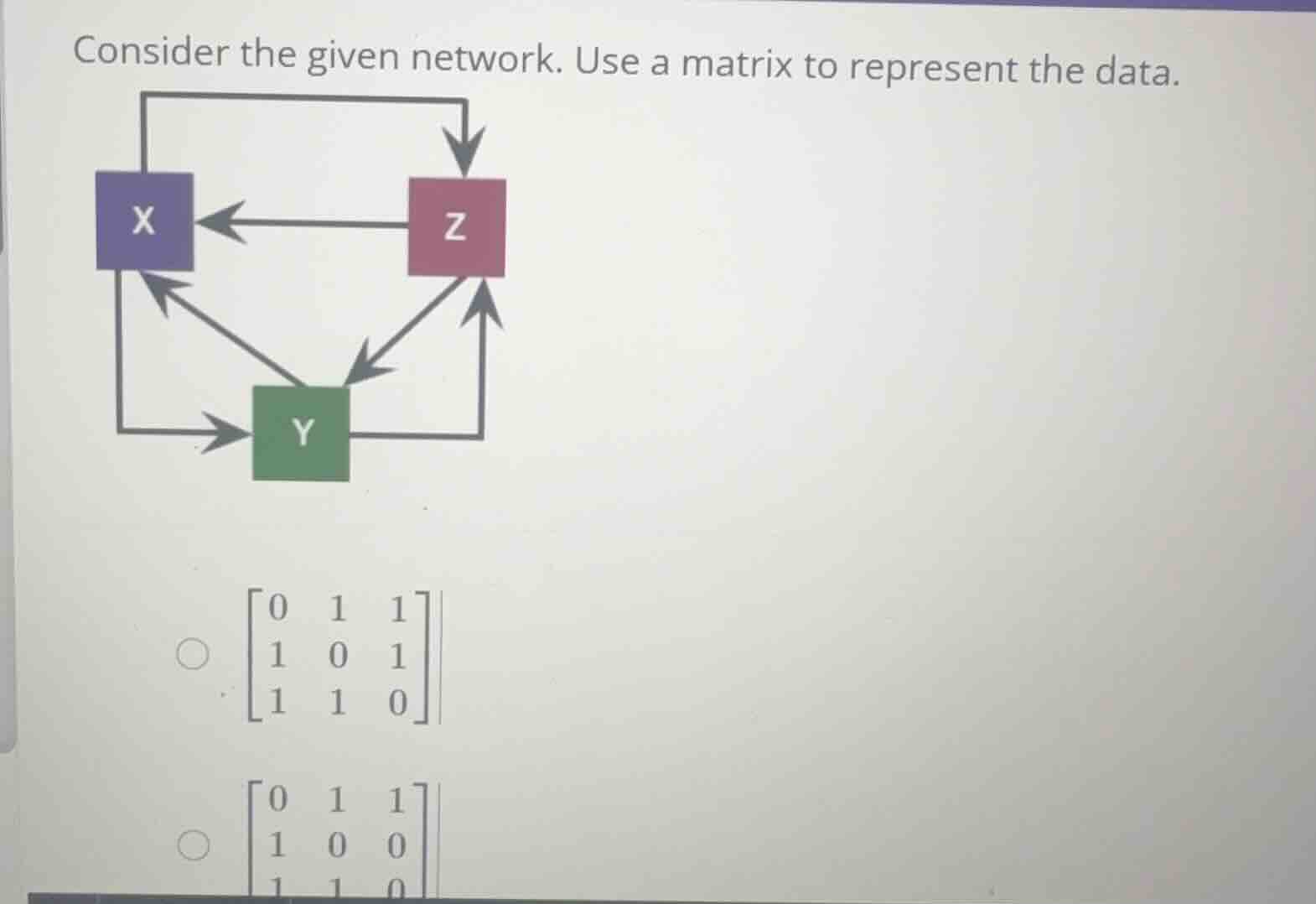
consider the given network. use a matrix to represent the data.
Identify the network vertices and directed edges
The network has three vertices: \(X\), \(Y\), and \(Z\). We define the adjacency matrix \(A\) where the rows and columns represent \(X\), \(Y\), and \(Z\) in alphabetical order. The element \(a_{ij}\) represents a directed edge from the vertex of row \(i\) to the vertex of column \(j\).
Determine the directed connections
Analyze the directed arrows between vertices:
- From \(X\): Arrows go to \(Y\) and \(Z\). Thus, row 1 (\(X\)) is \(
$$\begin{bmatrix} 0 & 1 & 1 \end{bmatrix}$$
\).
- From \(Y\): Arrows go to \(X\) and \(Z\). Thus, row 2 (\(Y\)) is \(
$$\begin{bmatrix} 1 & 0 & 1 \end{bmatrix}$$
\).
- From \(Z\): Arrows go to \(X\) and \(Y\). Thus, row 3 (\(Z\)) is \(
$$\begin{bmatrix} 1 & 1 & 0 \end{bmatrix}$$
\).
Construct the final adjacency matrix
Combine the rows to form the complete \(3 \times 3\) representation matrix:
$$
LATEXBLOCK3
$$

Snap & solve any problem in the app
Get step-by-step solutions on Sovi AI
Photo-based solutions with guided steps
Explore more problems and detailed explanations
- **(A) \(
$$\begin{bmatrix} 0 & 1 & 1 \\ 1 & 0 & 1 \\ 1 & 1 & 0 \end{bmatrix}$$
\) (Correct answer)**
- (B) \(
$$\begin{bmatrix} 0 & 1 & 1 \\ 1 & 0 & 0 \\ 1 & 1 & 0 \end{bmatrix}$$
\)