QUESTION IMAGE
Question
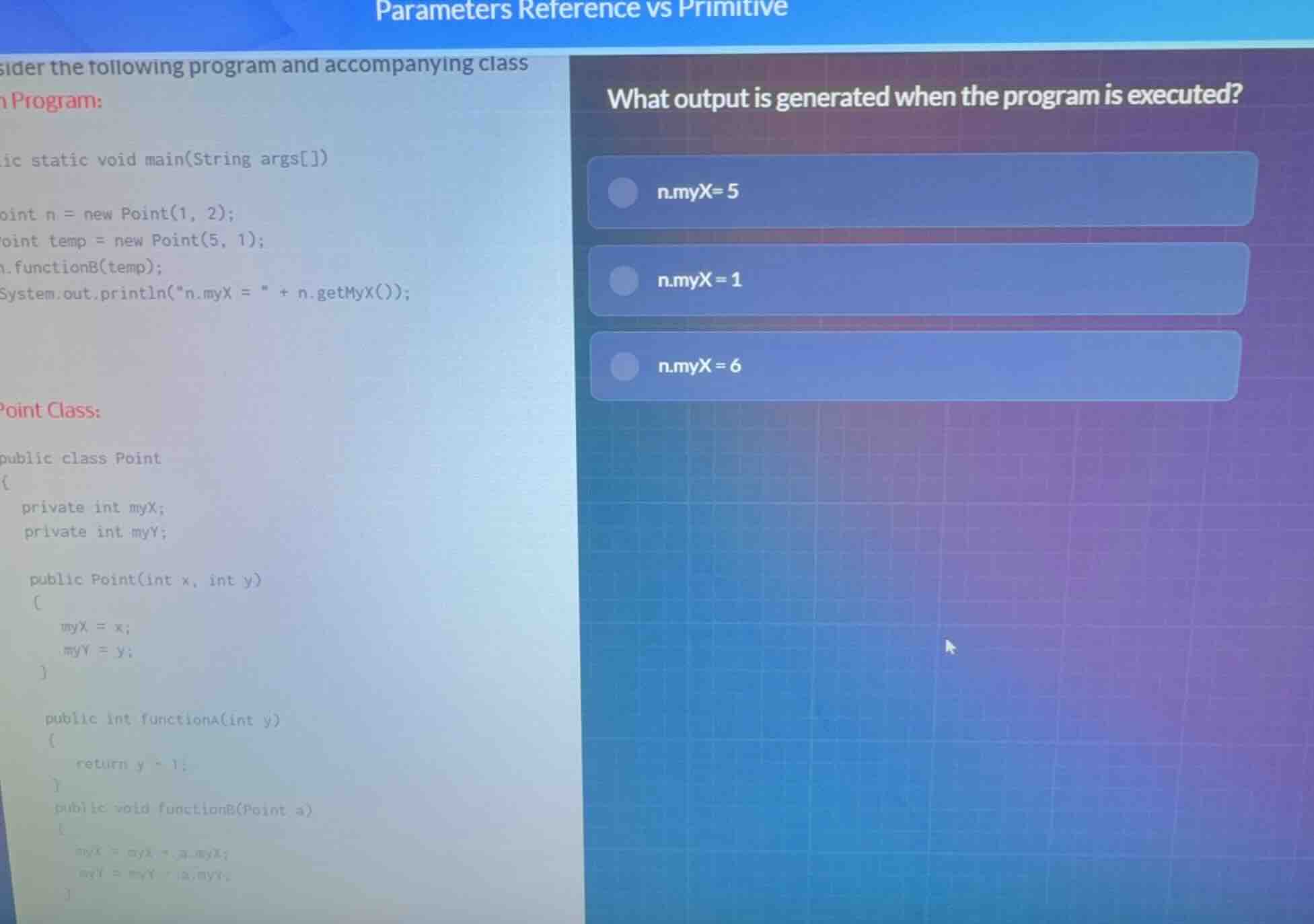
consider the following program and accompanying class
in program:
public static void main(string args)
{
point n = new point(1, 2);
point temp = new point(5, 1);
n.functionb(temp);
system.out.println(
.myx = \ + n.getmyx());
}
point class:
public class point
{
private int myx;
private int myy;
public point(int x, int y)
{
myx = x;
myy = y;
}
public int functiona(int y)
{
return y - 1;
}
public void functionb(point a)
{
myx = myx + a.myx;
myy = myy + a.myy;
}
public int getmyx()
{
return myx;
}
}
what output is generated when the program is executed?
- n.myx = 5
- n.myx = 1
- n.myx = 6
🆕 New Concept Discovered: Object-Oriented Parameter Passing
How objects and references behave when passed to methods.
Step 1: Analyze the initial state of the objects
In the main method, two Point objects are instantiated:
Point n = new Point(1, 2);
- This creates an object
nwheren.myX = 1andn.myY = 2.
Point temp = new Point(5, 1);
- This creates an object
tempwheretemp.myX = 5andtemp.myY = 1.
Step 2: Trace the method call n.functionB(temp)
The method functionB is called on the object n with temp passed as the argument a:
public void functionB(Point a)
{
    myX = myX + a.myX;
    myY = myY + a.myY;
}
Inside this method:
myXandmyYrefer to the instance variables of the calling object, which isn.a.myXanda.myYrefer to the instance variables of the passed objecta(which istemp).
Let's calculate the new value for n.myX:
Step 3: Determine the output
After n.functionB(temp) finishes executing, the program prints the value of n.getMyX():
System.out.println("n.myX = " + n.getMyX());Since n.myX was updated to 6, the printed output is:n.myX = 6

Snap & solve any problem in the app
Get step-by-step solutions on Sovi AI
Photo-based solutions with guided steps
Explore more problems and detailed explanations
n.myX = 6