QUESTION IMAGE
Question
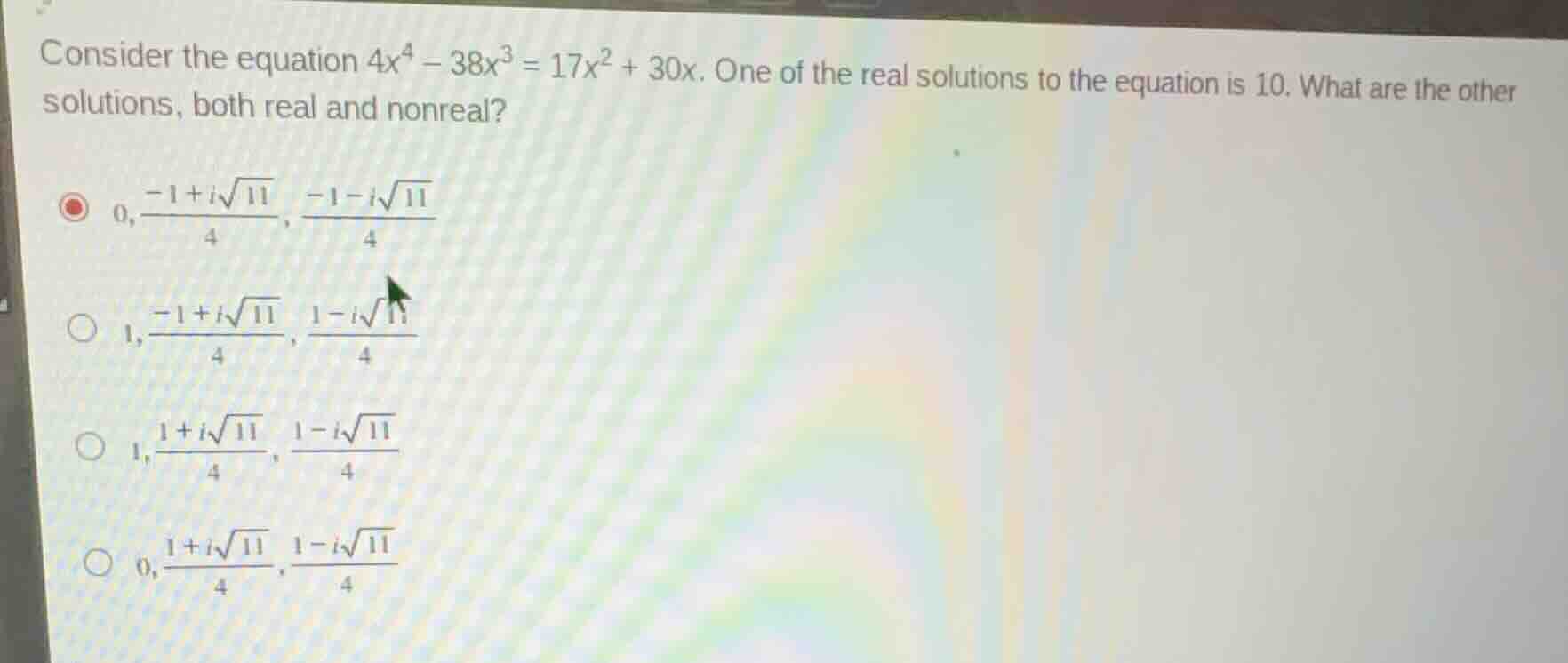
consider the equation (4x^4 - 38x^3 = 17x^2 + 30x). one of the real solutions to the equation is 10. what are the other solutions, both real and nonreal?
- (0, \frac{-1 + isqrt{11}}{4}, \frac{-1 - isqrt{11}}{4})
- (1, \frac{-1 + isqrt{11}}{4}, \frac{1 - isqrt{11}}{4})
- (1, \frac{1 + isqrt{11}}{4}, \frac{1 - isqrt{11}}{4})
- (0, \frac{1 + isqrt{11}}{4}, \frac{1 - isqrt{11}}{4})
Rearrange the polynomial equation
Using the Roots of Polynomials knowledge point
$$
4x^4 - 38x^3 - 17x^2 - 30x = 0
$$
Factor out the common term
Using the Factoring Quadratics knowledge point
$$
x(4x^3 - 38x^2 - 17x - 30) = 0
$$
Thus, \(x = 0\) is one of the real solutions.
Perform polynomial division
Using the Polynomial Division knowledge point
$$
LATEXBLOCK0
$$
The quotient is \(4x^2 + 2x + 3 = 0\).
Solve the remaining quadratic equation
Using the Factoring Quadratics knowledge point
$$
LATEXBLOCK1
$$
Identify the complete set of other solutions
The other solutions are:
$$
0, \frac{-1 + i\sqrt{11}}{4}, \frac{-1 - i\sqrt{11}}{4}
$$

Snap & solve any problem in the app
Get step-by-step solutions on Sovi AI
Photo-based solutions with guided steps
Explore more problems and detailed explanations
- (A) \(0, \frac{-1 + i\sqrt{11}}{4}, \frac{-1 - i\sqrt{11}}{4}\) (Correct answer)
- (B) \(1, \frac{-1 + i\sqrt{11}}{4}, \frac{1 - i\sqrt{11}}{4}\)
- (C) \(1, \frac{1 + i\sqrt{11}}{4}, \frac{1 - i\sqrt{11}}{4}\)
- (D) \(0, \frac{1 + i\sqrt{11}}{4}, \frac{1 - i\sqrt{11}}{4}\)