QUESTION IMAGE
Question
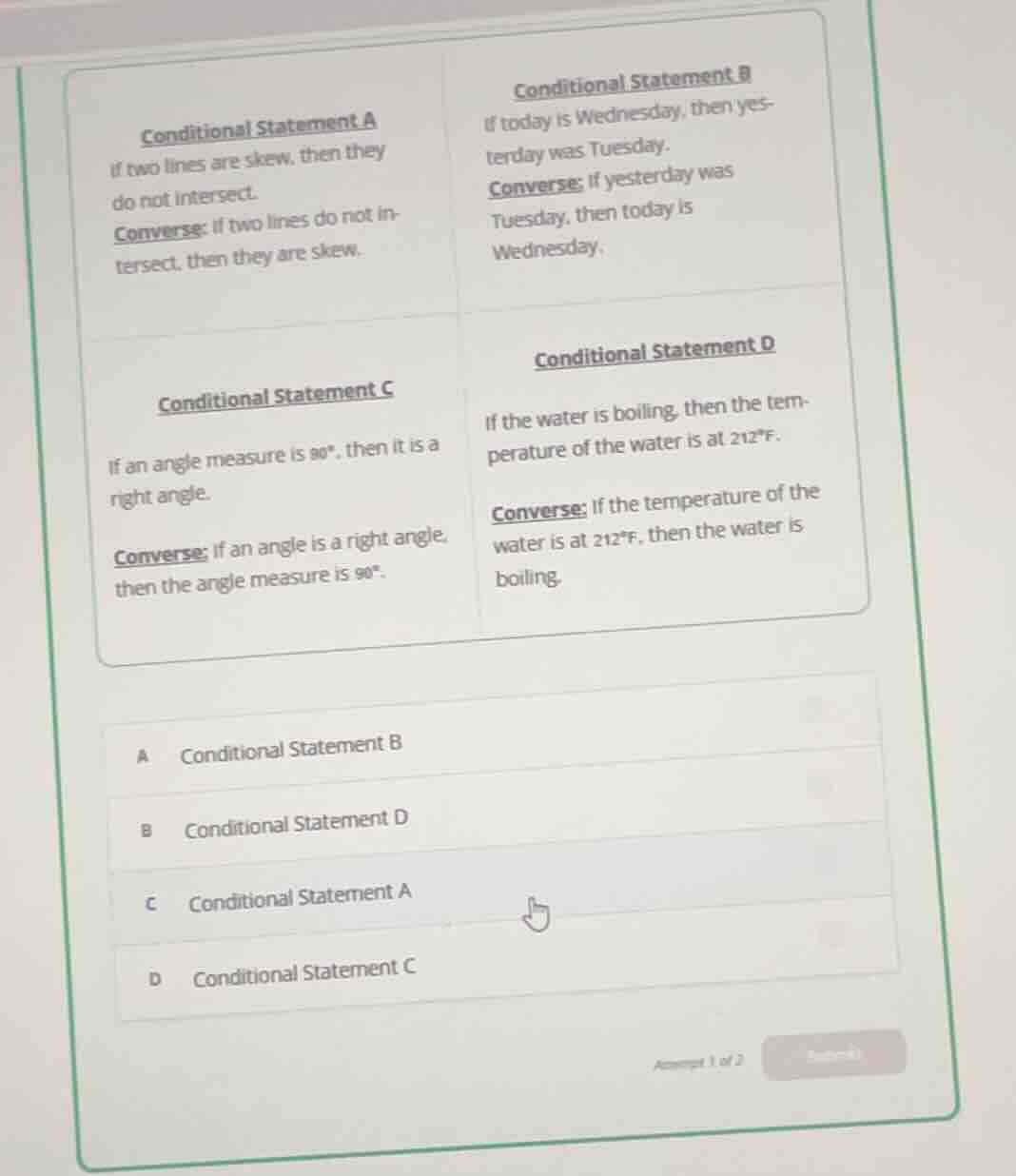
conditional statement a
if two lines are skew, then they do not intersect.
converse: if two lines do not intersect, then they are skew.
conditional statement b
if today is wednesday, then yesterday was tuesday.
converse: if yesterday was tuesday, then today is wednesday.
conditional statement c
if an angle measure is \\(90^{\circ}\\), then it is a right angle.
converse: if an angle is a right angle, then the angle measure is \\(90^{\circ}\\).
conditional statement d
if the water is boiling, then the temperature of the water is at \\(212^{\circ}\text{f}\\).
converse: if the temperature of the water is at \\(212^{\circ}\text{f}\\), then the water is boiling.
a conditional statement b
b conditional statement d
c conditional statement a
d conditional statement c
Analyze the structure of conditional statements and their converses
Using the Conditional Statements knowledge point, we examine the relationship between a conditional statement \(p
ightarrow q\) and its converse \(q
ightarrow p\). A conditional statement is true if the hypothesis always leads to the conclusion. Its converse is true if the conclusion always leads back to the hypothesis. If we can find a counterexample where the converse's hypothesis is true but its conclusion is false, then the converse is false.
Evaluate Conditional Statement A
- Conditional: If two lines are skew, then they do not intersect. (True, by definition of skew lines in 3D space).
- Converse: If two lines do not intersect, then they are skew.
- Analysis: In a 2D plane, two parallel lines do not intersect, but they are not skew (skew lines must be non-coplanar). Since parallel lines serve as a counterexample, the converse is false.
Evaluate Conditional Statement B
- Conditional: If today is Wednesday, then yesterday was Tuesday. (True, based on the standard order of days).
- Converse: If yesterday was Tuesday, then today is Wednesday.
- Analysis: If yesterday was Tuesday, today must be Wednesday. There are no counterexamples. Thus, both the conditional and its converse are true.
Evaluate Conditional Statement C
- Conditional: If an angle measure is \(90^\circ\), then it is a right angle. (True, by definition).
- Converse: If an angle is a right angle, then the angle measure is \(90^\circ\).
- Analysis: By definition, all right angles measure exactly \(90^\circ\). Thus, both the conditional and its converse are true.
Evaluate Conditional Statement D
- Conditional: If the water is boiling, then the temperature of the water is at \(212^\circ\text{F}\). (This assumes standard atmospheric pressure, but let's look at the converse).
- Converse: If the temperature of the water is at \(212^\circ\text{F}\), then the water is boiling.
- Analysis: Water at \(212^\circ\text{F}\) under higher pressure might not boil, or the statement is generally treated as a biconditional definition in basic science contexts. However, Statement A has a definitive, clear geometric counterexample (parallel lines) making its converse unambiguously false. The question asks to identify the statement that has a false converse, which is Statement A.

Snap & solve any problem in the app
Get step-by-step solutions on Sovi AI
Photo-based solutions with guided steps
Explore more problems and detailed explanations
- A Conditional Statement B
- B Conditional Statement D
- C Conditional Statement A (Correct answer)
- D Conditional Statement C