QUESTION IMAGE
Question
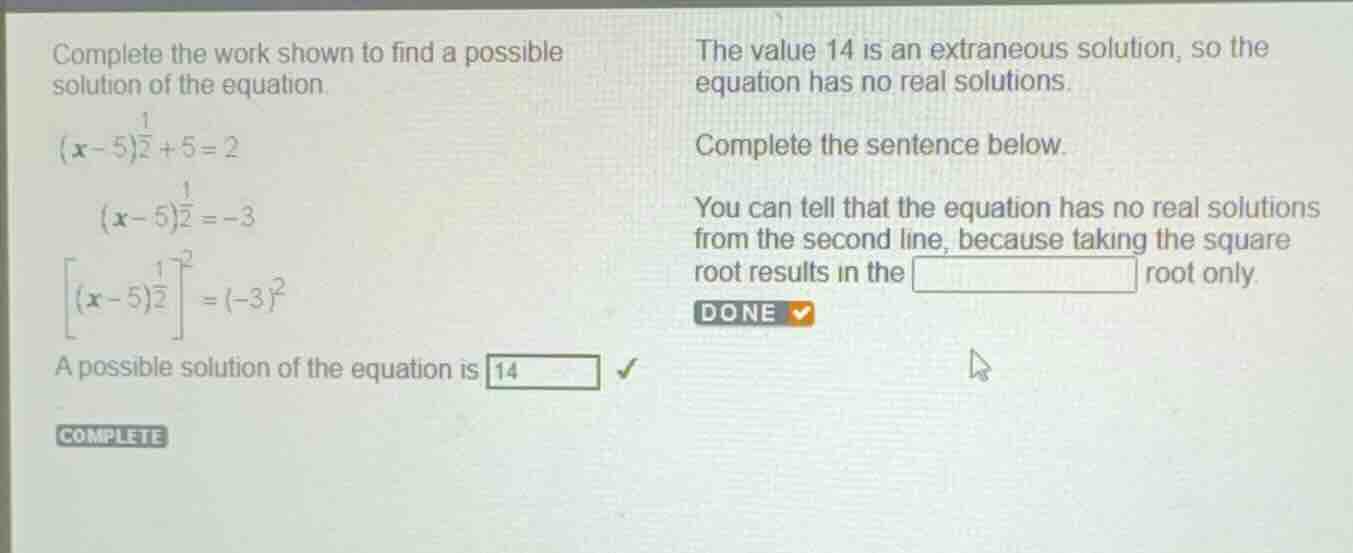
complete the work shown to find a possible solution of the equation.
\\((x-5)^{\frac{1}{2}} + 5 = 2\\)
\\((x-5)^{\frac{1}{2}} = -3\\)
\\(\left(x-5)^{\frac{1}{2}}\
ight^2 = (-3)^2\\)
a possible solution of the equation is 14
the value 14 is an extraneous solution, so the equation has no real solutions.
complete the sentence below.
you can tell that the equation has no real solutions from the second line, because taking the square root results in the root only.
<pre_analysis>
{
"quality": "clear",
"question_count": 1,
"skills_matched": [
"step_cot",
"blank_filling_formatter",
"explain_then_answer",
"tutor",
"mastery_adaptive_brevity"
],
"needs_drawing": false,
"concepts_used": [
"Solving Radical Equations",
"Extraneous Solutions"
],
"new_concepts": [
"Principal Square Root Definition"
],
"current_concepts": [
"Solving Radical Equations",
"Extraneous Solutions",
"Principal Square Root Definition"
]
}
</pre_analysis>
<reasoning>
Analyze the given equation and steps
Using the Solving Radical Equations knowledge point
\[
\]
Evaluate the second line for real solutions
Using the Extraneous Solutions knowledge point
\[
\]
Identify the missing term in the sentence
The second line is \((x-5)^{\frac{1}{2}} = -3\). The expression \((x-5)^{\frac{1}{2}}\) represents the principal square root of \(x-5\). By definition, the principal square root of a real number is always non-negative (positive or zero). Therefore, taking the square root of a real number results in the positive root only (or non-negative root).
</reasoning>
<answer>
Complete the sentence below.
You can tell that the equation has no real solutions from the second line, because taking the square root results in the <blank>positive</blank> root only.
</answer>
<post_analysis>
{
"subject": "Mathematics",
"question_type": "Fill-in-the-blank",
"knowledge_point": [
"Mathematics",
"Algebra",
"Solving Radical Equations"
]
}
</post_analysis>
Snap & solve any problem in the app
Get step-by-step solutions on Sovi AI
Photo-based solutions with guided steps
Explore more problems and detailed explanations
<pre_analysis>
{
"quality": "clear",
"question_count": 1,
"skills_matched": [
"step_cot",
"blank_filling_formatter",
"explain_then_answer",
"tutor",
"mastery_adaptive_brevity"
],
"needs_drawing": false,
"concepts_used": [
"Solving Radical Equations",
"Extraneous Solutions"
],
"new_concepts": [
"Principal Square Root Definition"
],
"current_concepts": [
"Solving Radical Equations",
"Extraneous Solutions",
"Principal Square Root Definition"
]
}
</pre_analysis>
<reasoning>
Analyze the given equation and steps
Using the Solving Radical Equations knowledge point
\[
\]
Evaluate the second line for real solutions
Using the Extraneous Solutions knowledge point
\[
\]
Identify the missing term in the sentence
The second line is \((x-5)^{\frac{1}{2}} = -3\). The expression \((x-5)^{\frac{1}{2}}\) represents the principal square root of \(x-5\). By definition, the principal square root of a real number is always non-negative (positive or zero). Therefore, taking the square root of a real number results in the positive root only (or non-negative root).
</reasoning>
<answer>
Complete the sentence below.
You can tell that the equation has no real solutions from the second line, because taking the square root results in the <blank>positive</blank> root only.
</answer>
<post_analysis>
{
"subject": "Mathematics",
"question_type": "Fill-in-the-blank",
"knowledge_point": [
"Mathematics",
"Algebra",
"Solving Radical Equations"
]
}
</post_analysis>