QUESTION IMAGE
Question
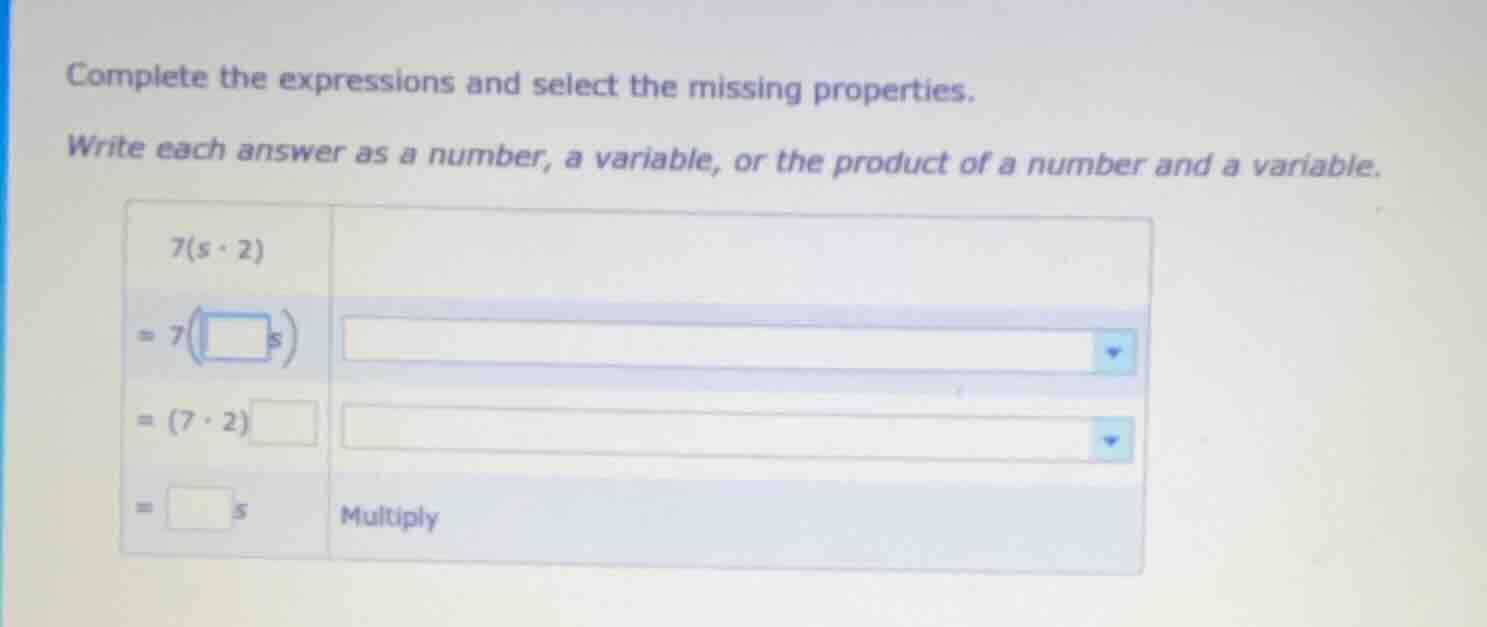
complete the expressions and select the missing properties. write each answer as a number, a variable, or the product of a number and a variable. 7(s·2) = 7(□s) = (7·2)□ = □s multiply
Step1: Apply Commutative Property of Multiplication
The commutative property of multiplication states that \(a \cdot b = b \cdot a\). So, \(s \cdot 2 = 2 \cdot s\). Thus, \(7(s \cdot 2)=7(2s)\). The property used here is the Commutative Property of Multiplication.
Step2: Apply Associative Property of Multiplication
The associative property of multiplication states that \((a \cdot b) \cdot c = a \cdot (b \cdot c)\). So, \(7(2s)=(7 \cdot 2)s\). The property used here is the Associative Property of Multiplication.
Step3: Multiply \(7 \cdot 2\)
Calculate \(7 \cdot 2 = 14\). So, \((7 \cdot 2)s = 14s\).

Snap & solve any problem in the app
Get step-by-step solutions on Sovi AI
Photo-based solutions with guided steps
Explore more problems and detailed explanations
First box: \(2\), Property: Commutative Property of Multiplication
Second box: \(s\), Property: Associative Property of Multiplication
Third box: \(14\)