QUESTION IMAGE
Question
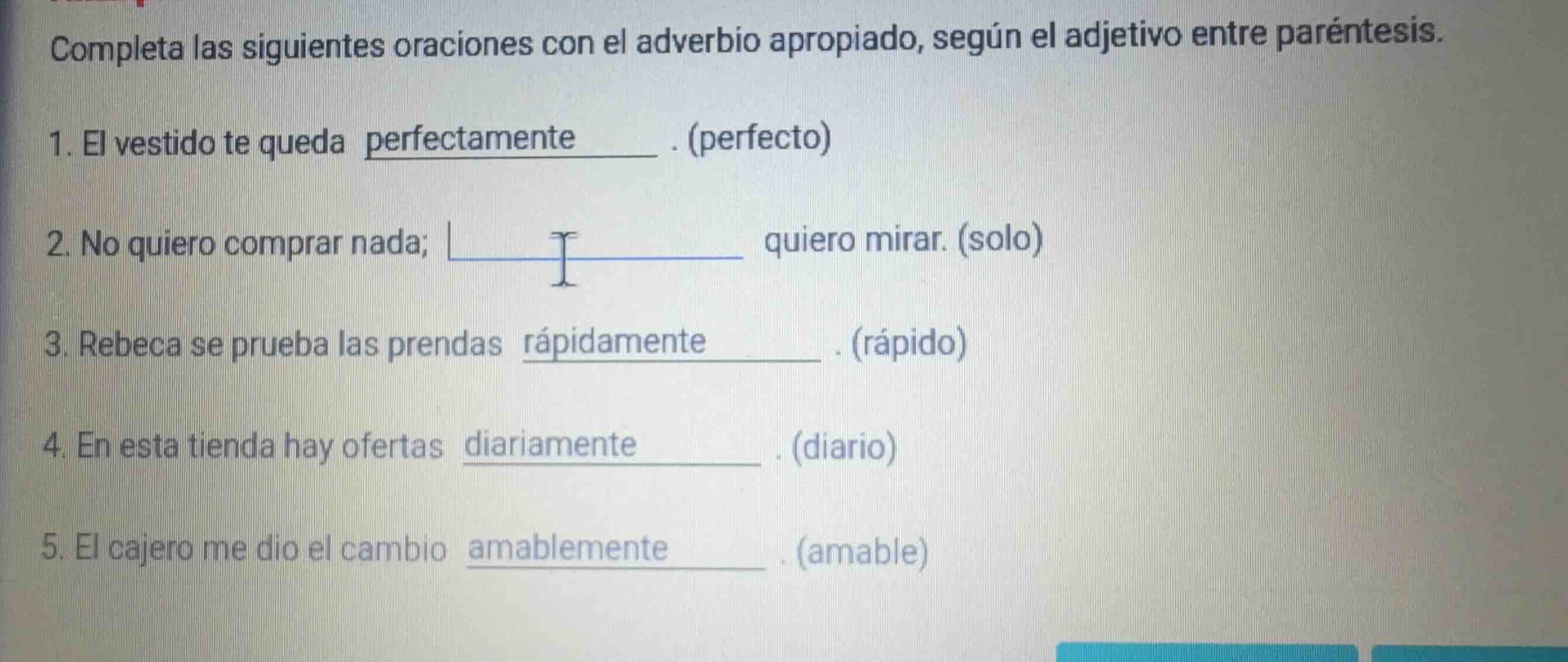
completa las siguientes oraciones con el adverbio apropiado, según el adjetivo entre paréntesis.
- el vestido te queda perfectamente . (perfecto)
- no quiero comprar nada; ______ quiero mirar. (solo)
- rebeca se prueba las prendas rápidamente . (rápido)
- en esta tienda hay ofertas diariamente . (diario)
- el cajero me dio el cambio amablemente . (amable)
Form adverbs from adjectives
To form adverbs from Spanish adjectives, take the feminine singular form of the adjective and add the suffix "-mente". If the adjective ends in "-o", change it to "-a" before adding "-mente". If it ends in "-e" or a consonant, add "-mente" directly. Written accents remain on the original stressed vowel of the adjective.
Apply rules to each item
- perfecto: Ends in "-o". Feminine form is perfecta. Adding "-mente" yields perfectamente.
- solo: Ends in "-o". Feminine form is sola. Adding "-mente" yields solamente (or simply solo as an adverb, but solamente is the standard suffix-derived form).
- rápido: Ends in "-o". Feminine form is rápida. Keeping the accent, adding "-mente" yields rápidamente.
- diario: Ends in "-o". Feminine form is diaria. Adding "-mente" yields diariamente.
- amable: Ends in "-e". Adding "-mente" directly yields amablemente.

Snap & solve any problem in the app
Get step-by-step solutions on Sovi AI
Photo-based solutions with guided steps
Explore more problems and detailed explanations
Question 1
- El vestido te queda <blank>perfectamente</blank>. (perfecto)
Question 2
- No quiero comprar nada; <blank>solamente</blank> quiero mirar. (solo)
Question 3
- Rebeca se prueba las prendas <blank>rápidamente</blank>. (rápido)
Question 4
- En esta tienda hay ofertas <blank>diariamente</blank>. (diario)
Question 5
- El cajero me dio el cambio <blank>amablemente</blank>. (amable)