QUESTION IMAGE
Question
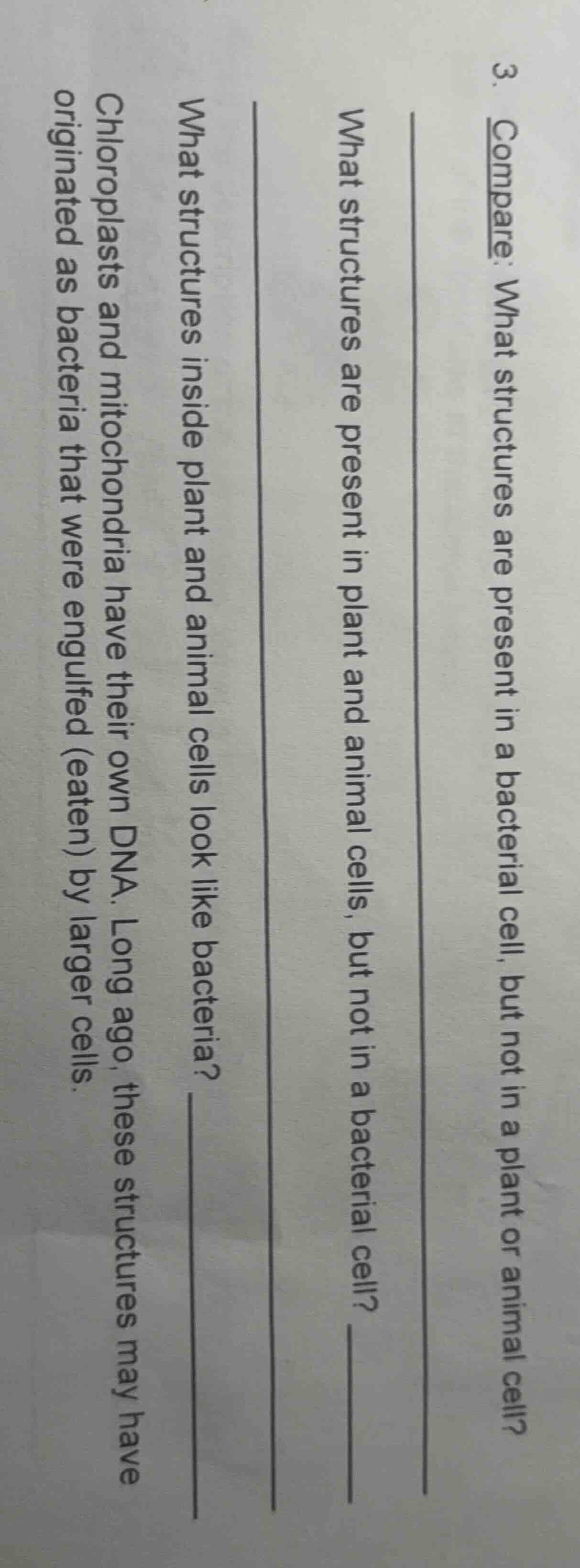
- compare: what structures are present in a bacterial cell, but not in a plant or animal cell?
what structures are present in plant and animal cells, but not in a bacterial cell?
what structures inside plant and animal cells look like bacteria?
chloroplasts and mitochondria have their own dna. long ago, these structures may have originated as bacteria that were engulfed (eaten) by larger cells.
1. What structures are present in a bacterial cell, but not in a plant or animal cell?
Bacterial cells are prokaryotic, while plant and animal cells are eukaryotic. Prokaryotes have structures like the cell wall (composed of peptidoglycan in most bacteria, different from plant cell walls which have cellulose), and they lack membrane - bound organelles. A key structure unique to many bacteria is the plasmid (a small, circular piece of DNA separate from the main chromosome) and some have flagella for movement (though some eukaryotic cells have flagella, bacterial flagella have a different structure). Also, bacterial cells have a nucleoid region (where the circular DNA is located) instead of a true nucleus. The most distinct structure present in bacterial cells but not in plant or animal cells is the peptidoglycan - based cell wall (plant cell walls have cellulose, animal cells lack a cell wall in most cases) and plasmids (plant and animal cells have linear chromosomes in a nucleus and no plasmids in the same sense).
Plant and animal cells are eukaryotic, so they have membrane - bound organelles. Bacterial cells are prokaryotic and lack these. Structures like the nucleus (with a nuclear membrane enclosing the genetic material), mitochondria (in animal and plant cells, for energy production), endoplasmic reticulum (smooth and rough, for protein and lipid synthesis), Golgi apparatus (for processing and packaging molecules), and in plant cells, chloroplasts (for photosynthesis) and a large central vacuole are present in plant/animal cells but not in bacterial cells. The most fundamental is the nucleus (enclosed by a nuclear envelope, containing linear chromosomes), and other membrane - bound organelles like mitochondria (in animal and plant cells, bacteria lack them) and the endoplasmic reticulum are also absent in bacterial cells.
The endosymbiotic theory suggests that mitochondria and chloroplasts (in plant cells) originated from bacteria that were engulfed by larger cells. Mitochondria and chloroplasts have their own circular DNA (similar to bacterial DNA, which is also circular), they have their own ribosomes (similar in size to bacterial ribosomes, 70S, while eukaryotic cytoplasmic ribosomes are 80S), and they are surrounded by a double membrane (the outer membrane may have come from the host cell, and the inner membrane from the engulfed bacterium). So mitochondria (in both plant and animal cells) and chloroplasts (in plant cells) have structures and characteristics similar to bacteria.

Snap & solve any problem in the app
Get step-by-step solutions on Sovi AI
Photo-based solutions with guided steps
Explore more problems and detailed explanations
Structures like the peptidoglycan - based cell wall (in most bacteria), plasmids, and the nucleoid region (instead of a true nucleus) are present in bacterial cells but not in plant or animal cells. A prominent example is the peptidoglycan cell wall (plant cell walls have cellulose, animal cells usually lack a cell wall) and plasmids (small, circular DNA molecules separate from the main chromosome, not found in plant or animal cells in this form).