QUESTION IMAGE
Question
the commutative property practice
complete this assessment to review what youve learned. it will not count toward your grade.
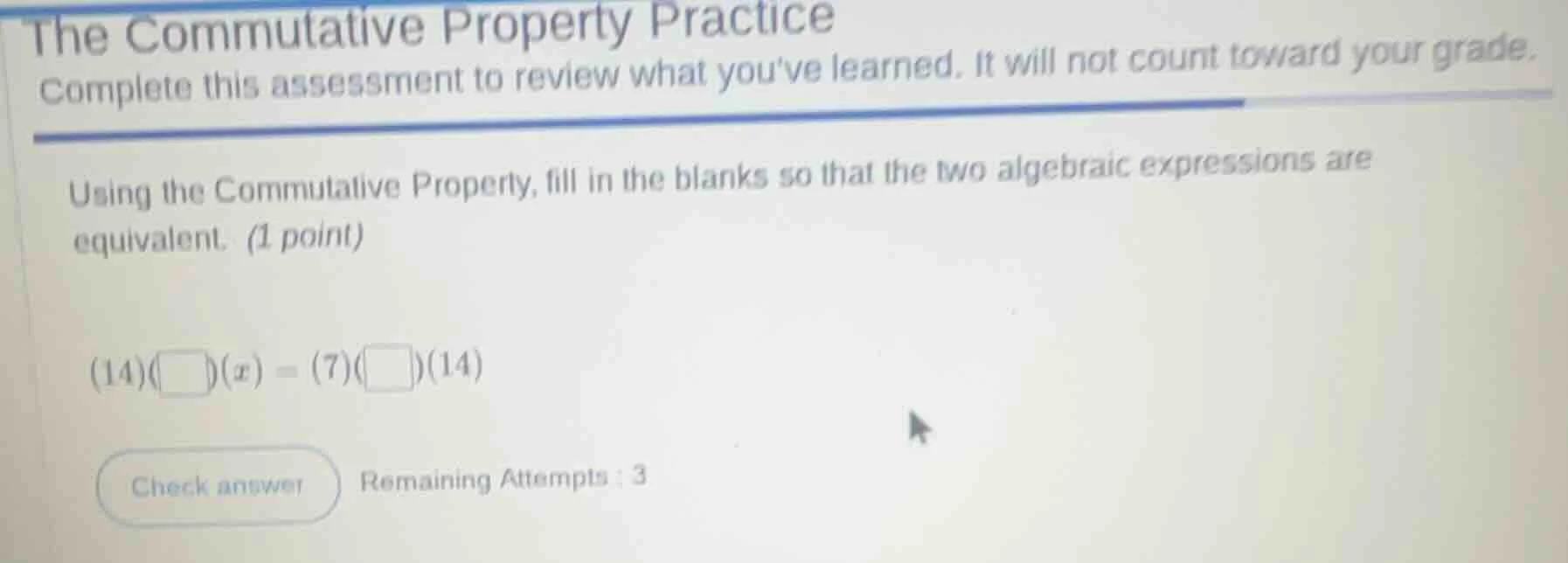
using the commutative property, fill in the blanks so that the two algebraic expressions are equivalent. (1 point)
(14)(□)(x) = (7)(□)(14)
check answer remaining attempts : 3
Step1: Recall Commutative Property of Multiplication
The commutative property of multiplication states that for any numbers \(a\), \(b\), and \(c\), \(a\times b\times c = b\times a\times c = a\times c\times b\), etc. So we can rearrange the factors.
Step2: Analyze the left and right sides
On the left side, we have \((14)(\square)(x)\) and on the right side, we have \((7)(\square)(14)\). We need to match the factors.
Looking at the right side, we have \(7\), a blank, and \(14\). On the left side, we have \(14\), a blank, and \(x\).
For the first blank (in the left expression), we need the factor that is \(7\) (to match the \(7\) on the right), so the first blank is \(7\).
For the second blank (in the right expression), we need the factor that is \(x\) (to match the \(x\) on the left), so the second blank is \(x\).
Let's verify: Left side: \((14)(7)(x)=14\times7\times x\). Right side: \((7)(x)(14)=7\times x\times14\). By commutative property of multiplication, \(14\times7\times x = 7\times x\times14\) since multiplication is commutative (order of factors doesn't matter).

Snap & solve any problem in the app
Get step-by-step solutions on Sovi AI
Photo-based solutions with guided steps
Explore more problems and detailed explanations
First blank: \(7\), Second blank: \(x\) (So the filled expression is \((14)(7)(x)=(7)(x)(14)\))